StyleSeat Alternative: Keep Your Clients and Control Booking Costs
StyleSeat can help professionals get discovered, but its marketplace model is not right for every salon. Compare the fees, workflow, and client-control tradeoffs before switching.

Key takeaways
- StyleSeat is built around marketplace discovery, while Kevonia is built around your branded booking page and salon workspace.
- StyleSeat’s professional subscription is $35 per month, with additional processing and optional client-acquisition or pricing fees.
- Kevonia costs $49.99 per month with unlimited team members, bookings, clients, and services and no per-booking commission.
- The right choice depends less on the lowest monthly price and more on whether you need marketplace leads or direct control of your booking relationship.
- Before switching, test your busiest services, deposits, staff availability, cancellation rules, and client migration process.
| Tool | Starting price | Commission / booking fees | Standout features | Best fit |
|---|---|---|---|---|
| StyleSeat | $35/month Premium Plan | 2.5% + $0.30 card-present processing; 2.6% + $0.30 card-not-present processing; optional 30% New Client Connection fee capped at $50; optional 5.5% Smart Pricing fee capped at $16.50; clients pay a $2.35 booking fee | Marketplace profile and discovery, online booking, payments, growth tools | Professionals who want marketplace visibility and new-client acquisition |
| Kevonia | $49.99/month; 14-day free trial | 0% per-booking commission; no per-seat charge; Stripe processing applies to payments | Branded booking page, shared team calendar, availability rules, client records, service menu, deposits and payments | Salons and spas that want direct bookings and predictable team software costs |
You are probably looking for more than another booking calendar
If you searched for a styleseat alternative, you may not be trying to replace online booking itself. You may be trying to stop paying for bookings that came through your own website, reduce fee surprises, give a salon team one shared schedule, or keep regular clients in a booking experience that belongs to your business.
StyleSeat remains useful when marketplace visibility is the main reason clients find you. But a marketplace and a salon-owned booking system solve different problems. This comparison focuses on the decision behind the search: whether you need StyleSeat to help acquire clients, or whether you mainly need reliable software to run clients you already have.
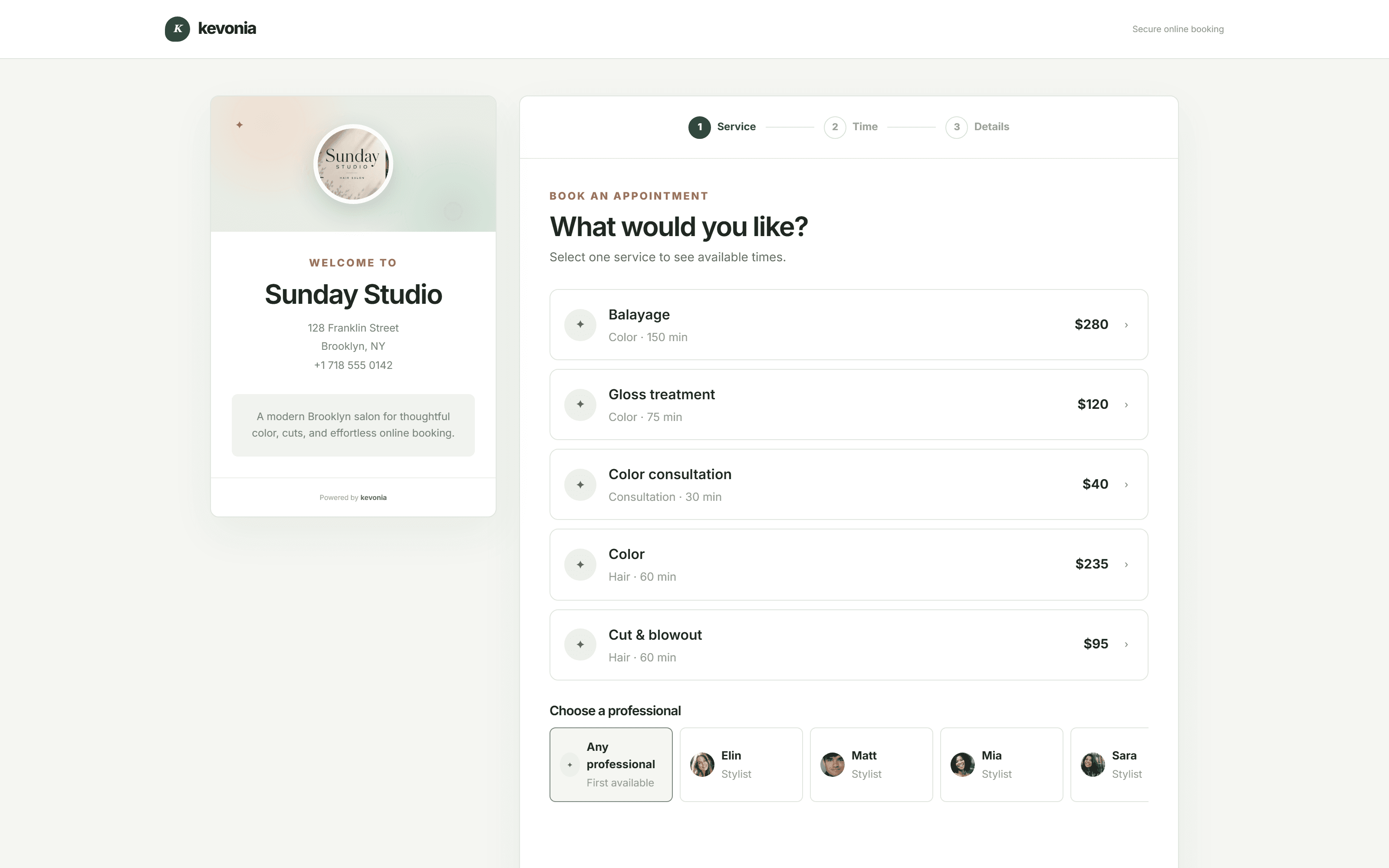
StyleSeat vs. Kevonia at a glance
StyleSeat’s current professional pricing centers on a $35-per-month Premium Plan. Card processing is listed as 2.5% plus $0.30 for card-present payments and 2.6% plus $0.30 for card-not-present payments. Its optional New Client Connection feature charges 30% of a new marketplace client’s first service, capped at $50, while Smart Pricing charges 5.5% of a service price, capped at $16.50, when the feature is used. Clients also pay a $2.35 booking fee when they book through StyleSeat. These are separate parts of the model, so the subscription alone is not the complete cost picture.
Kevonia has one plan at US$49.99 per month. The plan includes unlimited team members, bookings, clients, and services, with no per-booking commission and no per-seat charge. It includes a branded online booking page, team calendar, client records, service menu, availability rules, and Stripe payments. The free trial lasts 14 days, requires no credit card to start, and can be canceled before the trial ends so you are never charged. For more detail, see Kevonia's salon booking software with unlimited team members.
- Choose StyleSeat when discovery through a beauty marketplace is central to your growth plan.
- Choose Kevonia when your priority is a branded booking page, a shared team schedule, predictable software cost, and no commission on bookings.
- Compare payment volume separately from software cost. A lower subscription can still be more expensive if your workflow sends more appointments through paid acquisition or platform-based fees.
- Do not compare only the monthly sticker price. Compare the source of each booking, the payment method, and how much control you retain over the client relationship.
Comparison table: the real difference is the business model
The table below separates the recurring software charge from transaction and acquisition costs. It is designed for an owner comparing an alternative to StyleSeat, not for a client choosing where to book a haircut.
Where StyleSeat fits—and where it starts to feel restrictive
StyleSeat is strongest for an independent professional who wants a public profile inside a beauty marketplace. Its Premium Plan is designed to combine listing exposure, online booking, business-management tools, payments, and growth features. That can be valuable when you are still building a client base and want another discovery channel beyond social media, referrals, or your own website.
The tradeoff is that the platform can be involved in both discovery and booking. If a client finds you through the marketplace, the acquisition fee may apply to the first appointment. If you use Smart Pricing, the appointment price can also change for selected high-demand slots. Those tools may be commercially sensible when they produce profitable new business, but they make the cost of a booking depend on where the client came from and which features were active.
That distinction matters for a salon with several professionals. A single stylist may judge a marketplace fee against the value of one new client. An owner managing a full schedule may instead ask why the software should charge an acquisition fee on a client who arrived through the salon’s Instagram profile, Google listing, front desk, referral card, or existing client base. The usual advice to “pick the platform that brings you new clients” is incomplete if most of your appointments already come from channels you pay for or manage yourself.
- StyleSeat may be a good fit for a solo professional who actively wants marketplace exposure.
- It may be less attractive when nearly all bookings come from existing clients or the salon’s own marketing.
- The $2.35 client booking fee can affect the final price clients see at checkout, even though it is not the same as a professional subscription or commission.
- Optional growth tools should be measured against the revenue and repeat-booking rate they actually produce, not treated as automatically profitable.
What Kevonia does differently
Kevonia is a salon and spa management system centered on your own branded online booking page at kevonia.com/your-salon. Clients choose a service, professional, date, and time. Behind that page, the workspace gives your team a week and day calendar with per-professional filters and color coding, client records, a service menu, availability rules, and Stripe payments.
The practical difference is ownership of the booking path. Kevonia does not provide a marketplace that sends strangers to compare your business with nearby professionals. Instead, it gives you a booking page to place on the channels where your clients already find you. That makes it a better fit when the goal is to simplify operations and keep direct bookings direct, rather than pay for marketplace discovery. For more detail, see Kevonia's own booking path.
For a salon team, the schedule rules are more important than a long feature list. Kevonia checks double bookings against hours, breaks, time off, and existing appointments. You can set opening hours by weekday, multiple breaks, staff time off, salon closures, booking windows, minimum notice, and time-slot intervals. Services can include duration, cleanup or buffer time, price, optional deposit, and professional assignments. Those details address the failure case many comparison pages skip: a booking system can look affordable until one incorrectly available slot creates a late day, an overbooked stylist, or a client who arrives while the room is still occupied. For more detail, see Kevonia's salon reservation software.
Kevonia also includes client records with search by name, email, or phone, private notes, and visit history. The salon can set booking statuses such as needs confirmation, awaiting payment, booked, checked in, completed, no-show, or cancelled. Online payments and deposits run through Stripe, and payouts go to the salon’s bank account. These details make Kevonia relevant to hair salons, barbershops, tattoo studios, nail salons, spas, med spas, esthetician and lash studios, beauty clinics, wellness studios, and massage therapists—not only independent hairstylists.
The fee comparison depends on how your clients book
A simple example shows why the best styleseat alternative depends on your booking mix. Suppose a salon has a $100 service and the client pays by card on file. StyleSeat’s listed processing charge would be 2.6% plus $0.30, or $2.90 for that payment. If the client is a brand-new marketplace client and New Client Connection applies, the first appointment could also carry 30% of the service cost, subject to the published $50 cap. The $2.35 client booking fee is paid by the client and should be considered when evaluating how the checkout experience feels, even though it is not deducted from the salon’s listed service price.
Kevonia’s subscription is $49.99 per month, with 0% per-booking commission and no charge per team member. Stripe payment processing still applies because payments are handled through Stripe, so you should compare the processor cost shown for your own Stripe account with the total StyleSeat cost for the same payment volume. The important contrast is that Kevonia does not add a booking commission to the software plan, and the plan does not become more expensive because you add staff, services, clients, or bookings.
- List your last 30 days of appointments by source: marketplace, Google, social media, referral, phone, walk-in, or existing-client rebooking.
- Separate new-client acquisition charges from ordinary card-processing charges.
- Calculate fees on the service price before tips, and check whether deposits or refunds change the amount your business actually receives.
- Add the time cost of correcting double bookings, manually confirming appointments, and explaining checkout charges to clients.
- Run the comparison again for a busy month and a slow month. A platform that looks inexpensive at low volume may not be the same choice at full capacity.
The operational test most owners should perform before switching
The safest way to evaluate a styleseat alternative is not to compare screenshots. Rebuild one realistic week. Use your busiest professional, your longest service, one service with a cleanup buffer, one service requiring a deposit, one staff member with time off, and one day when the salon is closed. Then attempt the bookings that usually cause problems.
Check whether the system prevents a client from selecting a time that conflicts with the professional’s break, time off, existing booking, or required cleanup period. Test two professionals offering different services. Test a client canceling inside and outside your notice window. Test a refund from the booking record and confirm that the processing cost is visible before the refund is completed. A platform that passes this test is more useful than one that simply has a longer feature list.
Kevonia sends an automatic email reminder the day before an appointment. Clients can reschedule or cancel from that email within the salon’s notice window. The salon can review cancellation history, restore a cancellation, block a client from booking online with a reason, and see the client’s no-show history. These controls are especially relevant when the reason for switching is not just price but fewer avoidable disruptions to the day.
Do not assume a clean migration means every StyleSeat client will automatically appear in the new system. Before changing the link in your Instagram bio, Google profile, email signature, and business cards, decide how you will invite existing clients to use the new booking page. Keep a short overlap period if you can, and tell regulars exactly what is changing: the booking link, deposit rule, cancellation window, or reminder process. The software switch is only half the project; the client communication determines whether the change feels organized or confusing.
- Export or record the client information you are permitted to retain under your current agreements and privacy obligations.
- Recreate services with accurate duration, price, buffer, professional assignment, and deposit settings.
- Configure each professional’s schedule, breaks, time off, closure dates, booking window, minimum notice, and slot interval.
- Test booking, cancellation, rescheduling, payment, refund, and no-show workflows with internal test appointments.
- Replace the old booking link only after the new path works on mobile and desktop.
Which software model fits different salon situations?
There is no universal winner because StyleSeat and Kevonia are optimized for different jobs. The right choice depends on whether your next dollar of software spend should buy discovery, operational control, or both through separate tools.
- Solo professional building from zero: StyleSeat may be worth considering if marketplace exposure is a primary source of new inquiries and you are willing to track the acquisition economics of those bookings.
- Established solo professional with repeat clients: Kevonia may make more sense when clients already know where to find you and you want a direct branded booking page without per-booking commission.
- Small salon with multiple professionals: Kevonia’s unlimited team members, shared calendar, per-professional filters, color coding, and scheduling rules address the coordination problem directly.
- Salon that needs retail inventory or a native mobile app: Kevonia is not the right answer based on its current feature set. It does not currently offer retail or inventory POS, marketing or SMS campaign tools beyond the booking reminder email, multi-location management from one account, or a native mobile app.
- Business that depends on marketplace lead generation: Do not switch solely because a flat-fee system looks cleaner. First measure how many profitable first-time clients StyleSeat actually sends you and how many return without another acquisition charge.
If you are already comparing several salon platforms, the fee logic is similar to the questions raised in Kevonia’s comparisons of Booksy, Square Appointments, Phorest, and Vagaro: identify whether the platform is mainly a marketplace, a scheduler, a payment system, or a broader salon-management workspace. The label matters less than the charges and workflow attached to each booking source.
A practical decision: switch, stay, or run both temporarily
Stay with StyleSeat if its marketplace consistently produces profitable clients and the added fees are lower than what you would spend acquiring those clients elsewhere. Do not stay merely because moving feels inconvenient. Calculate the value of first appointments, repeat visits, processing fees, client booking fees, and the time your team spends managing the platform.
Choose Kevonia if you want one branded booking page and a workspace for your team, and your business can attract clients through its own channels. The $49.99 monthly plan is predictable, includes unlimited team members, bookings, clients, and services, and has no per-booking commission or per-seat charge. It is particularly relevant when the problem is schedule control, client records, deposits, reminders, cancellations, or staff availability rather than a lack of marketplace exposure.
Running both systems for a short period can be sensible when marketplace leads still matter but the salon wants to move regular clients to a direct booking page. The danger is creating two calendars that staff must monitor. If you do this, define which platform handles which type of booking, reconcile the schedules every day, and stop the overlap once the experiment answers the question. Two systems are a temporary measurement strategy, not a permanent substitute for a clear source of truth.
The short answer for most searchers is this: StyleSeat is a discovery-led marketplace with a subscription and usage-based fees; Kevonia is a direct, branded salon and spa management workspace with a flat monthly plan and no booking commission. Pick the model that matches how clients already find you and how much control your team needs after they book.
Sources
Frequently asked questions
Is Kevonia a good StyleSeat alternative for a salon with multiple professionals?+
It can be, especially when the salon needs one shared workspace rather than separate individual profiles. Kevonia includes unlimited team members, a week and day calendar with per-professional filters and color coding, double-booking protection, staff time-off rules, service assignments, client records, and Stripe payments. It does not currently offer a marketplace that sends new clients to the salon, so it is best when the salon can direct clients to its branded booking page.
Does StyleSeat charge a booking fee?+
Yes. StyleSeat’s current help documentation says clients pay a $2.35 booking fee when they book with a professional on StyleSeat. That is separate from the professional’s subscription, payment-processing fees, and optional professional-side features such as New Client Connection or Smart Pricing.
Does Kevonia take a percentage from each booking?+
No. Kevonia’s plan is US$49.99 per month with 0% per-booking commission. There is also no per-seat charge, and the plan includes unlimited team members, bookings, clients, and services. Stripe payment-processing costs still apply to payments because Kevonia uses Stripe for card payments and deposits.
Will switching from StyleSeat automatically bring over my clients and appointments?+
Do not assume that it will. Treat migration as a project: determine what information you can retain, recreate services and staff schedules, configure deposits and notice rules, test the booking page, and tell clients exactly where to book next. Replace links in your social profiles and other client-facing channels only after the new workflow has been tested.
Which is better if I need new clients, StyleSeat or Kevonia?+
StyleSeat is the more direct fit if you specifically want marketplace discovery. Kevonia provides a branded booking page but does not currently operate a marketplace that sends new clients to you. If you already receive clients through referrals, Google, social media, or repeat bookings, Kevonia may fit the operational need better; if marketplace acquisition is essential, compare the revenue from those new clients against the fees attached to acquiring them.
What does Kevonia not include?+
Kevonia does not currently offer multi-location management from one account, retail or inventory POS, marketing or SMS campaign tools beyond the booking reminder email, or a native mobile app. If one of those is essential, include it in your evaluation before switching. Kevonia’s current strength is the combination of direct online booking, team scheduling, client records, service and availability rules, deposits, Stripe payments, reminders, and booking controls.
More from the blog

How to Prevent Salon Overbooking and Double Bookings: 9 Practical Steps
Double bookings damage client trust and put staff under pressure. Use these practical scheduling controls to keep every stylist, service, and appointment time accurate.

Vagaro Alternative: Kevonia vs. Vagaro in 2026
Vagaro offers a broad salon platform, while Kevonia keeps booking and daily scheduling simpler with one $49.99 plan and no per-booking commission. Compare both before you switch.

Why Clients Don’t Finish Booking Online: 9 Fixes
Clients may want the appointment but still abandon the booking page. Learn how to find the friction, fix the biggest problems, and recover more completed bookings.