What to Say to Salon Clients: Scripts That Sound Human
The right words can calm an unhappy guest, set a clear boundary, and make rebooking feel natural. Use these salon client scripts as starting points, not rigid lines.

Key takeaways
- Lead with the client’s need, then explain the next step in plain language.
- Use specific scripts for consultations, delays, price changes, complaints, and rebooking.
- Do not promise an outcome, discount, or refund before you know what happened.
- Turn repeated conversations into written salon policies and consistent team habits.
- Kevonia can keep appointment details, client notes, service settings, and booking communication organized in one workspace.
What to Say to Salon Clients When You Are Not Sure What to Say
If you searched for what to say to salon clients, you probably do not need another list of generic compliments. You need words for real moments: greeting a first-time guest, finding out what they actually want, explaining a price, handling a late arrival, responding to a complaint, or asking someone to book again.
The most useful approach is simple: acknowledge what the client needs, ask one clear question, explain the next step, and avoid promising more than you can deliver. The scripts below are starting points. Adjust them to your salon’s voice, the service, and the client’s comfort level.
Start Every Client Conversation With Clarity
A good salon conversation is not about talking constantly. It is about making the client feel oriented and heard. At the beginning of the visit, tell the client what will happen and invite them to describe the result they want in their own words.
- Welcome the client by name when you can: “Hi, Maya. It’s good to see you. How has your hair been since your last visit?”
- Set the agenda: “Before we begin, I want to understand the look you want, what you want to avoid, and how much time you have for styling at home.”
- Ask an outcome question: “When you leave today, what do you most want to feel different?”
- Confirm the request: “So you want to keep the length, add movement around your face, and have something you can manage without heat every morning. Did I get that right?”
- Explain the plan: “I’ll start with the shape we discussed, then I’ll show you how to style it before we finish.”
This confirmation step is more valuable than rushing into a recommendation. It exposes mismatched expectations before the service begins. It also gives a quiet client permission to participate without needing to lead the entire conversation.
Use the same structure for nails, lashes, skin treatments, massage, and spa services. Replace technical language with the client’s goal. Instead of “I’ll use a graduated bob technique,” say, “I’ll build a shape that gives you volume at the back but still grows out softly.”
What to Say During the Consultation
The consultation should answer four questions: What does the client want? What have they tried? What constraints matter? What can you realistically deliver today? A consultation is not the time to impress someone with jargon or agree automatically to an unrealistic reference photo.
- “What do you like about this photo, and what would you change about it for yourself?”
- “What has worked well for you in the past?”
- “How much time are you realistically willing to spend on this at home?”
- “Are there any products, ingredients, techniques, or sensations you want me to avoid?”
- “Based on your current condition and the time available today, I recommend this version first.”
- “That exact result would require more time or more than one appointment. Today, I can safely get you closer by doing this.”
The sentence clients often need most is: “Here is what I can do today, and here is what would need to happen later.” It is honest without being dismissive. If the service is not appropriate, say so clearly: “I do not want to promise that result today because it could compromise the health of your hair. I can offer these two safer options instead.”
A common failure is asking for approval after the service has already become difficult to reverse. Confirm major changes before you make them: “We are moving from the reference length to this shorter point. Are you comfortable with that before I continue?” That small pause prevents a client from feeling surprised at the end.
Scripts for Prices, Deposits, and Policy Boundaries
Clients usually react better to a price or policy when they hear it before the appointment, in plain language, with the reason and the next step. Avoid apologizing for your price as if the service is an inconvenience. State the amount, what it covers, and what the client can choose.
For a standard price explanation, say: “This service is $___ and includes the consultation, the service, and the finish we discussed. If we decide together that you need an additional service, I will tell you the price before we add it.” If the final amount depends on time or materials, say that before beginning rather than at checkout.
When you need to explain a change, use a direct version of how to tell a client about a price increase: “Starting on [date], this service will be $___ instead of $___ because the appointment now includes [specific change]. Your appointment on [date] will be honored at the current price. I wanted to give you notice before the new rate begins.” Do not bury the change inside a casual message or make the client discover it at checkout.
For a deposit, say: “A $___ deposit reserves this appointment and is applied to your service total. If you need to change the appointment, please use the notice period shown in our policy. I can explain how the deposit is handled if you need to cancel.” Stripe recommends making deposit terms, payment expectations, and refund policies clear before work begins. (stripe.com)
If a client asks for a discount, do not invent an answer at the front desk. Say: “I understand you are trying to stay within a budget. The service is $___, and I can show you a shorter option at $___ that still addresses your main goal.” That protects the value of your work while giving the client a real choice.
Scripts for Late Arrivals, Delays, and Cancellations
Timing conversations should be factual, calm, and specific. The client does not need a lecture about how busy the salon is; they need to know what can still happen and what decision is required.
- When the client is late: “You are ___ minutes late, so we have ___ minutes remaining. We can do the original service in a shortened version, reschedule, or choose a different service. Which works best for you?”
- When the stylist is delayed: “I’m sorry—we are running about ___ minutes behind. You can wait, move to the next available time, or reschedule without pressure. I’ll update you by ___.”
- When the appointment must be moved: “I need to reschedule your appointment because [brief reason]. I can offer [option one] or [option two]. I know this disrupts your plans, and I’m sorry for the inconvenience.”
- When a client cancels inside the notice window: “I’ve recorded the cancellation. Your appointment falls inside our notice window, so the policy is [plain explanation]. I can help you review the next available appointment.”
Do not say “It’s our policy” and stop there. A policy explains the rule; a helpful conversation explains the available options. If your team needs a consistent approach, write salon front desk scripts for the three most common timing problems and give staff authority to follow them without asking the owner every time.
For a deeper operational framework, pair these words with a written late-arrival policy that states the cutoff, shortened-service options, and rescheduling process before clients book.
What to Say When a Client Is Unhappy
When a client complains, resist the urge to defend the stylist, explain every detail, or decide immediately that the client is unreasonable. First find out what outcome they expected and what they believe went wrong. A useful response is: “I’m sorry this did not feel right to you. Tell me what you were expecting and what feels different now.”
After listening, reflect the concern without automatically agreeing to every accusation: “I understand that you wanted a softer shape and that the finish feels too blunt to you.” Then explain the next step: “Let me look at it carefully. I can adjust the outline today, or I can have the service lead review it with us before we decide.”
- Acknowledge the experience: “I can see why that was frustrating.”
- Ask for the specific problem: “What part feels most different from what we discussed?”
- Take responsibility for your part: “We should have confirmed that length before cutting.”
- Offer a defined remedy: “I can correct the shape today at no additional service charge,” or “I need to review this with the owner before I promise a solution.”
- Close the loop: “I’ll contact you by [time] with the next step.”
Service-recovery guidance from the Agency for Healthcare Research and Quality emphasizes acknowledgment, listening, a fair fix, appropriate atonement, follow-up, and keeping promises. Although the source is written for healthcare, the communication sequence transfers well to salon complaints because the underlying problem is the same: a person believes the experience did not match what was promised. (ahrq.gov)
One situation where the usual “just apologize and offer a discount” advice is wrong is a disputed fact pattern. If the client says a chemical service caused a reaction, an employee behaved inappropriately, or a payment was unauthorized, stop improvising. Document what was reported, involve the appropriate manager, and follow your safety, incident, and payment procedures. Do not diagnose, argue, or promise a refund before the facts are reviewed.
If the issue involves an online payment, explain exactly what you have done: “I processed the refund from your booking today. You’ll receive the confirmation by email, and your bank may take additional time to post it.” If your system sends an automatic refund email, tell the client that rather than making them wonder whether the request was completed.
Scripts That Make Rebooking Feel Natural
Rebooking works best when it is connected to the service, not treated as a sales interruption. Mention the likely maintenance point and give two appointment choices. That is more useful than asking, “Do you want to book again?” before the client has seen the result.
- After a haircut: “This shape should be easy for the next six to eight weeks. I have Tuesday at 10:00 or Thursday at 3:30 available if you want to reserve one.”
- After color: “To keep this tone even, most clients prefer to refresh it around [timeframe]. Would you like me to check dates now, or would you rather wait and book online later?”
- After a facial or lash service: “Your next appointment depends on how your skin or lashes respond. I’ll note what we used today, and you can choose the next timing once you see how it settles.”
- For a client who is not ready: “No problem. I’ll send you home with the maintenance notes. If you decide to return, tell us what you liked and what you would change.”
Notice the difference between a recommendation and pressure. The first gives the client useful timing information; the second makes the client responsible for protecting your schedule. Give people a clear way to decline without making the relationship awkward.
For clients who have not returned, a short, personal message is better than a vague blast: “Hi, Jordan. I was thinking about the copper tone we created and wanted to check how it has been wearing. If you would like a refresh, I have [two options]. No pressure if the timing is not right.” Keep the message relevant to the client’s last visit and stop contacting people who do not want follow-up.
If your team needs more detail on timing, offer design, and follow-up choices, the guidance on getting clients to rebook can sit behind this script rather than replacing the personal conversation.
Where Kevonia Fits Into the Conversation
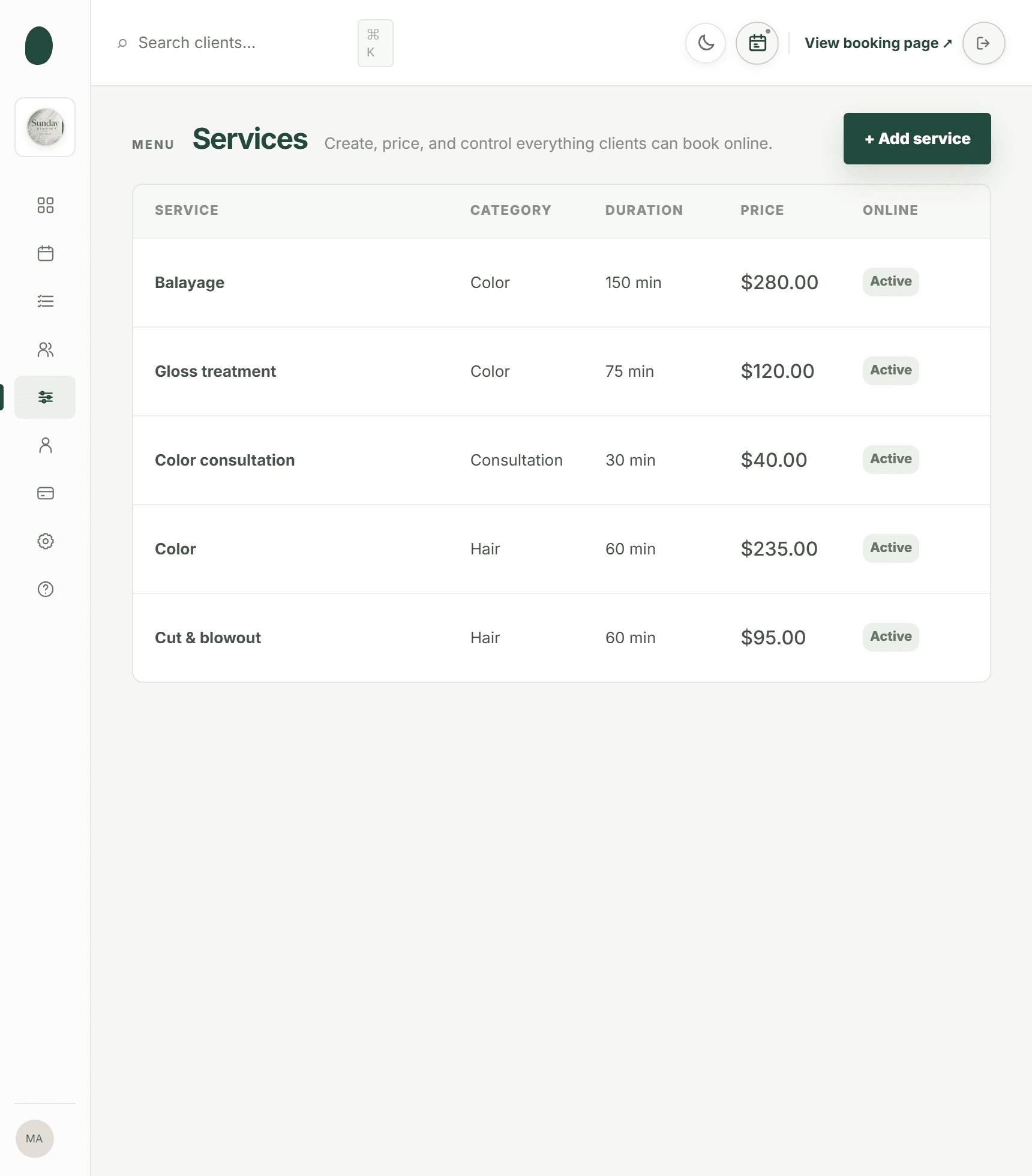
Words work better when the operational details behind them are accurate. Kevonia is salon and spa management software with a branded online booking page at kevonia.com/your-salon and a workspace for the team calendar, client records, service menu, availability rules, and Stripe payments. That gives the front desk and service providers one place to check what was booked before they make a promise.
For example, a staff member can review the client’s visit history and private notes before a consultation, check the assigned professional and service duration, and see whether cleanup or buffer time has been included. Availability rules account for opening hours, breaks, time off, closures, booking windows, minimum notice, and time-slot intervals. Double-booking protection checks those settings against existing appointments.
Kevonia also supports card payments and deposits through Stripe, with payouts to the salon’s bank account. The salon controls booking statuses such as needs confirmation, awaiting payment, booked, checked in, completed, no-show, and cancelled. An automatic email reminder goes out the day before an appointment, and clients can reschedule or cancel from that email within the salon’s notice window.
The important distinction is what Kevonia does not try to be. It is not a retail or inventory POS, a marketing or SMS campaign platform, a native mobile app, or a multi-location management system from one account. Its fit is strongest when you want booking, scheduling rules, client records, service setup, and payment handling organized without per-seat charges: the plan is US$49.99 per month, with unlimited team members, bookings, clients, and services. The free trial lasts 14 days, requires no credit card to start, and can be canceled before it ends without being charged.
That matters to client communication because your script should match your actual process. If clients can reschedule from the reminder email, say so. If a deposit is required for one service but not another, show the correct service rule. If the owner has hidden revenue figures from the front desk, do not ask staff to discuss numbers they cannot see. Clear systems reduce the chance that a well-intentioned employee gives the wrong answer.
Turn Good Phrases Into a Team Standard
A script is useful only if the team can use it under pressure. Choose the conversations that happen repeatedly and create a one-page language guide. Include the approved wording, the information staff must verify first, and the point at which the owner or manager takes over.
- List the five conversations that cause the most inconsistency: price questions, late arrivals, cancellations, complaints, and rebooking.
- Write one short version for speaking and one version for email or chat.
- Mark every variable that must be filled in, such as the date, price, notice period, or available appointment times.
- Define what staff may decide alone and what requires manager approval.
- Review the scripts after a real incident and change the process, not just the wording, if the same problem repeats.
Train the team to avoid phrases that sound dismissive: “That’s not my problem,” “You should have read the policy,” “Everyone else understands,” and “There’s nothing I can do.” Replace them with ownership and options: “I’ll check what happened,” “Here is what the policy says and what I can offer,” or “I need to involve the manager so I give you an accurate answer.”
Keep client records factual. Write “client requested a correction to the left side of the haircut; manager offered an adjustment appointment” rather than “client was difficult.” Objective notes help the next team member understand the situation without inheriting someone else’s judgment. If a repeated pattern requires a boundary, document the behavior and the action taken, not a label.
A Quick Formula for Almost Any Salon Message
When you need to write a message quickly, use this five-part formula: name the client, state the relevant fact, acknowledge the impact, give the next step, and make the response easy. For example: “Hi, Elena. Your stylist is running 20 minutes behind today. I’m sorry for the delay. We can begin at 2:20, move you to 4:00, or reschedule for tomorrow. Which option would you prefer?”
The formula works because it removes guesswork. It also keeps you from filling silence with explanations, defensiveness, or unnecessary promises. Before sending, check three things: Is the amount or timing accurate? Is the action the client should take obvious? Does the message sound respectful if it is read by the owner, manager, or another team member later?
The best answer to what to say to salon clients is not one perfect sentence. It is a repeatable way to be clear before the service, honest when plans change, specific when something goes wrong, and helpful without giving away control of your schedule or standards.
Sources
- Stripe, Deposit invoices 101: What it is and how to use one
- Agency for Healthcare Research and Quality, Strategy 6P: Service Recovery Programs
- Kevonia home page
- Kevonia online spa scheduling software
- Kevonia beauty salon booking software
- Kevonia spa booking software
- Kevonia, Clients Who Arrive Late: A Salon Policy That Works
- Kevonia, How to Get Clients to Rebook: A Practical Salon Guide
Frequently asked questions
What should I say when a salon client first arrives?+
Welcome the client by name, explain what will happen, and ask an open question about the result they want. Try: “Hi, Jamie. It’s good to see you. Before we begin, tell me what you want to feel different when you leave today.” Then confirm the request in your own words before recommending a service.
What should I say to a salon client who is unhappy with the result?+
Start with acknowledgment, not defense: “I’m sorry this did not feel right to you. Tell me what you expected and what feels different now.” Listen, repeat the specific concern, take responsibility for your part, and offer a defined next step. Do not promise a refund, free service, or technical correction until you understand what happened.
How should I tell a salon client about a price increase?+
Give notice before the new price applies. State the effective date, old and new price, and the reason in one sentence: “Starting on [date], this service will be $___ because it now includes ___. Your appointment on [date] remains at the current price.” Avoid surprising the client at checkout or apologizing as though your pricing is improper.
What should I say when a client is late?+
State the time impact and offer choices: “You are 15 minutes late, so we have 30 minutes remaining. We can do a shortened version, reschedule, or choose another service. Which works best?” This is clearer than scolding the client or silently trying to complete an appointment that no longer fits the schedule.
How do I ask a salon client to rebook without sounding pushy?+
Connect the recommendation to maintenance, then offer options: “This shape should stay easy for about six weeks. I have Tuesday at 10:00 or Thursday at 3:30 if you want to reserve one.” If the client declines, accept it gracefully and give them the information they need to return later.
Should salon client conversations be written down?+
Write down factual details that affect future service: the client’s preferences, agreed plan, important constraints, complaint details, promised follow-up, and outcome. Avoid labels such as “difficult.” A clear client record helps the team give consistent answers and prevents the client from having to repeat the same story.
More from the blog

Bring Lapsed Salon Clients Back Without Chasing Them
A practical plan for identifying genuinely lapsed clients, deciding who to contact, writing messages that feel personal, and turning one return visit into a new routine.

Clients Who Arrive Late: A Salon Policy That Works
A practical way to handle late salon clients without punishing reasonable delays, disrupting the next appointment, or leaving your team to make inconsistent decisions.

How to Deal With a Difficult Salon Client in 2026
A practical 2026 guide to handling demanding, disrespectful, late, or nonpaying salon clients without losing control of the situation or your team’s trust.