How to Get Clients to Rebook: A Practical Salon Guide
Want more repeat appointments? Use this practical system to make rebooking easy, timely, and relevant without pressuring clients or relying on constant discounts.

Key takeaways
- Ask for the next appointment at the moment the client is most satisfied: during checkout.
- Recommend a realistic return interval based on the service, not a generic “see you next time.”
- Make rebooking easy with a direct booking path, accurate availability, and clear reminders.
- Track rebooking by service, professional, and client segment so you can improve the process.
- Use incentives carefully; a consistent client experience usually supports retention better than blanket discounts.
How to Get Clients to Rebook Without Sounding Pushy
If you are searching for how to get clients to rebook, you probably do not need another vague reminder to “build relationships.” You need a repeatable process: when to ask, what to say, how to make the next appointment easy to book, and what to do when a client leaves without scheduling.
The best rebooking process starts before checkout. Deliver the service well, explain what the client should expect next, recommend a sensible timeframe, and give them a simple choice. Rebooking should feel like useful professional guidance—not a sales pitch added at the end.
1. Make the Service Worth Repeating
Clients rebook when the value of returning is clear. That value may be a result they want to maintain, a routine they enjoy, or the confidence that a familiar professional understands their preferences. Your first job is therefore operational, not promotional: make the appointment consistent enough that the client can imagine returning.
During the appointment, reinforce the result in concrete language. A stylist can explain how long a shape or color typically looks its best. A nail professional can point out when growth will become noticeable. An esthetician can explain what improvement usually requires over several visits. A massage therapist can suggest whether the client would benefit from another session soon or only as needed.
- Confirm the client’s goal at the beginning of the appointment.
- Explain what you are doing and why, without overwhelming the client.
- Give one or two simple home-care recommendations that protect the result.
- Describe the likely maintenance window before the client leaves.
- Record useful preferences, formulas, sensitivities, or service details for the next visit.
Do not promise an exact outcome or fixed return date when the right timing depends on hair growth, skin response, lifestyle, or the service itself. A credible recommendation builds more trust than an aggressive attempt to lock in every client at four-week intervals.
2. Recommend the Next Visit at the Right Moment
The strongest time to ask is usually after the client has seen or felt the result and before the transaction is complete. For many services, that means while you are showing the finished look, discussing maintenance, or walking the client to the front desk. Waiting until the client is already out the door creates an extra decision and an extra opportunity to forget.
A useful recommendation has three parts: the reason to return, the approximate timing, and an easy choice. For example: “Your cut should be in a good place for about six to eight weeks. I have Thursday afternoon or Saturday morning available—would either work for you?” The client can say yes, choose an option, or tell you why they are not ready.
Use language that gives control back to the client. “Would you like to reserve your next visit?” is better than “You need to book again now.” If the client is unsure, offer a light next step: “No problem. I’ll send you the booking link so you can choose when you are ready.” We cover this in more depth in salon booking link.
- For maintenance services: recommend the normal upkeep interval.
- For event services: ask whether the client has another date or occasion coming up.
- For corrective or treatment plans: explain the next step and why timing matters.
- For occasional services: offer a reminder point rather than insisting on a fixed schedule.
- For clients who are traveling or budgeting carefully: suggest a broader window and let them decide.
3. Use a Simple Rebooking Script at Checkout
Your team should not have to invent a rebooking conversation under pressure. Create a short script that sounds natural in your salon, then let each professional adapt the wording. The script should be specific enough to use consistently but flexible enough for different services and personalities.
A reliable checkout script is: “Based on today’s service, I’d recommend coming back in [timeframe]. Would you like to reserve that now?” If the client says yes, present two realistic appointment choices. If the client says not yet, respond without resistance: “Of course. I’ll make sure you have our booking link, and you can schedule when it suits you.”
- Client agrees: offer two suitable dates and confirm the professional, service, price, and timing.
- Client is undecided: explain the return window and provide the booking path.
- Client says the price is a concern: discuss a lower-maintenance option only if it genuinely meets the client’s goal.
- Client had a poor experience: listen first, resolve the issue, and do not push for another booking before trust is restored.
- Client is leaving town: ask whether they want to book after their return or receive a reminder from the salon.
Avoid scripts that rely on guilt, scarcity, or invented urgency. “If you do not book today, you may never get back in” can make a client feel managed rather than cared for. A recommendation based on the service and the client’s needs is more credible and easier for staff to deliver consistently.
4. Remove Friction From the Booking Process
A client may intend to return and still fail to rebook because the process takes too many steps. They may not know which service to select, which professional is available, how long the appointment will take, or whether the salon is open when they want to visit. Every unanswered question increases the chance that “I’ll book later” becomes no booking at all.
Give clients one clear route back to you. A branded online booking page can let them choose the service, professional, date, and time without waiting for a reply. Make sure the service names are understandable, durations are accurate, and cleanup or buffer time is included where needed. If a deposit is required, explain it before the client reaches payment. For more detail, see Kevonia's nail salon booking software.
- Put the booking link in the appointment confirmation, email signature, website, social profiles, and receipts where appropriate.
- Use service names clients recognize instead of internal shorthand.
- Show the correct professional and duration for each service.
- Set realistic opening hours, breaks, time off, closures, booking windows, and minimum notice.
- Check the booking experience on a phone before sending clients there.
This is where salon rebooking becomes a systems problem rather than a motivation problem. If clients regularly ask, “Which option do I choose?” or “Can I book with the same person?” review the service menu and availability rules before adding another promotion.
5. Follow Up With Clients Who Did Not Rebook
Not every client should be chased immediately. Separate normal follow-up from marketing. A client who has just completed an appointment may need a reminder about maintenance timing, while a client who has not visited for months may need a different, more personal message. The message should be relevant to the service and easy to act on.
A useful follow-up includes the client’s first name, a reference to the service or result, the likely return window, and one direct booking route. For example: “Hi Maya, your gel manicure usually looks its best for about three weeks. If you are ready for your next appointment, you can choose a time here: [booking link].” Keep it short and avoid stacking multiple offers, questions, and announcements into one message.
- Same day or next day: thank the client and reinforce care instructions.
- A few days before the expected maintenance window: send a helpful rebooking prompt if appropriate.
- After a missed appointment or cancellation: make rescheduling easy without shaming the client.
- After a longer gap: ask whether their needs changed before recommending a service.
- After a complaint: follow up on the resolution first; ask for a new booking only when the issue is genuinely settled.
Reminder research comes mainly from healthcare rather than salons, so do not treat it as a guaranteed beauty-business result. Still, the evidence is directionally useful: a systematic review of 21 randomized studies found that electronic notifications improved attendance and reduced no-shows, with multiple notifications performing better than a single notification in that setting. (pmc.ncbi.nlm.nih.gov)
For email, keep appointment information separate from promotional content when possible. If a message is marketing rather than a transactional appointment communication, follow applicable rules for accurate sender information and a clear opt-out process. The Federal Trade Commission’s CAN-SPAM guidance explains these requirements for commercial email. (ftc.gov)
6. Decide Whether Incentives Actually Help
Discounts can create a reason to return, but they should not be your default answer to weak rebooking. A blanket discount may train clients to wait for a deal, reduce service margins, and make loyal full-price clients feel overlooked. First fix the timing, service recommendation, availability, and booking experience.
If you use an incentive, make it specific and financially understandable. You might test a modest benefit for booking the next maintenance visit, a first return visit after a long gap, or a package where the client already intends to purchase several related appointments. Know the cost of the incentive before launching it, including professional compensation and payment processing.
- Define the behavior you want: booking before checkout, returning within a service window, or trying a suitable service.
- Set an expiration date that is realistic for the service cycle.
- Exclude appointments that would have happened without the incentive when evaluating results.
- Track revenue and margin, not only the number of bookings.
- Stop the offer if it attracts low-value bookings but does not improve profitable retention.
Never treat a deposit or stored payment method as automatic permission to charge for an unrelated future appointment. Stripe’s documentation says businesses should explain the intended use, obtain specific customer consent, and keep a record of the agreement when saving payment details for future use. (docs.stripe.com)
7. Where Kevonia Fits Into Rebooking
Kevonia fits when you want the rebooking process to connect the client-facing booking path with the day-to-day salon schedule. It provides a branded booking page at kevonia.com/your-salon where clients choose a service, professional, date, and time, plus a workspace with a team calendar, client records, service menu, and availability rules.
For rebooking specifically, the practical difference is that your recommendation can point to a live route back to the salon instead of asking the client to call, message, or remember to search for you later. The service menu can hold duration, cleanup or buffer time, price, optional deposit, and professional assignments. Availability rules can account for opening hours, breaks, time off, closures, booking windows, minimum notice, and time-slot intervals.
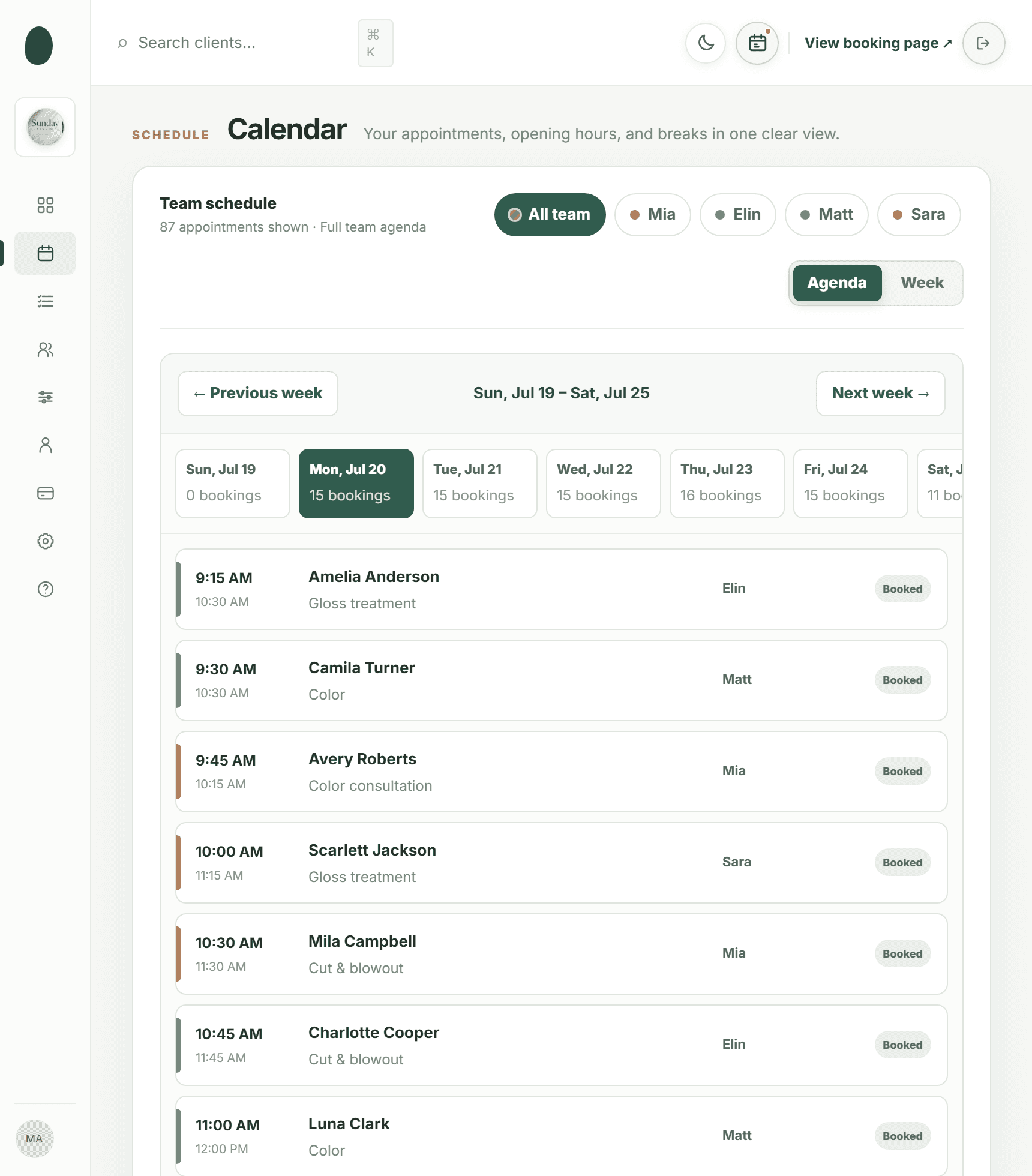
Kevonia also includes client records with visit history and private notes, which can help a professional prepare a more relevant next-visit recommendation. Its team calendar includes day and week views, professional filters, and color coding. Double-booking protection checks hours, breaks, time off, and existing bookings before an appointment is accepted, reducing a common source of friction after a client agrees to return.
The system sends an automatic email reminder the day before an appointment, and clients can reschedule or cancel from that email within the salon’s notice window. That is useful for preserving a scheduled return while still giving clients a clear way to change plans. Kevonia also supports card payments and deposits through Stripe, with payouts going to the salon’s bank account.
Kevonia has one plan at US$49.99 per month, with unlimited team members, bookings, clients, and services and no per-booking commission. The free trial lasts 14 days, requires no credit card to start, and can be canceled before the trial ends without being charged. If you are comparing systems, evaluate whether the booking flow and calendar rules match your actual rebooking process—not just whether a tool has the longest feature list.
8. Measure Rebooking and Improve One Step at a Time
You cannot improve rebooking by looking only at total appointments. Track what happens after completed visits so you can see where clients are dropping out. Start with a simple baseline for the last four to eight weeks, then compare the same measures after your team adopts the new process.
- Calculate the percentage of completed appointments followed by a future appointment booked before the client leaves.
- Break the result down by service, professional, new versus returning client, and appointment type.
- Track how many clients book later through the online page after leaving without an appointment.
- Measure cancellations and reschedules separately from true no-shows.
- Compare revenue and margin for rebooked clients, especially if you use discounts or packages.
- Review the results monthly and change one part of the process at a time.
A low rebooking rate does not automatically mean your staff is failing. It may indicate that the recommended interval is unrealistic, the service menu is confusing, the preferred professional has limited availability, prices do not match expectations, or clients are not receiving a convenient follow-up. Look for patterns before coaching individuals.
For example, if hair clients accept a recommendation but cannot find a suitable Saturday appointment, the issue is capacity or availability—not the checkout script. If nail clients book once and disappear after a price increase, review the service value and pricing communication. If spa clients cancel frequently because plans change, make rescheduling straightforward and review your notice window.
The goal is not to make every client book the same cadence. The goal is to make the next appropriate appointment easy to understand, easy to schedule, and worth returning for.
Common Rebooking Mistakes to Avoid
Even well-intentioned salons can make rebooking feel uncomfortable or inefficient. These mistakes are common because they focus on the salon’s need for a full calendar rather than the client’s reason for returning.
- Asking before discussing the result: the client has not yet heard why another visit would help.
- Using the same return interval for every service and every client.
- Offering only one date, then treating a scheduling conflict as a lost client.
- Sending vague messages such as “It’s time to come back” with no service context or booking path.
- Overloading clients with discounts, product pitches, and multiple calls to action.
- Rebooking a client into the wrong service because the original appointment type was not documented clearly.
- Ignoring cancellations and making the client start the entire booking process again.
- Promising availability that the calendar cannot actually support.
- Treating a client who had a complaint like a normal promotional lead.
- Continuing promotional messages after a client has opted out or asked not to be contacted.
If your salon uses text messages or automated calls for promotions, get advice on the rules that apply to your message type, consent process, and state. The FTC distinguishes purely informational appointment reminders from messages that include a sales pitch, and commercial email has separate requirements. Do not assume that a client giving you a phone number for an appointment automatically permits every kind of marketing contact. (ftc.gov)
FAQ: Getting Salon Clients to Rebook
The answers below address the questions salon owners usually face when turning rebooking into a consistent process.
When should I ask a client to rebook?
Ask after the client can see or feel the result and before they leave. For many salons, that is during the final consultation or at checkout. Explain the recommended return window first, then offer two suitable appointment choices. If the client is not ready, provide an easy booking route and end the conversation without pressure.
What should I say when a client says they will book later?
Acknowledge the answer and make “later” actionable: “That’s completely fine. Your recommended window is around four to six weeks, and you can book anytime through our online page.” If there is a genuine reason to plan ahead, such as a holiday or a limited schedule, explain it honestly rather than creating urgency.
How often should I follow up with a client who has not rebooked?
Start with one relevant follow-up around the service’s expected maintenance window. Add another only when you have a clear reason and the message remains useful. Repeated generic reminders can feel like pressure and may reduce trust. Separate appointment communications from promotional campaigns and honor opt-outs.
Should I offer a discount to get clients to rebook?
Only if the offer supports a specific business objective and still leaves acceptable margin. Test it against a no-discount group or an earlier period, and measure profitable repeat visits rather than redemption alone. Before discounting, improve service consistency, checkout recommendations, availability, and the booking path.
How can I improve rebooking if my salon has several professionals?
Give each professional the same basic script and service-timing guidance, then let them use their own voice. Make professional assignments and availability clear online. Review rebooking by professional alongside schedule capacity so you do not confuse a full calendar or limited hours with weak client demand.
Can booking software help me get clients to rebook?
It can remove administrative friction, but it cannot replace a good service or a relevant recommendation. Look for an easy client booking page, accurate service durations, realistic availability rules, client history, payment or deposit support, and reminders. Kevonia combines those elements in one salon and spa management workspace, with a single US$49.99 monthly plan and a 14-day free trial with no credit card required to start.
Sources
- Using digital notifications to improve attendance in clinic: systematic review and meta-analysis
- Save a customer’s payment method when they use it for a payment — Stripe Documentation
- Save a customer’s payment method without making a payment — Stripe Documentation
- Complying with the Telemarketing Sales Rule — Federal Trade Commission
- CAN-SPAM Act: A Compliance Guide for Business — Federal Trade Commission
- Kevonia
Frequently asked questions
When should I ask a client to rebook?+
Ask after the client can see or feel the result and before they leave. Explain the recommended return window, then offer two suitable appointment choices. If the client is not ready, provide an easy booking route without pressure.
What should I say when a client says they will book later?+
Acknowledge the answer and make “later” actionable: give the expected maintenance window and a direct booking path. Explain real scheduling constraints honestly, but do not manufacture urgency.
How often should I follow up with a client who has not rebooked?+
Start with one relevant follow-up around the service’s expected maintenance window. Add another only when it remains useful and appropriate. Keep appointment communications separate from promotional messages when possible, and honor opt-outs.
Should I offer a discount to get clients to rebook?+
Only when the offer supports a specific objective and leaves acceptable margin. Measure profitable repeat visits, not redemptions alone. Fix service consistency, checkout recommendations, availability, and booking friction before relying on discounts.
How can I improve rebooking if my salon has several professionals?+
Give the team a shared script and service-timing guidance while allowing each professional to sound natural. Make professional assignments and availability clear online, then review rebooking by professional alongside schedule capacity.
Can booking software help me get clients to rebook?+
It can remove administrative friction but cannot replace a good service or relevant recommendation. Look for an easy booking page, accurate service durations, availability rules, client history, payment or deposit support, and reminders. Kevonia provides these tools in one workspace.
More from the blog

What to Say to Salon Clients: Scripts That Sound Human
The right words can calm an unhappy guest, set a clear boundary, and make rebooking feel natural. Use these salon client scripts as starting points, not rigid lines.

StyleSeat Alternative: Keep Your Clients and Control Booking Costs
StyleSeat can help professionals get discovered, but its marketplace model is not right for every salon. Compare the fees, workflow, and client-control tradeoffs before switching.

How to Get New Salon Clients Without Wasting Your Marketing Budget
A practical client-acquisition system for salons: improve local search, create a clear first-visit offer, build referrals, and remove booking friction.