How to Get New Salon Clients Without Wasting Your Marketing Budget
A practical client-acquisition system for salons: improve local search, create a clear first-visit offer, build referrals, and remove booking friction.

Key takeaways
- Make your salon easy to find, trust, and book before spending more on promotion.
- Use one clear first-visit offer for a specific type of client instead of discounting every service.
- Track where every new client came from so you can invest in channels that produce completed appointments.
- Treat the booking experience, reminders, deposits, and rebooking process as part of marketing—not back-office administration.
How to get new clients for a salon: start with the booking path
If you are searching for how to get new clients for a salon, you probably do not need another list of vague ideas such as “post more on social media.” You need a repeatable path from discovery to appointment: the right person finds you, understands what you do, believes the salon is a good fit, sees a suitable time, and completes the booking without having to call three times.
The most useful way to approach client growth is to fix the leaks in that path before increasing the number of people entering it. A salon with beautiful photos but no clear service descriptions will lose searches. A salon with strong reviews but no online availability will lose ready-to-book visitors. A salon that fills first appointments but never records the source will not know which marketing deserves more budget.
- Define the client and service you want more of.
- Make your local presence accurate and convincing.
- Give prospects one obvious next step: book, call, or request a consultation.
- Create a first-visit experience worth referring.
- Measure completed appointments, not likes or reach.
Choose a narrow client opportunity before promoting the salon
“Everyone who needs beauty services” is too broad to guide your marketing. Choose one client opportunity for the next 30 days. Examples include busy professionals who need predictable weekday appointments, parents looking for low-maintenance cuts, clients with curly hair, guests preparing for weddings, men seeking regular grooming, or people looking for a specific skin or nail service.
Then pair that audience with one service that is easy to understand. Instead of promoting “all salon services,” use an offer such as “consultation and dimensional color for first-time color clients” or “weekday express facial for clients with limited time.” The point is not to make the service cheap. The point is to make the decision simple and show the prospect that your team understands a particular need.
The U.S. Small Business Administration recommends defining a target market and competitive advantage as part of a marketing plan. For a salon, that means writing down who you want, what problem you solve, why your salon is a credible choice, and how a person actually buys the service. Use that logic on every page, profile, and promotion rather than changing your message every week.
- Client: Who is most likely to value this service and return?
- Need: What result, concern, or occasion brings them to the salon?
- Proof: Which photos, reviews, qualifications, or explanations reduce their uncertainty?
- Next step: What should they do immediately after seeing the offer?
- Capacity: Which days, professionals, and appointment lengths can actually support more demand?
This step also prevents a common failure: advertising a service that the salon cannot deliver consistently. If your new-client offer is a long color appointment but only one stylist can perform it, a successful promotion may create a three-week wait. That delay can turn a promising lead into a lost client. Match the message to real availability before publishing it.
Own the local search results that ready-to-book clients use
A verified Google Business Profile is one of the first places to improve because it connects local discovery with practical information: hours, location, photos, services, reviews, website links, and booking links. Google says Business Profiles can help service businesses appear on Search and Maps, attract new customers, and direct people to websites and booking options.
Complete the profile as if a first-time visitor is comparing you with three nearby salons. Use the exact business name customers recognize, current hours, the correct phone number, a precise service area or address, and recent images that show the space and the work. Add the services you genuinely provide, not every possible category. Inaccurate information creates disappointment before the first appointment.
Add a direct booking destination wherever Google gives you that option. Google’s local business links documentation explains that businesses can add appointment links and choose a preferred link when more than one is available. Test the link on a phone while logged out: it should open the booking page, show useful services, and make it possible to find a suitable time without extra messages.
- Add photos of the storefront, treatment areas, team, and representative results.
- Write service names that a local customer would actually search for.
- Check your holiday hours and temporary closures before they cause missed visits.
- Use the same business details on your website, social profiles, and directories.
- Review the booking link monthly, especially after changing software or service menus.
Reviews are not just a vanity metric. They answer the questions a new client is silently asking: Was the stylist skilled? Was the salon welcoming? Was the appointment on time? Was the price explained? Ask satisfied clients for an honest review after a completed visit, give them a direct review link or QR code, and reply to positive and negative feedback professionally. Google specifically warns that offering discounts or other incentives in exchange for reviews is prohibited.
Build an offer that creates first appointments without training clients to wait for discounts
A first-visit offer can reduce hesitation, but a permanent blanket discount can make your regular pricing look arbitrary. Start with a defined offer, a defined audience, and a defined end point. For example, offer a complimentary consultation with a booked color service, a first-visit add-on with selected treatments, or a weekday introductory service during your quietest period.
State exactly what is included, who it is for, which professionals or times apply, and what happens after the first visit. If a service requires a consultation, patch test, preparation, or extra time, say so before the person books. Surprise requirements create cancellations and poor reviews; clear expectations create better-fit appointments.
- Name the result rather than using a generic phrase such as “special offer.”
- Use a real deadline or capacity limit only when it is genuine.
- Show the regular price and the introductory price when a discount is involved.
- Explain whether deposits, consultations, or cancellation terms apply.
- Give the visitor one booking path instead of sending them to several social profiles.
The usual advice is to promote an offer everywhere at once. That is often the wrong move for a small salon. Test it in one local channel first—your Google profile, a neighborhood partnership, or a small social campaign—and track completed appointments for two to four weeks. If the offer fills times you already sell easily, it is not generating useful incremental demand. Move it to quiet periods or change the audience.
When a friend, local creator, or partner receives a free or discounted service in exchange for posting, ask for a clear disclosure in the post itself. The Federal Trade Commission says material relationships, including payment or free products and services, should be disclosed clearly so viewers can evaluate the recommendation honestly.
Turn current clients into a measurable referral source
Referrals work best when the request is specific and easy to act on. Do not simply say, “Tell your friends about us.” After a client compliments the result, say something like: “If you know someone looking for this service, you can send them our booking link and ask them to mention your name.” Give the referred person a clear first-visit option and record the referrer at booking or check-in.
Choose a reward that protects your margin. It could be a fixed credit toward a future service, a small add-on, or a benefit available after the referred client completes the appointment. Avoid rewards that require your team to remember complicated conditions. A simple rule is easier to explain, track, and deliver consistently.
- Ask at the moment the client expresses satisfaction, not weeks later.
- Use a unique referral code, referral name, or booking question.
- Reward completed first visits rather than leads that never show.
- Do not pressure clients who are unhappy or have unresolved complaints.
- Review the results monthly: referrals received, appointments completed, reward cost, and repeat visits.
Your referral system should also protect the experience after the introduction. Give the new client the same consultation quality, arrival instructions, pricing clarity, and follow-up as every other guest. If the referral feels rushed or confusing, the original client may stop recommending you even if the service itself was good.
Use local partnerships and content that solve a real client problem
Local partnerships can outperform broad advertising when the partner already serves the people you want. Consider photographers, bridal shops, gyms, apartment communities, clothing boutiques, wellness professionals, corporate offices, and event planners. The partnership needs a useful exchange: a co-hosted consultation day, a preparation checklist, a guest benefit, a referral arrangement, or educational content—not just a stack of business cards.
Create content around decisions clients are already trying to make. A colorist could explain how much time a transformation takes, what maintenance looks like, and which photos help during a consultation. A spa could explain how to choose between two treatments. A nail salon could show the difference between service durations and aftercare. This content attracts better-fit inquiries because it answers practical questions before the person contacts you.
Use short videos and photos as proof, not as a substitute for information. Show the starting point, process, finished result, service length, and a realistic maintenance expectation when appropriate. Include the neighborhood or service area naturally so the post is useful to local people rather than a generic beauty image that could belong anywhere.
- Publish one educational post tied to your chosen client opportunity.
- Tag or collaborate with one relevant local business when the content genuinely helps both audiences.
- Add a direct booking instruction to the post or profile.
- Save common questions and turn them into service-page copy or consultation prompts.
- Review which posts led to profile visits, inquiries, and completed appointments.
Do not assume that a large audience equals a full schedule. A post seen by people outside your service area may generate attention but no revenue. For a local salon, a smaller audience with a clear need, nearby location, and immediate booking option is usually more valuable than high reach without intent.
Where Kevonia fits in the client-acquisition system
Kevonia fits after discovery: it gives a salon a branded online booking page that is open 24/7, so a prospect can choose a service, professional, date, and time without waiting for a reply. That booking page can be placed on your website, social profiles, and Google Business Profile. The salon keeps the marketing message focused on getting the right person to the next step.
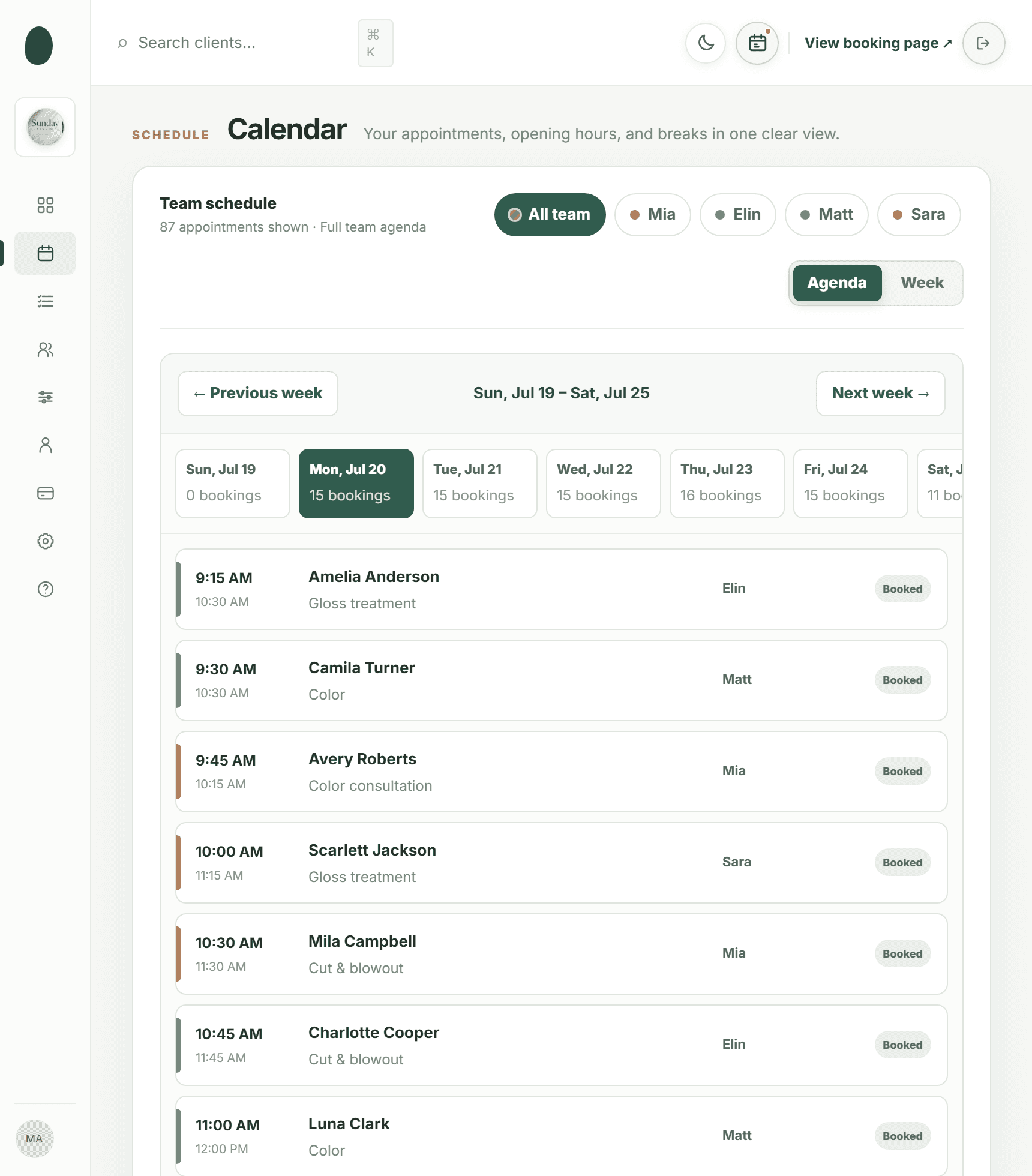
The difference is that booking capacity and front-desk administration are handled in the same workspace. Kevonia includes a week and day team calendar with professional filters and color coding, availability rules for hours, breaks, time off, closures, booking windows, minimum notice, and time-slot intervals, plus double-booking protection that checks existing bookings and blocked time.
For client growth, the client record matters as much as the initial booking. Kevonia lets the salon search records by name, email, or phone and keep private notes and visit history. That makes it easier to recognize a first-time client, remember the consultation, and deliver a more personal next visit instead of treating every appointment as an isolated transaction.
Kevonia also supports Stripe card payments and deposits, automatic email reminders the day before an appointment, and client rescheduling or cancellation through the reminder email within the salon’s notice window. These tools do not create demand by themselves, but they reduce avoidable friction after marketing has done its job. The owner can also see total and new clients, recent booking activity, no-shows as a percentage of the last 30 days’ bookings, and revenue trends on the overview screen.
The plan is US$49.99 per month with unlimited team members, bookings, clients, and services, no per-booking commission, and no feature tiers. Kevonia offers a free 14-day trial with no credit card required to start; cancel anytime before the trial ends and you are never charged. That makes it practical to test the complete booking path with your own services and availability before deciding whether it fits.
Measure the source of every new appointment
You cannot improve client acquisition if every new person is recorded as “Google” or “Instagram.” Ask one short source question during booking or check-in: “How did you hear about us?” Use a small set of options that match your actual channels, such as Google Search, Google Maps, Instagram, referral, local partner, paid ad, walk-in, or returning client’s guest.
Track the journey in a simple monthly sheet or workspace: source, first appointment booked, appointment completed, service revenue, discount or reward cost, no-show status, and whether the client returned. A channel that produces many inquiries but few completed appointments may have a booking problem, weak service fit, unclear pricing, or an audience outside your area. A channel with fewer leads but strong repeat behavior may deserve more attention.
- New inquiries by source.
- First appointments booked by source.
- Completed first appointments by source.
- No-shows and cancellations by source.
- Average first-visit revenue.
- Clients who return within your normal service cycle.
- Cost of discounts, ads, partner rewards, or creator services.
Set a decision rule before reviewing the numbers. For example, continue a channel when it produces completed first visits at an acceptable acquisition cost and shows signs of repeat demand; change the message when people inquire but do not book; fix the booking path when people reach the calendar but abandon it; and stop spending when a channel produces attention without profitable appointments.
This is where many salon marketing plans fail: they measure exposure instead of business outcomes. A full calendar is not automatically healthy if it is filled with low-margin services, poorly timed appointments, or clients who never return. Growth should improve both demand and the quality of the operating schedule.
A 30-day client-growth plan for a salon
If you are still asking how to get more salon clients, do not launch ten tactics at once. Use the next 30 days to build and test one complete system. The goal is not to become visible everywhere; it is to learn which message and channel produce completed appointments for your specific salon.
- Days 1–3: Choose one target client, one service, one first-visit offer, and the appointment capacity behind it.
- Days 4–7: Update your Google Business Profile, service descriptions, photos, hours, phone number, and booking link.
- Week 2: Ask recent satisfied clients for honest reviews, reply to existing reviews, and create one referral process the team can explain in one sentence.
- Week 3: Publish three useful pieces of local content and approach two complementary businesses about a specific partnership.
- Week 4: Review source data, completed appointments, no-shows, first-visit revenue, and repeat bookings. Keep, change, or stop each test.
At the end of the month, make one operational improvement as well as one marketing improvement. If many people book but arrive late, clarify arrival instructions and timing. If clients abandon online booking, simplify service choices and explain durations. If new guests do not rebook, improve the consultation and next-visit recommendation. Client acquisition and client experience are connected; marketing creates the opportunity, but the appointment determines whether the opportunity compounds.
The strongest salons usually do not depend on one viral post or one large promotion. They make the business easy to discover, easy to trust, easy to book, and worth recommending. Build those four conditions deliberately, then use actual appointment data to decide what to do more often.
Sources
Frequently asked questions
What is the fastest way to attract new salon clients?+
Start with the channels closest to booking intent: an accurate Google Business Profile, strong service pages, visible reviews, and a direct online booking link. Then use a specific first-visit offer for a service and audience you can serve promptly. This is usually more dependable than posting broad promotional content without a clear next step.
Should a salon offer a discount to get first-time clients?+
A discount can reduce hesitation, but it should be limited and measurable. Tie it to one service, audience, time period, or quiet schedule, and explain all conditions before booking. You can also use a consultation, add-on, or education-focused offer instead of reducing the core price. Never offer discounts in exchange for Google reviews.
How can a new salon get clients with a small marketing budget?+
Prioritize free or low-cost foundations first: claim and complete your Google Business Profile, add current photos, request honest reviews, create a direct booking path, contact complementary local businesses, and ask satisfied clients for referrals. Track every source before paying for ads. A small budget works better when the booking process is already clear and reliable.
What should I post on social media to get salon bookings?+
Post content that helps a local prospect make a decision: realistic before-and-after results, service duration, maintenance expectations, preparation instructions, pricing context, stylist specialties, and answers to common questions. Include the neighborhood or service area and one clear booking instruction. Content that demonstrates fit usually performs better for bookings than generic inspirational images.
How do I know which marketing channel brought in a new client?+
Ask every new client how they heard about the salon and use consistent source categories. Record the source, booked service, completed appointment, revenue, discount or acquisition cost, no-show status, and whether the client returned. Review the data monthly. Do not judge a channel only by views, likes, or inquiries.
Can Kevonia help me get new salon clients?+
Kevonia does not replace promotion, referrals, or local search. It supports the conversion and operations after someone decides to book. Its branded booking page is available 24/7, clients choose a service, professional, date, and time, and the workspace includes calendars, availability rules, client records, deposits through Stripe, and reminder emails. The price is US$49.99 per month with unlimited team members, bookings, clients, and services, and the trial is free for 14 days with no credit card required to start.
More from the blog

How Much Should a Salon Spend on Marketing in 2026?
A practical way to set your salon marketing budget in 2026—without copying a generic percentage or wasting money on channels you cannot measure.

Bring Lapsed Salon Clients Back Without Chasing Them
A practical plan for identifying genuinely lapsed clients, deciding who to contact, writing messages that feel personal, and turning one return visit into a new routine.

How to Get Clients to Rebook: A Practical Salon Guide
Want more repeat appointments? Use this practical system to make rebooking easy, timely, and relevant without pressuring clients or relying on constant discounts.