Clients Who Arrive Late: A Salon Policy That Works
A practical way to handle late salon clients without punishing reasonable delays, disrupting the next appointment, or leaving your team to make inconsistent decisions.

Key takeaways
- Base your policy on the time needed to complete the service safely, not an arbitrary punishment.
- Use clear decision points for small delays, shortened services, rescheduling, and repeated lateness.
- Tell clients what to do when they are running late and show the policy before they book.
- Document exceptions, deposits, refunds, and repeat patterns so staff can enforce the rule consistently.
Start with the decision clients actually want answered
If you searched for “clients who arrive late salon policy,” you probably need more than a sentence saying “arrivals over 15 minutes may be refused.” You need to know what your team should say when someone is eight minutes late, what happens when a 60-minute appointment now has only 45 minutes left, and whether a deposit can be kept when the service cannot go ahead.
The most workable approach is a decision policy rather than a punishment policy: keep the appointment when the service can still be completed properly, shorten it when that protects the next booking, and reschedule when continuing would create a rushed or unsafe service. The exact cutoff should depend on the service, the professional’s schedule, and whether the client communicated before arriving.
Set the rule around service time, not one universal number
A five-minute delay is not the same operational problem for a 30-minute brow appointment and a three-hour color correction. A universal “15-minute late rule” is easy to print, but it can be too lenient for a tightly booked lash fill and unnecessarily harsh for a long service with built-in flexibility.
Start by calculating the minimum time each service needs. Include consultation, setup, processing, cleanup, and any required aftercare explanation. If a haircut is booked for 60 minutes but the actual cut can be completed in 45 minutes without rushing, your team may have a little flexibility. If a chemical service requires a fixed processing window, losing 15 minutes at the beginning may make the original appointment impossible.
- Define a small courtesy window, such as five minutes, for normal arrival friction.
- Identify the point at which the full service can no longer be completed to your usual standard.
- Decide whether the service can be shortened without changing the promised result or creating a safety problem.
- Set a rescheduling point for situations where the remaining time is not enough.
- Make the rule service-specific where necessary instead of forcing every appointment into the same cutoff.
A useful policy can still use a simple public rule, such as “Arrivals more than 15 minutes late may need a shortened service or rescheduling.” Internally, however, staff should check the remaining appointment time and the next booking before deciding. The visible rule sets expectations; the internal decision process keeps it fair.
What to do when a client is late: use a four-step response
Your front desk or service provider should not have to improvise while another client is waiting. Give the team a short sequence that works for most appointments. This is especially important in a multi-professional salon, where one person’s decision can delay several other appointments.
- Check the clock and the appointment details. Confirm the scheduled start time, service length, professional, and any cleanup or processing time.
- Contact the client promptly if they have not arrived. Ask for an estimated arrival time rather than simply asking whether they are coming.
- Assess the remaining service window. Decide whether the full service, a modified service, or no service can be delivered without pushing the next booking late.
- State the option clearly and record what happened. Avoid vague promises such as “we will see what we can do” if the schedule cannot support the original appointment.
A practical message might be: “Hi, this is the salon. Your appointment started at 2:00 p.m. We have not seen you yet. Please let us know your estimated arrival time. We can hold the appointment if there is enough time to complete the service, but arriving late may mean a shorter service or rescheduling.”
When the client arrives, avoid debating whether the delay was justified in front of other guests. Confirm the remaining time and the available choices. For example: “We have 40 minutes left before the next appointment. We can complete the cut today, but we cannot include the blowout, or we can move you to another opening.” The client may be disappointed, but the boundary is easier to accept when it is tied to time and service scope rather than blame.
Choose what happens at each stage of lateness
A clear salon late arrival policy should explain the outcome, not merely define “late.” Clients need to know whether arriving late changes the service, the price, the deposit, or the ability to book again. Your team also needs permission to stop when the remaining time is not sufficient.
- Small delay: Welcome the client and continue if the appointment can remain on schedule. Do not turn a two-minute delay into a confrontation.
- Moderate delay: Offer a shortened or modified service if the client agrees and the result remains appropriate. Explain what will be omitted before beginning.
- Significant delay: Reschedule when the remaining time cannot support the booked service or would make the next client wait.
- No communication: Treat the appointment according to your late-cancellation or no-show terms once the stated contact window has passed.
- Repeat lateness: Keep the policy consistent, then consider advance deposits, a narrower booking window, or online booking restrictions for future appointments.
Do not promise a full service at the original price if the client arrives late and you know the professional will have to skip essential work. At the same time, do not automatically reduce the price when the client receives the full booked service and the delay simply reduces idle time that was available in the schedule. Your written policy should explain that the appointment end time normally remains fixed unless the salon chooses to extend it without affecting another booking.
For a late client hair appointment, the most common practical choice is to preserve the appointment end time and remove optional elements first. A consultation, safety check, required preparation, or processing step should not be skipped merely to fit the client in. If the only way to finish is to rush or compromise the result, rescheduling is the more professional option.
When charging a fee is fair—and when it is the wrong move
A late-arrival charge is not automatically the best solution. In many cases, the real financial protection comes from applying the same cancellation or no-show terms that were disclosed when the client booked. Charging a new “late fee” at checkout, when the client never saw that term, creates an avoidable dispute and makes staff look inconsistent.
If your policy includes a deposit or missed-appointment charge, show the amount, the trigger, and the payment method before the client commits to the booking. The Federal Trade Commission says mandatory charges should be presented clearly and conspicuously, with the total price understandable before purchase. That principle is useful for salon policies even when the specific rule applying to your business depends on the fee structure and applicable state or local law. (ftc.gov)
- Use a fee when the client agreed to the relevant booking terms and the late arrival prevents the salon from using the reserved time.
- Consider waiving or reducing it for a first incident, a documented emergency, or a delay the salon caused.
- Do not charge a fee while also representing that the client received the full service unless your terms clearly explain why the fee applies.
- Keep the same decision standard across clients, while allowing a documented exception process for legitimate circumstances.
- Have the owner or manager review disputed charges rather than requiring a stylist to negotiate during a service.
If an online payment or deposit needs to be returned, process it through the original payment record rather than creating an informal cash arrangement. Stripe’s documentation explains that completed payments are refunded, while an incomplete payment may be canceled instead; refunds are sent back through the payment flow and can take time to appear for the customer. (docs.stripe.com)
Handle emergencies, access needs, and the exceptions your policy needs
The usual advice is to enforce the same cutoff every time. That is too rigid. A fair policy needs an exception path for circumstances that are outside ordinary lateness, including a medical emergency, a serious transportation incident, or a disability-related access need. The exception does not require you to keep a professional working indefinitely; it requires a thoughtful review of what accommodation is reasonable.
Under Title III of the Americans with Disabilities Act, businesses open to the public must make reasonable modifications to policies and procedures when necessary for a person with a disability, unless the modification would fundamentally alter the nature of the service. A salon should not ask intrusive questions or demand medical details simply because a client requests flexibility. Instead, document the request, consider whether a reasonable adjustment is possible, and seek qualified legal advice when the situation is unclear. (ada.gov)
- If the salon caused the delay, apologize and decide whether to extend the service or offer a new appointment without penalizing the client.
- If the client reports an emergency, prioritize safety and decide whether to waive the charge or reschedule.
- If the client requests a disability-related modification, review it case by case rather than applying an automatic refusal.
- If a service cannot safely be completed in the remaining time, explain that limitation without treating the client as dishonest.
- Record the exception and the reason in a private client note so the next team member does not repeat the same discussion.
The exception process should not be so broad that every late client receives a different deal. A useful standard is: can the salon reasonably preserve the client’s access and dignity without compromising safety, service quality, or the next scheduled appointment? If yes, make the adjustment. If no, offer the clearest alternative and document why.
Write policy language clients can understand before they book
Your policy should be short enough to read during booking and specific enough to prevent an argument. Put it on the booking page, in the confirmation email, and wherever clients review appointment terms. Avoid legal-sounding phrases such as “at the sole discretion of management” unless you explain what discretion means in practice.
Here is a starting template you can adapt: “Please arrive on time for your appointment. If you are running late, contact us as soon as possible with your estimated arrival time. We will do our best to keep your appointment, but the service may need to be shortened so we can remain on schedule. If the remaining time is not enough to complete the service safely and properly, we may need to reschedule the appointment. Late arrivals that prevent us from providing the booked service may be handled under our late-cancellation or no-show policy. Deposits and charges will follow the terms shown at booking. We will consider reasonable exceptions for emergencies and disability-related access needs.”
- Name the contact method: phone, email, or the booking link.
- State whether the service ends at the scheduled time.
- Explain what happens to optional service elements when time is reduced.
- Connect late arrivals to the existing deposit, cancellation, or no-show terms.
- Tell clients how to reschedule instead of leaving them with only a penalty.
- Review the wording whenever your booking window, deposit rules, or service durations change.
Do not write “late clients will be charged” if your actual practice is to shorten services without a charge. Do not write “we hold appointments for 15 minutes” if your team regularly waits 25 minutes. Clients judge policies by what happens at the desk, so the written rule and the operational rule must match.
Make the policy operational for the whole team
A policy fails when it exists only on a website. Every professional should be able to see the appointment time, service duration, client contact details, and relevant history without searching through personal messages. The goal is not to create a surveillance system; it is to prevent the same client from receiving three different answers from three different people.
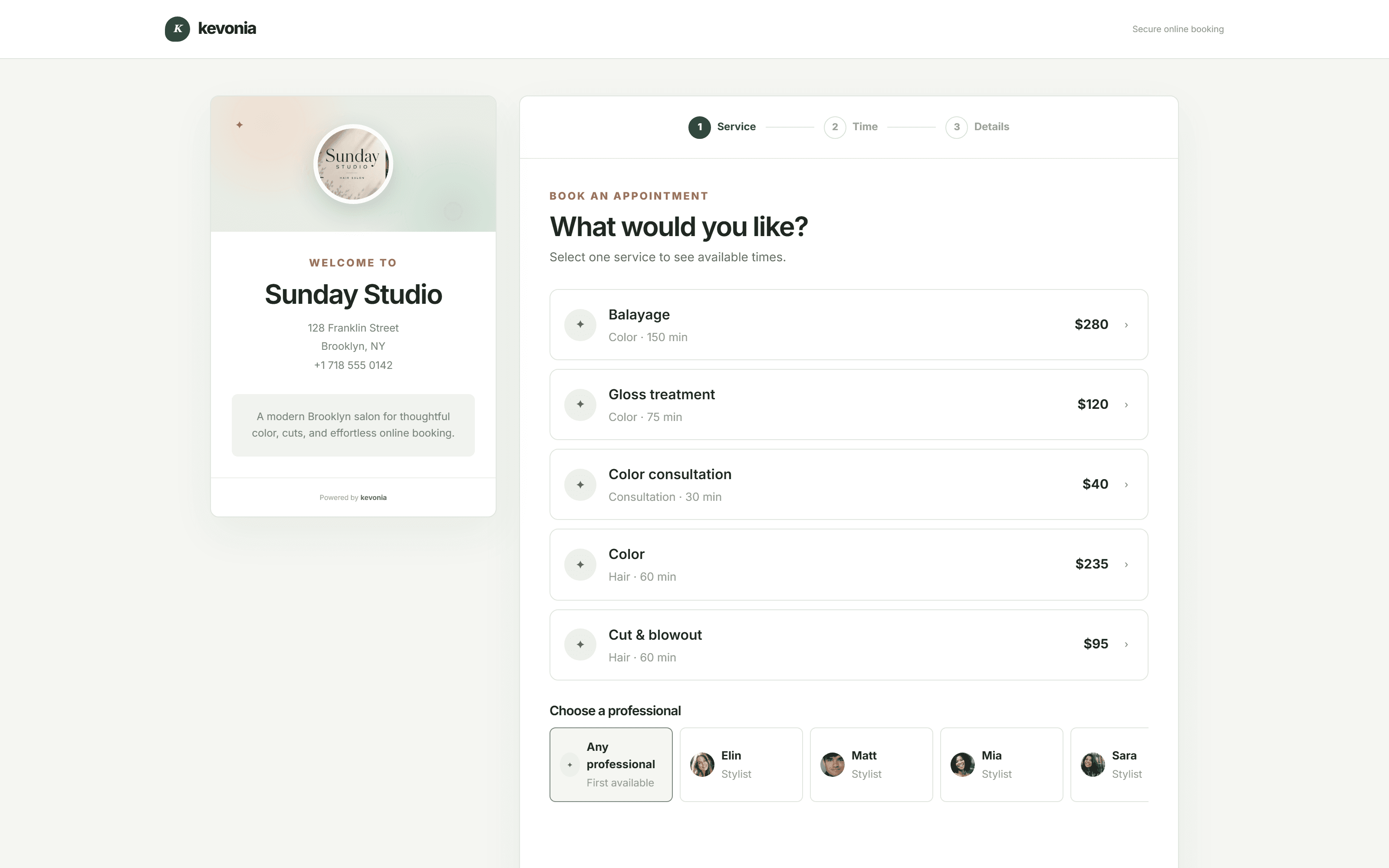
Kevonia can fit this workflow through its branded online booking page, team calendar, service menu, availability rules, client records, and Stripe payment support. You can set service duration and cleanup or buffer time, define opening hours and staff time off, view appointments by professional, and keep private notes about prior late arrivals or exceptions. Its booking statuses also let the salon distinguish booked, checked in, completed, cancelled, and no-show appointments instead of treating every problem as the same event.
For a salon that wants scheduling rules to match the written policy, Kevonia’s availability settings can help prevent appointments from being offered when they conflict with hours, breaks, time off, closures, or existing bookings. The software does not decide whether a client deserves an exception; your team still makes that judgment. It gives the team a shared calendar and client record so the decision can be applied consistently. For owners comparing workflows across service businesses, the same scheduling logic can also support appointment software for barbershops.
Use private notes for facts, not labels. “Arrived 22 minutes late on May 4; offered shortened service and declined” is useful. “Difficult client” is vague and can bias the next interaction. A well-organized record also helps when you need to explain a repeat-booking restriction or decide whether a previous exception should be repeated.
- Give staff one approved message for a late arrival and one approved message for rescheduling.
- Require the person handling the appointment to record the arrival time and outcome.
- Use the same status definitions across the team.
- Review repeated lateness privately with the owner or manager instead of arguing at the front desk.
- Audit the policy monthly: late arrivals, shortened services, reschedules, waived charges, and complaints.
Test the policy against real salon scenarios
Before publishing the policy, run it through situations that expose contradictions. The point is not to predict every possible excuse. It is to make sure the team can reach a reasonable decision without inventing a new rule in the moment.
- The five-minute delay: A client arrives five minutes late for a 45-minute manicure. The professional can finish by the scheduled end time. Continue normally and avoid turning a minor delay into a fee dispute.
- The 12-minute delay: A client arrives 12 minutes late for a 60-minute haircut with a next appointment immediately afterward. Offer the haircut within the remaining time and explain that the styling finish may need to be shortened.
- The 20-minute delay with notice: A color client calls from traffic and will arrive 20 minutes late. Check the processing and cleanup requirements. If the full service cannot be completed, offer a new opening and apply the stated terms consistently.
- The 20-minute delay without notice: Contact the client, document the attempt, and follow the published late-cancellation or no-show process after the stated waiting period.
- The emergency: A client explains that a medical emergency caused the delay. Prioritize safety, consider waiving the charge, and record only the information needed to explain the decision.
- The repeat pattern: A client has arrived late three times in two months. Speak with them before the next booking, require a deposit if that is part of your written terms, or limit online booking if your business rules allow it.
This testing step is one of the pieces many short policy templates skip. A rule may sound fair until you apply it to a 30-minute service, a processing service, a professional working alone, or a client who called ahead. If the answer changes depending on who is at the desk, the policy needs clearer decision points rather than harsher language.
For spas and longer treatments, add arrival-readiness details. A guest may be physically present but still need to complete intake, change clothes, use a restroom, or prepare for the treatment. Decide whether the booked time begins at the scheduled start or after preparation, and state that clearly. A scheduling system such as spa booking software can help you display service duration and buffers, but the policy still needs to explain what “on time” means for the guest.
Review results and adjust without moving the goalposts
Track the operational effect of the policy for 30 days before changing it. Count how often clients arrive late, how often services are shortened, how often appointments are rescheduled, and how much staff time is spent discussing exceptions. Also note whether the policy creates complaints from clients who were on time for their next appointment but had to wait.
Look for patterns by service and time of day. If late arrivals cluster around a particular appointment type, the problem may be an unrealistic duration, an unclear service description, or insufficient buffer time rather than client behavior. If new clients are late more often than returning clients, improve directions, parking information, arrival instructions, or the confirmation email before adding a stricter fee.
Kevonia includes an automatic email reminder the day before an appointment, and clients can reschedule or cancel from that email within the salon’s notice window. That can help a client act before the appointment becomes a late arrival, although it is still your responsibility to write clear notice rules and decide what happens after the window closes.
The best policy is not the one with the largest penalty. It is the one that protects the next client, preserves service quality, gives staff a repeatable response, and tells the late client exactly what will happen. Publish it before booking, apply it calmly, make reasonable exceptions, and revise it when your actual schedule shows that the rule is not working.
Sources
- Federal Trade Commission: The Rule on Unfair or Deceptive Fees FAQ
- Stripe Documentation: Refund and cancel payments
- ADA.gov: Businesses That Are Open to the Public
- Kevonia
- Kevonia salon booking program
- Kevonia salon reservation software
- Kevonia barbershop appointment software
- Kevonia spa booking software
- Kevonia hair salon booking software
- Kevonia: How to Organize Client Records for a Salon in 2026
Frequently asked questions
What is a reasonable grace period for a salon client who arrives late?+
Many salons choose a small courtesy window, often around five minutes, but there is no universal number that fits every service. Base the decision on the minimum time needed to complete the service safely and properly. A five-minute delay may be manageable for a long appointment but disruptive for a tightly timed 30-minute service.
Should a salon shorten the service or reschedule a late client?+
Shorten the service only when the remaining time still allows you to deliver an appropriate result and the client agrees to what will be omitted. Reschedule when the full service cannot be completed, when required processing or preparation would be skipped, or when continuing would make the next client wait.
Can I charge a late fee if a client arrives late?+
You can use a late-arrival, late-cancellation, or no-show charge only according to terms the client saw and accepted before booking, and you should check applicable state and local requirements. State the amount or calculation, the event that triggers it, and how payment or deposits are handled. Do not invent a new fee at checkout.
What should my team say when a client is running late?+
Ask for the client’s estimated arrival time, check the remaining service window, and give a specific option. For example: “We can see you when you arrive, but because we have another appointment after yours, we may need to shorten the service. If there is not enough time to complete it properly, we will need to reschedule under our booking policy.”
How should a salon handle a client who is repeatedly late?+
Document the dates, arrival times, and outcomes without using insulting labels. Then speak with the client before the next appointment. You may require a deposit, limit online booking, offer only appointment times with more flexibility, or stop accepting future bookings if those options are allowed by your written terms and applied consistently.
Should a late-arrival policy include exceptions for emergencies or disabilities?+
Yes. Include a short statement that the salon will consider reasonable exceptions for emergencies and disability-related access needs. Businesses open to the public may need to make reasonable modifications to policies for people with disabilities unless the change would fundamentally alter the service. Handle requests respectfully and case by case.
More from the blog

How to Deal With a Difficult Salon Client in 2026
A practical 2026 guide to handling demanding, disrespectful, late, or nonpaying salon clients without losing control of the situation or your team’s trust.

How to Write a Salon Booking Confirmation Email in 2026
A salon booking confirmation email should remove uncertainty, not create more work. Use this practical guide to write clear confirmations that clients can trust and act on.

Where to Share Your Salon Booking Link in 2026
Your booking link only works when clients can find it at the moment they decide to book. Here are the best places to share it and how to prioritize them.