How to Deal With a Difficult Salon Client in 2026
A practical 2026 guide to handling demanding, disrespectful, late, or nonpaying salon clients without losing control of the situation or your team’s trust.

Key takeaways
- Separate a solvable service complaint from behavior that threatens your staff or business.
- Use a calm, documented process: listen, clarify, offer a reasonable remedy, and set a boundary.
- Put policies, deposits, payment records, and client notes in place before the next difficult interaction.
- End the relationship when a client repeatedly violates clear boundaries or creates a safety risk.
How to deal with a difficult salon client: start with the real problem
When a client is angry, demanding, late, insulting, or refusing to follow your salon’s policies, the immediate question is usually, “What do I say right now?” The better question is, “Is this a service problem I can solve, or a behavior problem I need to contain?” Those situations require different responses.
A legitimate complaint about a haircut, color result, wait time, pricing misunderstanding, or booking error may deserve a correction or refund. Personal insults, threats, harassment, repeated no-shows, chargeback pressure, or refusal to pay require boundaries. Your goal is not to make every client happy at any cost. It is to resolve reasonable issues fairly while protecting your staff, schedule, revenue, and reputation.
1. Classify the client’s behavior before you respond
Do not respond to every difficult interaction with the same script. A client who is disappointed may calm down after a clear explanation. A client who is abusive may use your willingness to negotiate as an invitation to demand more. Classify what is happening first, then choose the smallest response that solves the actual problem.
- Service dissatisfaction: The client believes the result, timing, or service did not match what was promised.
- Miscommunication: The client expected a different service, professional, price, duration, or result than the booking or consultation described.
- Policy conflict: The client objects to a cancellation fee, deposit, late-arrival rule, correction policy, or payment requirement.
- Boundary violation: The client is yelling, insulting, making sexual comments, targeting a staff member’s identity, invading personal space, or refusing reasonable instructions.
- Safety concern: The client threatens violence, follows an employee, damages property, appears intoxicated, or creates an immediate risk to people in the salon.
The classification matters because “the client did not like the result” is not the same as “the client is threatening the stylist.” Treating both as ordinary customer service can teach an abusive client that escalation works. On the other hand, treating every unhappy client as dangerous can destroy trust and make your team afraid to hear valid feedback.
If the conduct involves harassment based on race, color, religion, national origin, sex, disability, age, or another protected characteristic, take it seriously even when the person making the comments is a customer. The Equal Employment Opportunity Commission explains that harassment by customers or clients can create employer obligations, and employers should act promptly once they know about it. Review the EEOC’s small-business guidance and adapt your written policy with qualified local advice where needed.
2. Use a calm script that does not invite an argument
Your tone matters, but your structure matters more. Do not improvise a long defense while the client is emotional. Keep the conversation short, specific, and focused on what can happen next. Avoid matching the client’s volume, diagnosing their personality, or arguing about whether they are being unreasonable.
- Acknowledge the concern: “I can see that you are unhappy with the result.”
- Ask one clarifying question: “What specific part would you like us to review?”
- State the relevant fact: “The appointment was booked for a partial highlight, not a full color correction.”
- Offer a defined option: “We can schedule a consultation and correction review within three days,” or “We can refund the unused portion of the service.”
- Set the boundary: “I am willing to discuss the service, but I will not continue while you are insulting the stylist.”
- Close the conversation if necessary: “If the language continues, we will end today’s appointment and ask you to leave.”
A useful sentence is: “Here is what I can do.” It moves the conversation away from an unlimited negotiation and toward a concrete remedy. If you cannot offer the requested outcome, say so plainly and give the reason. Do not promise a free redo, future discount, or refund just to make the moment quiet unless you intend to honor it.
If the client is complaining in front of other guests, move the discussion to a private area when it is safe. Do not corner the person, block an exit, or send one junior employee to manage an aggressive client alone. A manager or owner should take over, while another team member stays aware of what is happening.
3. Resolve legitimate complaints with a fair remedy
A fair remedy depends on what failed, what the client paid for, and what your policy promised. The remedy should correct the service problem without turning every complaint into a blank check. Before offering anything, check the consultation notes, service description, timing, products used, photos if available, and the client’s stated expectations.
- Minor finish issue: Offer a reasonable adjustment or brief follow-up appointment with the original professional when appropriate.
- Material service failure: Consider a correction appointment, partial refund, or full refund based on the facts and your written policy.
- Expectation mismatch: Explain the difference between the requested service and the booked service, then decide whether goodwill is appropriate.
- Late-arrival problem: Apply the same late policy you use for other clients unless a manager documents a specific exception.
- Product reaction or injury: Stop the service, document what occurred, recommend appropriate medical attention where necessary, and contact your insurer or professional adviser.
Do not promise that a correction will produce an exact result if hair, skin, nails, or tattoos have physical limits. A professional explanation is not a refusal to help. It is part of informed service. Describe what can safely be done, how long it may take, and what additional cost or risk applies before proceeding.
For payment disputes, keep the records connected to the appointment: booking details, consent or consultation notes, invoice, receipt, refund decision, cancellation history, and messages with the client. Stripe explains that a card dispute can pull the payment and related dispute fees from the payment balance while the business prepares evidence, so documentation is more useful than an emotional account of the interaction.
4. Handle late arrivals, no-shows, and clients who refuse to pay
Many difficult interactions start before the service begins. A client arrives 25 minutes late, expects the full appointment, becomes angry when you shorten the service, and then disputes the price. The solution is not to negotiate from scratch at the front desk. Your booking process should make the timing, price, deposit, and cancellation expectations visible before the appointment.
If a salon client refuses to pay, stay factual and avoid physical confrontation. Confirm the service performed, show the agreed price, and explain the available payment methods. If the person still refuses, document the incident, involve the owner or manager, and follow your local procedures for unpaid services or trespass concerns. Do not threaten arrest, post personal information online, or hold someone’s identification or belongings as leverage.
- Before booking: Publish service duration, price, deposit terms, late-arrival rules, and cancellation notice requirements.
- At booking: Capture the client’s contact details and the exact service selected.
- Before arrival: Send a reminder that repeats the appointment time and cancellation or rescheduling window.
- At check-in: Tell the client promptly if the service must be shortened or rescheduled because of lateness.
- At checkout: Show the final amount and record whether the appointment was completed, partially completed, cancelled, or marked as a no-show.
- After the incident: Add a neutral private note describing dates, actions, amounts, and policy decisions—not insults or speculation.
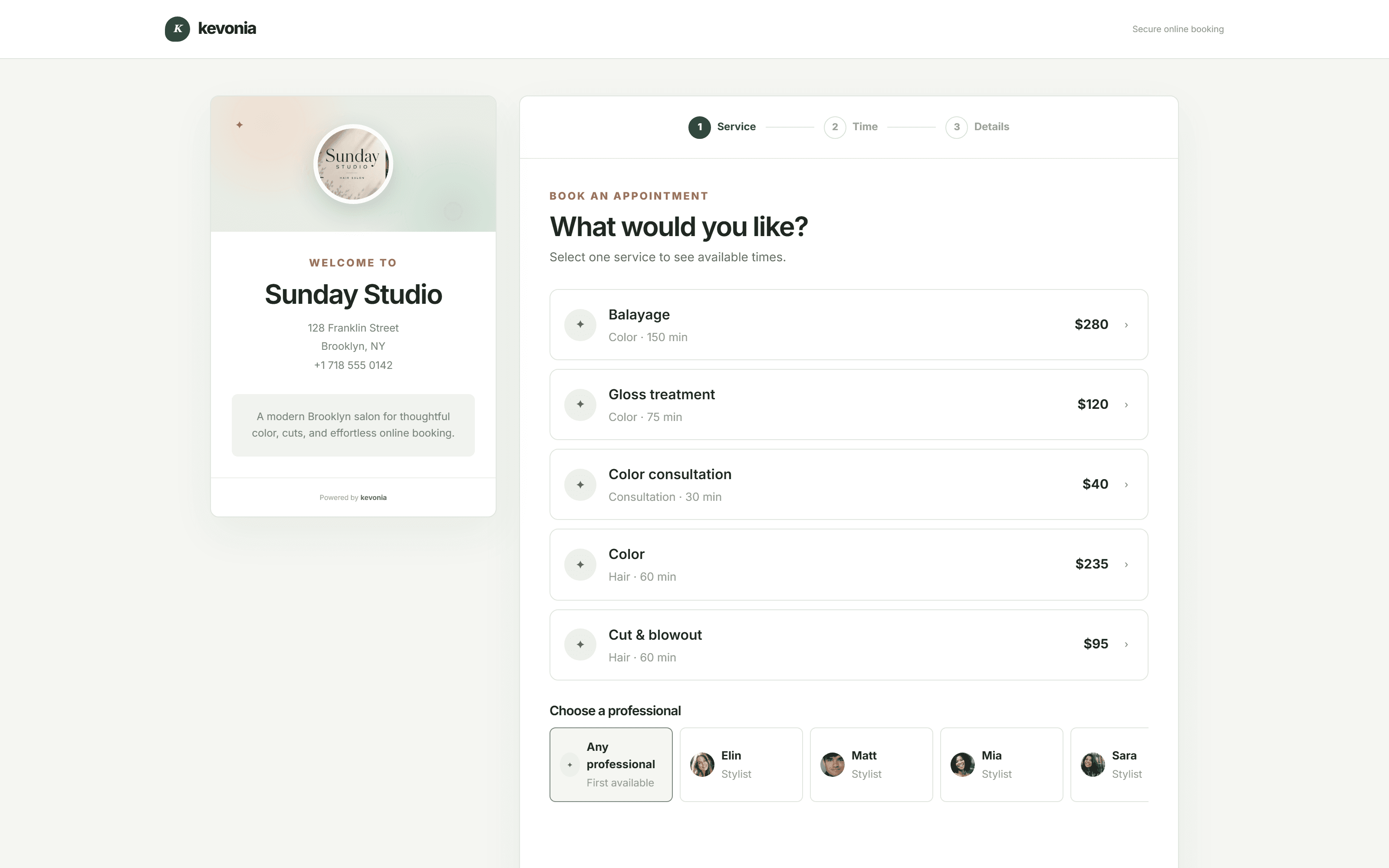
Kevonia can support this workflow with a branded booking page, service durations and prices, optional deposits, availability rules, reminder emails, booking statuses, client records, and Stripe payments. Its salon reservation software is designed to keep the booking facts and appointment history together instead of relying on scattered texts and memory.
5. Protect your team from harassment, threats, and unsafe behavior
Your team should never be required to tolerate abuse because the person is paying. Tell employees exactly when to stop serving a client and call a manager. Examples include threats, stalking or following staff, unwanted sexual touching or comments, slurs, throwing objects, blocking an employee’s movement, deliberate property damage, or behavior that suggests the person may become violent.
The Occupational Safety and Health Administration describes workplace violence broadly enough to include threats, harassment, intimidation, and other threatening behavior, including conduct involving customers and visitors. OSHA recommends a workplace violence prevention approach that covers workers, clients, visitors, and contractors. Use its guidance as a starting point for a simple salon procedure, then consider your building, staffing, closing routine, and local emergency resources.
- Have a manager or owner take over when an employee uses the agreed signal.
- Move other clients and staff away from the interaction when possible.
- Do not allow an employee to meet an aggressive client alone after closing.
- Call emergency services when there is an immediate threat, assault, weapon, or credible danger.
- Preserve relevant messages, camera footage, appointment records, and witness names.
- Check in with the affected employee afterward and document the incident promptly.
If a customer makes discriminatory or sexual comments toward a team member, do not tell the employee to ignore it or move them while the customer stays. The EEOC says employers should take steps to end harassing behavior once they know about it. In practice, that may mean ending the appointment, removing the client from the premises, investigating what happened, and deciding whether the client can return.
6. Decide when to end the client relationship
You do not need to keep every client. Ending the relationship may be appropriate when the client repeatedly violates policies, threatens or harasses staff, refuses to pay, damages property, creates repeated chargeback or no-show problems, or demands exceptions that make the appointment unprofitable and disruptive. The decision should be based on documented conduct and applied consistently, not on a protected characteristic or a client’s lawful request for accessibility.
If you are considering banning a client from your salon, review your policy, contract, local requirements, and any accessibility or discrimination concerns first. A short written notice is usually safer than a public confrontation. You can say: “We are ending our professional relationship and will not accept future appointments. Any eligible refund will be processed according to our policy. Please do not return to the premises unless we contact you.” Keep the explanation factual and limited.
Do not announce the client’s name or story on social media. Do not encourage staff to post about the incident. If the client leaves a negative review, respond once with a calm statement that protects privacy: “We cannot discuss private appointment details, but we take concerns seriously and invite the reviewer to contact the owner directly.” The FTC’s consumer-review rule also makes deceptive or fake reviews, paid reviews conditioned on a particular sentiment, and misleading review practices risky for businesses.
Kevonia includes the option to block a client from booking online, record a reason, and keep no-show history on the client record. That gives an owner a practical way to prevent an ended relationship from quietly turning into another online appointment. The decision should still come from your policy and judgment; software only helps enforce the decision consistently.
7. Build a process that prevents repeat conflict
The best time to deal with a difficult client is before the appointment becomes difficult. A clear process reduces ambiguity for clients and gives staff permission to enforce the same standards. Review your policies at least once a year and whenever a recurring incident exposes a gap.
- Write a plain-language late, cancellation, no-show, deposit, refund, correction, and conduct policy.
- Put the policy where clients can see it during booking and confirmation—not only in a hidden footer.
- Train staff on two or three approved phrases for complaints, payment problems, and abusive behavior.
- Define who can approve a refund, waive a fee, shorten a service, or end a client relationship.
- Use private client notes for relevant facts, dates, and decisions; never use labels such as “crazy” or “awful.”
- Review patterns monthly: repeated no-shows, refunds, late arrivals, disputes, and complaints by service or professional.
- Role-play the hardest scenarios so a new receptionist does not have to invent a response under pressure.
A client record should help the next professional understand what happened without prejudging the person. For example: “June 4: arrived 22 minutes late; service shortened after client agreed; charged posted price; client raised voice at checkout; owner spoke with client; future bookings require owner approval.” That is more useful and more defensible than an emotional label.
Kevonia’s client records, cancellation history, booking statuses, team calendar, availability rules, deposits, and Stripe payment workflow can give an owner one place to review the facts. For barbershops and salons that manage many professionals, the booking page and calendar can also reduce the appointment ambiguity that often causes conflict in the first place. The relevant barbershop booking software page explains that use case without requiring a separate per-seat plan.
8. Where Kevonia fits into difficult-client management
Kevonia is not a replacement for judgment, staff training, or a written conduct policy. Its role is to make the operational facts easier to see and apply. The branded online booking page lets clients choose a service, professional, date, and time. The workspace includes a team calendar, client records, service menu, availability rules, and Stripe payments.
For a difficult client, the practical differences are specific: you can review visit history and private notes, see whether a deposit or online payment was collected, check cancellation history, set an appointment status such as no-show or cancelled, refund an online payment from the booking, and block future online bookings when your policy supports that decision. The client is emailed automatically when a refund is processed, and Stripe’s processing fee on the refund is shown so the real cost is visible.
Kevonia uses one plan at US$49.99 per month with unlimited team members, bookings, clients, and services, and no per-booking commission. The free trial lasts 7 days, requires no credit card to start, and can be cancelled before the trial ends so you are never charged. Those terms may matter if you want to test whether a more consistent booking and recordkeeping process reduces front-desk friction before changing your daily workflow.
A simple decision checklist for the next incident
When a difficult interaction begins, use this sequence instead of reacting from frustration. It keeps the response proportionate and gives your team a repeatable standard.
- Is anyone in immediate danger? If yes, prioritize safety and contact emergency help.
- Is the issue a service complaint, a policy dispute, a payment problem, harassment, or a combination?
- What do the booking, consultation, payment, and client records show?
- What remedy is reasonable under the written policy?
- What boundary must be stated before the conversation continues?
- Who has authority to decide the next step?
- What needs to be documented before the end of the shift?
- Should this client be allowed to book again?
The most professional outcome is not always a retained client. Sometimes it is a corrected service and a repaired relationship. Sometimes it is a documented refund and no future booking. In the most serious cases, it is protecting your employee, ending the conversation, and involving emergency or legal support. Knowing the difference is the core of how to deal with a difficult salon client without allowing one person to control your whole business.
Sources
- U.S. Equal Employment Opportunity Commission — Small Business Fact Sheet: Harassment in the Workplace
- U.S. Equal Employment Opportunity Commission — Harassment
- Occupational Safety and Health Administration — Workplace Violence
- Stripe Documentation — Disputes
- Federal Trade Commission — Consumer Reviews and Testimonials Rule: Questions and Answers
Frequently asked questions
What should I say to an angry salon client?+
Acknowledge the concern, ask what specific result they expected, state the relevant booking or service fact, and offer one or two reasonable options. Use language such as, “I understand you are unhappy. Here is what I can do today.” If the client begins insulting or threatening staff, state that the behavior must stop and end the appointment if it continues.
Should I refund a client who is unhappy with a salon service?+
Not automatically. Review what was booked, what was performed, what the consultation established, and what your refund or correction policy says. A correction appointment, partial refund, full refund, or no refund may be appropriate depending on the facts. Make the decision consistently and document the reason.
What should I do if a salon client refuses to pay?+
Stay calm, confirm the service and posted price, show the client the amount due, and involve the owner or manager. Do not use physical force, hold personal belongings, or threaten the client. Document the incident and review whether deposits, clearer service descriptions, or a card-on-file process would prevent a repeat.
When should I stop serving a difficult client?+
Consider ending the relationship when the client threatens, harasses, stalks, damages property, repeatedly refuses to pay, repeatedly violates booking policies, or creates an unreasonable safety or disruption risk. Apply the same standards consistently, check for discrimination and accessibility concerns, and send a brief factual written notice.
Can I block a problem client from booking online?+
You can often prevent future bookings when your policy and applicable law support that decision, but document the conduct and apply the rule consistently. For serious incidents, confirm the approach with qualified local legal or insurance advice. Kevonia includes online booking blocking with a reason and no-show history on the client record.
How can salon software help with difficult clients?+
Software can keep appointment details, deposits, payments, cancellation history, client notes, booking statuses, and refund records together. That helps you verify what happened, apply policies consistently, and reduce arguments caused by missing information. It does not replace staff training, clear policies, or an owner’s judgment.
More from the blog
What to Say to Salon Clients: Scripts That Sound Human
The right words can calm an unhappy guest, set a clear boundary, and make rebooking feel natural. Use these salon client scripts as starting points, not rigid lines.

Bring Lapsed Salon Clients Back Without Chasing Them
A practical plan for identifying genuinely lapsed clients, deciding who to contact, writing messages that feel personal, and turning one return visit into a new routine.

Clients Who Arrive Late: A Salon Policy That Works
A practical way to handle late salon clients without punishing reasonable delays, disrupting the next appointment, or leaving your team to make inconsistent decisions.