Salon Payment Dispute Chargeback: What to Do in 2026
A practical 2026 guide for salon and spa owners dealing with disputed card payments, chargebacks, deposits, refunds, evidence, and prevention.

Key takeaways
- A chargeback is decided by the client’s card issuer, not your booking software or payment processor.
- Respond before the deadline with a short timeline and evidence matched to the dispute reason.
- Accept valid disputes quickly, but challenge misunderstandings and unauthorized claims with organized records.
- Clear policies, recognizable statements, receipts, and appointment records reduce preventable disputes.
- Kevonia keeps booking, client, appointment, deposit, and payment details together so you can investigate faster.
What salon owners actually need to know about a chargeback
If you searched for “salon payment dispute chargeback,” you probably have a specific problem: a client says they did not authorize a card payment, wants money back after missing an appointment, does not recognize your business name on their statement, or claims the service was not provided. The practical question is whether you should refund the client, accept the dispute, or fight it—and what records will give you a reasonable chance of recovering the money.
A chargeback is not the same as a normal refund request. The client has contacted their card issuer, and the issuer has started a formal process that can temporarily remove the payment from your payment balance. Your job is to identify what happened, decide whether the claim is valid, and submit a clear response through your processor before the stated deadline. This guide explains that process for salons, spas, barbershops, nail studios, tattoo studios, and other appointment-based businesses.
Chargeback, dispute, refund, and inquiry: know the difference
Payment terminology is confusing because processors often use “dispute” and “chargeback” interchangeably. In practical terms, a dispute begins when a cardholder questions a payment with their bank. A formal chargeback reverses the payment through the card network, and the processor debits the disputed amount from your account, usually along with a dispute-related fee. The bank that issued the client’s card—not Stripe and not your booking software—makes the final decision. Supporting details are available from dispute and chargeback.
A refund is different: you choose to send money back to the client. If the client contacts you before going to their bank and the claim is valid, a normal refund is usually easier to track and explain than letting the matter become a chargeback. An inquiry or warning may be an earlier request for information, depending on the card network. Treat every notification as urgent, because failing to answer an inquiry can allow it to escalate.
- Refund: you voluntarily return all or part of the payment.
- Inquiry or warning: the processor or network asks for clarification before, or instead of, a formal dispute.
- Dispute: the cardholder’s issuer is challenging the payment and asking for a reversal.
- Chargeback: the disputed payment has been reversed from your processing balance, subject to the response and review process.
First response: investigate before you contact the client
Do not immediately accuse the client of fraud or tell them that a chargeback is illegal. First open the payment notification and record the dispute reason, amount, transaction date, response deadline, and any claim documents. Save a copy of the notification and create one case folder or note for the transaction. The deadline shown in the processor dashboard controls your case; general timelines are not a substitute for that date.
Next, match the payment to the appointment. Check the client’s name, email address, phone number, selected service, assigned professional, appointment date, deposit or full-payment amount, cancellation status, check-in or completion status, no-show history, refunds, and communications. A client may genuinely recognize the appointment but dispute only a deposit, a cancellation fee, or the remaining balance. A client disputed salon payment should be investigated at the transaction level rather than treated as proof that every payment from that client is bad.
- Confirm the exact payment and disputed amount.
- Read the issuer’s reason, not just the client’s short description.
- Check whether the appointment was completed, canceled, rescheduled, or marked no-show.
- Look for an existing refund, credit, reversal, or duplicate payment.
- Review the salon’s policy as it appeared when the client booked or paid.
- Decide whether the claim is valid, partly valid, or unsupported.
- Prepare the response and submit it before the processor’s deadline.
If the client’s complaint is valid—for example, you canceled the appointment and never returned an eligible deposit—accepting the dispute may be the cleanest outcome. If the client received the service, canceled outside the stated notice window, or is claiming a duplicate charge that your records disprove, challenge the dispute. If only part of the amount is justified, document the partial refund or partial liability instead of pretending the entire claim is wrong.
Build evidence that fits the dispute reason
A strong response is not a large pile of screenshots. It is a short, chronological explanation supported by records that answer the exact claim. Start with a one-paragraph summary: who booked, what service was selected, when payment was made, what happened on the appointment date, and why the issuer should uphold or reject the dispute. Then attach only evidence that supports those points.
For a claim that the client did not receive the service, show the appointment confirmation, booking details, check-in or completed status, service date, staff notes where appropriate, receipt, and relevant client communication. For a no-show fee or deposit dispute, show the policy that applied at booking, the appointment time, the cancellation or no-show record, reminders, and any messages showing when the client canceled or failed to attend. Avoid sending private information about unrelated clients or unnecessary treatment details.
For an unrecognized payment or fraud claim, connect the transaction to the cardholder without overstating what your records prove. Useful material may include the booking email, client email or phone number, billing details collected by the processor, prior undisputed transactions, receipt delivery, appointment communications, and evidence that the client used or attended the service. A recognizable statement descriptor and a receipt sent at payment can also help prevent confusion before it becomes a dispute.
- Unrecognized charge: receipt, booking confirmation, statement descriptor, client contact details, and communication linking the client to the appointment.
- No-show or canceled appointment: cancellation policy, booking timestamp, notice-window record, reminder, cancellation history, and appointment status.
- Service not provided: appointment confirmation, check-in or completion record, service details, receipt, and client messages.
- Duplicate payment: both transaction records, timestamps, payment methods, refund record if applicable, and an explanation of which payment was valid.
- Refund not received: original payment, refund date, refund amount, processor confirmation, and any explanation of processing time.
Keep the response readable. Label files by date and purpose, put events in order, and explain what each image or record proves. Do not rely on a link that the issuer may not open, and do not upload a blurry photograph of a screen when a clear export or readable screenshot is available. Stripe’s evidence guidance notes that merchants generally have one opportunity to submit a response, so review the packet before final submission.
How to respond to the most common salon disputes
The correct response depends on the reason code. A salon should not use the same explanation for a fraudulent claim, a no-show fee, and a duplicate charge. Read the issuer’s category first, then build the smallest complete case that addresses that category.
For a no-show or cancellation-related dispute, verify that the client saw the policy before paying and that the policy was specific enough to understand. Show the required notice period, the appointment time, when the client canceled if they did, and how the amount was calculated. If the policy was unclear, hidden, changed after booking, or not applied consistently, accepting the dispute or issuing a refund may be more sensible than defending a weak case.
For an unrecognized charge, contact the client politely if you have a reliable channel. Ask whether the statement name or a family member’s booking explains the transaction, and keep the exchange. If the client confirms the payment was theirs, that communication can support your response, but still submit the formal evidence through the processor. A promise from the client to call the bank does not automatically close an active dispute.
For a duplicate charge, compare the transaction IDs, timestamps, amounts, and payment methods. One entry may be a temporary authorization, a deposit followed by a balance, or a payment that was later refunded. Explain the sequence plainly. If you did charge twice, refund the duplicate when possible and include proof of the refund in the response.
For a complaint that the service was misrepresented or unacceptable, separate a genuine service-quality issue from a simple change of mind. Review the service description, price, appointment notes, client communications, and any resolution you offered. Do not include subjective arguments about the client’s personality or appearance. If the service clearly failed to match what was booked, resolve the client’s complaint rather than trying to win a technical dispute.
For an unauthorized card claim, do not assume that a client’s name on the booking proves the cardholder authorized the charge. Submit the processor’s available authorization and verification information, plus the booking and service records. The issuer may still decide for the cardholder, especially when the transaction was card-not-present, so prevention and accurate records matter as much as the response.
Should you refund, accept, or challenge the dispute?
Use a simple decision rule: refund when you agree the client is owed money; accept the dispute when the issuer’s claim is valid or your evidence is too weak; challenge when the payment was legitimate and your records directly answer the allegation. A refund made after a formal dispute may not stop the dispute automatically, so do not assume that sending money solves the processor case. Record the refund and still follow the processor’s instructions.
- Refund before a formal dispute when the client is clearly entitled to money and you can resolve the matter directly.
- Accept a formal dispute when the salon canceled, failed to provide the service, charged incorrectly, or cannot support the policy that was used.
- Challenge a formal dispute when the client received the booked service, the charge was authorized, the cancellation rule was clearly disclosed, or the transaction was not duplicated.
- Escalate internally when the amount is material, the claim involves possible identity theft, or the evidence conflicts across your booking and payment records.
Do not pressure a client to withdraw a dispute in exchange for a refund while ignoring the formal process. If the client says the matter is resolved, keep that message and submit the appropriate response through the processor. The issuer still needs a formal record, and a withdrawn dispute can continue to count toward dispute monitoring even if you recover the payment.
Also account for the business cost. A lost dispute can mean the payment is gone, a dispute fee remains, and staff time has been spent investigating it. A valid refund may be less expensive than a prolonged argument. The goal is not to contest every case; it is to make a consistent decision that protects revenue while treating clients fairly.
Prevent the next salon payment dispute chargeback
Most prevention work happens before the appointment. Write a cancellation and deposit policy in plain language. State the notice window, what happens after a late cancellation or no-show, whether a deposit is refundable, how rescheduling works, and whether the policy differs by service. Show the policy near the booking and payment step, not only on a separate page that clients may never open.
Use a business name that clients can recognize on their card statement, send a receipt immediately after payment, and make the receipt identify the service and appointment date. Ask staff to explain deposits and cancellation rules before taking payment for a high-value or long appointment. These small details reduce the chance that a client sees an unfamiliar charge weeks later and assumes it is fraudulent.
- Keep service names and prices consistent across your booking page, receipt, and staff explanation.
- Send appointment confirmations and reminders with the date, time, professional, service, and cancellation instructions.
- Record cancellations, reschedules, no-shows, refunds, and client explanations close to the event.
- Avoid charging a different amount from the one the client approved unless you clearly explain and document the change.
- Reconcile deposits and final balances so a deposit is not mistaken for a duplicate full payment.
- Review disputes monthly for patterns by service, professional, booking channel, payment type, or policy.
A salon chargeback deposit often starts with a policy misunderstanding: the client believes the deposit was a temporary hold, while the salon intended it as a cancellation-risk payment. Label the payment accurately, explain when it is applied or forfeited, and keep the booking record showing the client agreed to the terms. If your policy allows exceptions, document who approved the exception and when.
Where Kevonia fits for salon payment disputes
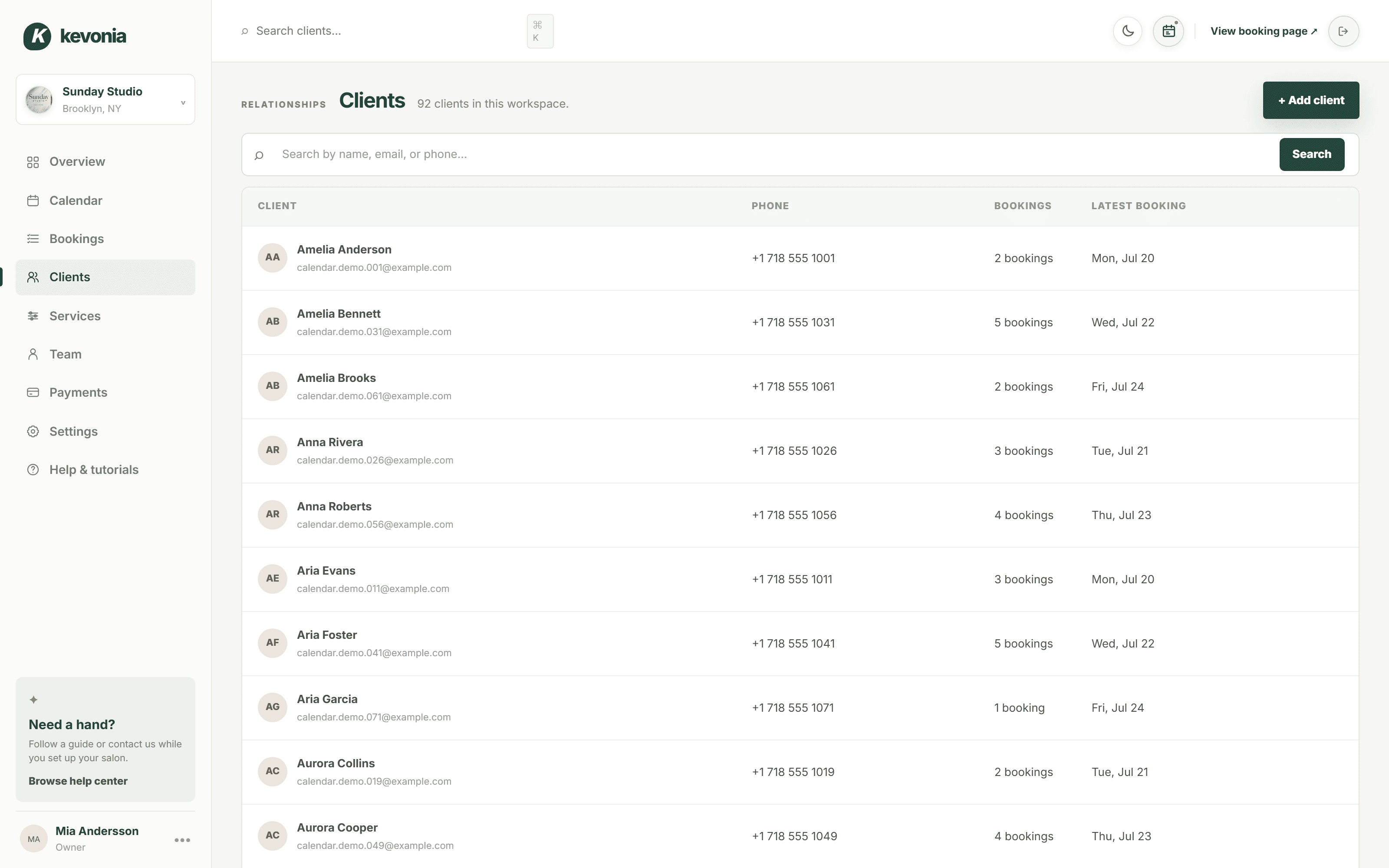
Kevonia is useful when the problem is not only processing the payment but proving what happened around the appointment. Kevonia combines a branded online booking page with a workspace containing a team calendar, client records, service menu, availability rules, and Stripe payments. That gives an owner one place to check the selected service, assigned professional, appointment time, client history, deposit or payment amount, and booking status before preparing a dispute response.
For prevention, Kevonia lets you set service duration, cleanup or buffer time, price, optional deposit, and per-professional assignment. Its availability rules include opening hours, breaks, time off, salon closures, booking windows, minimum notice, and time-slot intervals. Clients can reschedule or cancel from the reminder email within the salon’s notice window, and the salon can review cancellation history, restore a cancellation, or set a booking status such as awaiting payment, booked, checked in, completed, no-show, or canceled.
If you decide to refund, Kevonia lets the salon refund an online payment from the booking itself. The Stripe processing fee on the refund is shown so the real cost is visible, and the client is emailed automatically. Payments and deposits are handled through Stripe, with payouts going to the salon’s bank account. Kevonia does not decide whether a chargeback is won or lost; the card issuer makes that decision, and you still need to respond through the relevant payment process. For more detail, see Kevonia's online payment records.
Kevonia costs US$49.99 per month on one plan, with unlimited team members, bookings, clients, and services and no per-booking commission. The free trial lasts 7 days, requires no credit card to start, and you are never charged if you cancel before the trial ends. Those terms may matter if you are replacing disconnected booking, calendar, and payment processes while trying to improve your dispute records.
Kevonia is a fit for appointment-led businesses that want booking and payment records connected, including hair salons, barbershops, nail salons, day spas, med spas, esthetician and lash studios, tattoo studios, massage therapists, and wellness studios. It is not a retail or inventory POS, a marketing or SMS campaign platform, a native mobile app, or a multi-location management system from one account, so choose it for the workflow it actually supports.
Create a chargeback-ready salon record system
Do not wait for the first dispute to decide where records live. Create a repeatable case checklist and assign one person to monitor payment notifications. The owner or manager should be able to reconstruct the transaction without asking three staff members what happened weeks earlier. A consistent record also helps reveal whether the root problem is unclear deposits, staff overrides, duplicate payments, poor statement recognition, or a service-quality complaint.
- Payment: transaction amount, date, payment type, refund status, and processor reference.
- Booking: client, service, professional, appointment date and time, deposit terms, and booking status.
- Policy: the cancellation, refund, or deposit wording shown to the client at booking.
- Service outcome: checked-in, completed, no-show, canceled, rescheduled, or other documented status.
- Communication: confirmation, reminder, cancellation message, complaint, resolution, and refund explanation.
- Response: dispute reason, evidence submitted, submission date, deadline, and final outcome.
Review the record for consistency before submitting anything. If the booking says “completed” but the staff note says the client left before service, explain the difference. If the client canceled by phone, record the time and staff member who took the call. If a refund was promised but not processed, do not describe it as completed. Clear acknowledgment of a mistake is more credible than a response that conflicts with your own records.
Finally, review every lost or accepted dispute after it closes. Ask whether a clearer receipt, better statement name, different deposit wording, faster refund, stronger check-in record, or staff training would have prevented it. The purpose of a dispute review is not to blame an employee or client; it is to make the next transaction easier to understand and easier to prove.
Sources
Frequently asked questions
What should I do first when a salon payment is disputed?+
Open the payment notification, record the dispute reason and exact deadline, then match the transaction to the appointment. Check the client, service, professional, amount, deposit or balance, cancellation history, appointment status, refund history, policy, and communications. Decide whether the claim is valid before contacting the client or submitting evidence.
Can I refund a client after they file a chargeback?+
You may be able to refund the payment depending on the processor and dispute status, but a refund does not necessarily close an active chargeback. Record the refund and follow the processor’s instructions. If the dispute remains open, submit the refund proof or accept the dispute as directed. Do not assume the client withdrawing the complaint removes your obligation to respond.
What evidence helps fight a salon no-show chargeback?+
Use the policy shown at booking, the appointment date and time, the required cancellation notice, the time and method of any cancellation, reminder records, booking status, no-show history, and relevant client messages. Explain exactly how the disputed amount was calculated. If the policy was unclear or was not presented before payment, your defense is weaker.
What if a client says they do not recognize my salon charge?+
Check whether your statement descriptor matches the name clients know, then send or preserve the receipt, booking confirmation, client contact details, appointment information, and any message in which the client recognizes the payment. Ask politely whether a family member or another person made the booking. Still submit the formal response through your processor before the deadline.
Who decides whether a salon chargeback is won?+
The client’s card-issuing bank decides the outcome after reviewing the dispute and your response. Your processor, such as Stripe, provides the workflow and forwards evidence but does not control the issuer’s decision. You cannot guarantee a win, so prevention, clear policies, recognizable statements, receipts, and accurate appointment records are essential.
Does booking software automatically protect my salon from chargebacks?+
No. Booking software can make records and policies easier to manage, but it cannot guarantee that an issuer will reverse a chargeback. You still need to review each case, decide whether to accept or challenge it, and submit evidence through the payment processor. Kevonia can keep booking, client, service, appointment-status, deposit, and Stripe payment information connected for that investigation.
More from the blog

How to Close Your Salon for a Holiday Without Losing Clients
A holiday closure takes more than putting a note on the door. Use this practical checklist to protect appointments, payments, staff, and your first week back.

How to Take Deposits for Salon Appointments in 2026
A practical guide to choosing deposit amounts, writing your policy, collecting payment online, and handling cancellations, refunds, and no-shows.

PocketSuite Alternative: The Better Fit for Salon Teams
Looking for a PocketSuite alternative? Compare PocketSuite and Kevonia on pricing, payment fees, salon workflows, team scheduling, and booking limits.