How to Take Deposits for Salon Appointments in 2026
A practical guide to choosing deposit amounts, writing your policy, collecting payment online, and handling cancellations, refunds, and no-shows.

Key takeaways
- Set a deposit that protects your calendar without creating unnecessary friction for clients.
- Show the deposit amount, refund rules, cancellation deadline, and remaining balance before the client pays.
- Use one consistent process for collecting, recording, applying, refunding, and disputing deposits.
- Review deposit results by service and client behavior, then adjust the policy instead of applying the same rule blindly.
What you are really deciding when taking salon deposits
If you searched for how to take deposits for salon appointments, you probably do not need a complicated payments lecture. You need a workable answer to four questions: how much should you collect, when should you collect it, what happens if the client cancels, and how do you keep the process organized?
The best setup is simple for the client and predictable for your team. The client sees the appointment price, deposit amount, remaining balance, and cancellation terms before confirming. Your staff can see what was paid, apply it to the service, and follow the same policy whether the appointment is for a haircut, color correction, lash set, tattoo session, facial, or spa treatment.
Choose the right deposit model for your services
A deposit is money collected when the appointment is booked and credited toward the final service. It is not automatically a penalty. Whether you keep it after a cancellation depends on the terms you clearly disclosed and the situation that occurred. Start by choosing one of these models, then apply it consistently.
- Flat-dollar deposit: Charge a fixed amount, such as $25 or $50, for selected services. This is easy to explain and works well when many services have similar prices.
- Percentage deposit: Collect a percentage of the listed service price, such as 20% or 30%. This scales better when your menu includes both short, low-cost services and long, high-value services.
- Full prepayment: Collect the entire price at booking. This can suit prepaid packages, limited-availability appointments, or services that require substantial preparation, but it creates more refund and rescheduling expectations.
- Service-specific deposit: Require a deposit only for high-demand, long, or preparation-heavy services. For example, you might require one for bridal hair, color corrections, extensions, or multi-hour spa appointments but not for a quick bang trim.
- Client-specific deposit: Use a stronger requirement after repeated late cancellations or no-shows. If you do this, explain the requirement privately and document it so every team member understands the arrangement.
For many salons, a percentage or service-specific deposit is the most balanced starting point. A $25 deposit may be meaningful for a $60 service but too small to protect a four-hour appointment. On the other hand, a 50% deposit may feel excessive for a regular client booking a short, familiar service. Match the amount to the time your business is reserving, the preparation involved, and how difficult the slot is to refill.
Do not treat deposits as a substitute for a realistic schedule. If your calendar routinely has gaps because services run late, prices are unclear, or availability rules are too loose, collecting more money upfront will not solve the underlying problem. Review your service durations, cleanup time, breaks, and booking windows alongside your payment policy. For more detail, see Kevonia's salon reservation software.
Write a salon deposit policy clients can understand
Your salon deposit policy should answer the client’s practical questions before payment. Avoid vague language such as “deposits are nonrefundable under any circumstances” unless you have considered exceptions such as salon-initiated cancellations, emergencies, duplicate charges, or a service you cannot provide. A clear policy reduces arguments because the client knows what they agreed to.
- How much is due at booking?
- Is the deposit applied to the final service balance?
- What is the deadline for canceling or rescheduling without losing the deposit?
- How many times may the client reschedule?
- What happens if the client arrives late and the service cannot be completed?
- What happens after a no-show?
- Can the deposit be transferred to another person or service?
- When will the salon refund a deposit?
- How will a refund be issued?
- Who should the client contact about an exception?
Put the essential terms next to the booking confirmation and payment action, not only on a policy page hidden in your footer. If you collect a card for a future or recurring charge rather than a one-time appointment deposit, the disclosure and consent requirements can be different. The Federal Trade Commission advises businesses using recurring or negative-option billing to disclose material terms before enrollment and obtain proof of consent. That guidance is about recurring billing, but the broader operational lesson is useful for deposits too: show the important payment terms before the client commits. Supporting details are available from FTC guidance on recurring charges and cancellation.
Use plain language in the confirmation. For example: “A $40 deposit is required to reserve this appointment and will be applied to your service total. Cancel or reschedule at least 48 hours before the appointment to move the deposit to a new appointment. Cancellations within 48 hours and no-shows forfeit the deposit. If the salon cancels, the deposit will be refunded.” Have a local attorney review your final wording if you are unsure about state or local requirements.
Set the amount without losing good clients
The correct deposit is not necessarily the highest amount clients will tolerate. Think of it as a tradeoff between protecting revenue and preserving convenient booking. A deposit that is too low may not change no-show behavior. A deposit that is too high can discourage first-time clients, especially when the final price is variable or the appointment is several weeks away.
Use your own appointment data to choose a starting point. Look at the average price, duration, preparation cost, and historical cancellation rate for each service category. If a three-hour color appointment produces a $300 average ticket and is difficult to refill on short notice, a percentage deposit may make more sense than the same flat amount used for a 30-minute service.
- Group services by risk: short and easy to refill, long and difficult to refill, or preparation-heavy.
- Choose a flat amount or percentage for each group.
- Set the cancellation deadline based on how much notice you need to offer the slot again.
- Test the policy for several weeks without changing multiple variables at once.
- Compare completed appointments, late cancellations, no-shows, refund requests, and complaints.
- Adjust the deposit or deadline where the numbers show a problem.
Consider a more flexible rule for established clients with a reliable attendance history and a stricter rule for new clients booking high-value services. Avoid making exceptions casually at the front desk. A generous exception may be appropriate, but record what happened and whether the deposit was retained, transferred, or refunded so your books and team communication stay accurate.
How to take deposits for salon appointments step by step
Once the policy is decided, the collection workflow should take place during booking rather than through a separate manual request. Manual invoicing, text-message payment links, and handwritten notes create extra opportunities for missed payments, double bookings, and disagreements about what was promised.
- Build an accurate service menu. Add the service name, price or starting price, duration, cleanup or buffer time, and the professional who can perform it.
- Choose which services require a deposit. Do not automatically add a deposit to every service unless your business model genuinely calls for it.
- Set the deposit amount. Use a flat amount or percentage that is easy for clients and staff to understand.
- Publish your policy before payment. State the deposit, how it is applied, the cancellation deadline, the no-show rule, and the refund or transfer process.
- Require payment before holding the appointment. The booking should not be considered confirmed merely because a client entered contact information or requested a slot.
- Send a confirmation showing the appointment details and payment status. The client should be able to identify the service, professional, date, time, deposit, and remaining balance.
- Record changes against the original appointment. If the client reschedules, transfer or refund the deposit according to the policy instead of creating an unexplained second transaction.
- Reconcile payments regularly. Compare the calendar, payment records, refunds, and completed services so unpaid balances and duplicate entries are found quickly.
A card payment processor can help collect the money, but it does not decide your business policy. Stripe explains that successful payments can later be fully or partially refunded, while refunds depend on available balance and may take time to appear for the customer. Build that reality into your communication rather than promising that every refund will arrive immediately. Supporting details are available from Stripe’s refund and cancellation documentation.
For in-person appointments, decide whether the deposit is collected online and the balance is paid at the salon, or whether the client prepays everything. If the final service price can change after consultation, collecting a deposit and charging the balance after the service is often easier to explain. If the price is fixed and the appointment is highly specialized, full prepayment may be operationally simpler.
Where Kevonia fits into the deposit workflow
Kevonia is designed for salons and spas that want deposits connected to the appointment-booking process. Its branded online booking page lets a client choose a service, professional, date, and time. In the service menu, you can set the duration, cleanup or buffer time, price, optional deposit, and professional assignment.
That connection matters because the deposit is tied to the service the client selected instead of being handled as a separate administrative task. Kevonia also provides a week and day team calendar with per-professional filters and color coding. Its double-booking protection checks hours, breaks, time off, and existing bookings before availability is offered, which helps prevent the common problem of collecting a deposit for a slot your team cannot actually honor.
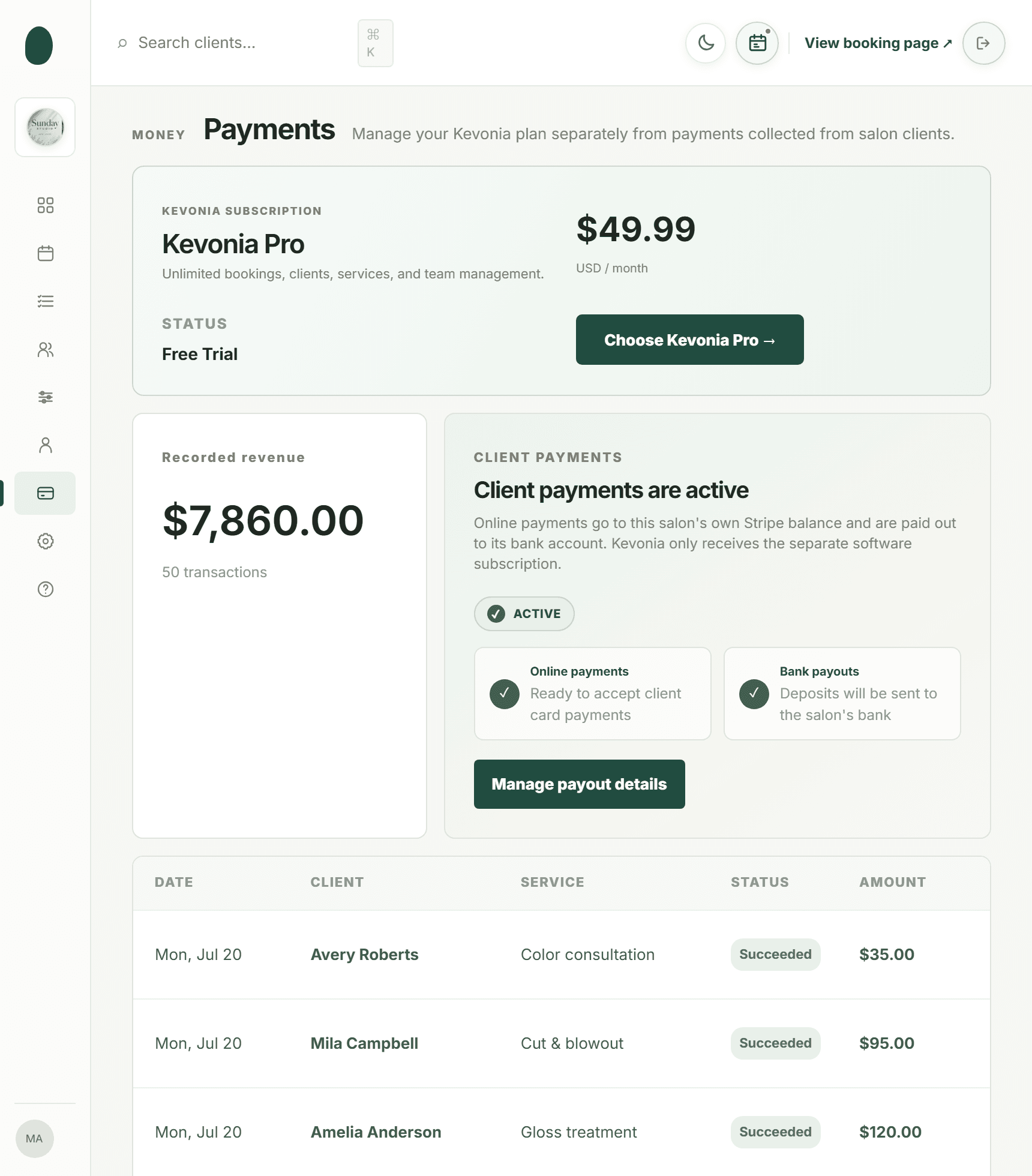
Payments and deposits are handled through Stripe, with payouts going to the salon’s bank account. Kevonia also keeps client records with search, private notes, and visit history, so your team can review relevant context before deciding how to handle a repeated late cancellation or a requested exception. The system includes a day-before email reminder, and clients can reschedule or cancel from that email within the salon’s notice window.
Kevonia is not a replacement for your written policy or judgment. You still decide which services require deposits, how much to collect, and when to make an exception. Its role is to put the service menu, availability rules, booking record, client information, and Stripe payment in one workspace. Kevonia has one plan at $49.99 per month, with unlimited team members, bookings, clients, and services, no per-booking commission, and a free 14-day trial with no credit card required to start. For more detail, see Kevonia's salon management software.
Handle cancellations, rescheduling, refunds, and no-shows
A deposit policy is tested when an appointment changes. Decide in advance which outcome applies to each situation, then use the same labels and actions in your booking and payment records. The goal is to avoid both extremes: giving away every deposit and creating an unnecessarily hostile experience for clients who provide reasonable notice.
- Early cancellation: Refund the deposit or leave it as a credit if your policy allows either option.
- On-time rescheduling: Transfer the deposit to one new appointment within a defined period, such as 30 days.
- Late cancellation: Retain the deposit when the client cancels inside the stated notice window, unless you choose to make an exception.
- No-show: Mark the appointment as a no-show, retain the deposit if that is your stated rule, and decide whether the client must prepay future bookings.
- Salon cancellation: Offer a full refund or a clearly communicated alternative. Do not make clients absorb the cost of a cancellation caused by your business.
- Service change: If the client changes to a lower-priced service, explain whether the deposit remains the same, is reduced, or becomes a credit.
- Late arrival: State whether the service may be shortened, modified, or canceled when the client arrives too late to complete it.
Keep an internal note for every exception: what happened, who approved it, what amount was retained or refunded, and whether the client may book under the normal policy next time. This is especially important when several professionals share a calendar. A clear record prevents one team member from promising a refund that another team member cannot verify.
If a client disputes a card charge, respond promptly through your payment provider and gather the booking confirmation, policy shown at checkout, cancellation history, appointment communications, and proof that the service was delivered or available. Stripe notes that a dispute can reverse the payment and fee from the account balance, and that failing to respond before the deadline can result in losing the dispute automatically. Supporting details are available from Stripe’s dispute-response guidance.
Common deposit mistakes that create complaints
Most deposit problems are process problems, not payment-technology problems. A client is more likely to complain when the price changed, the policy was hard to find, the deposit was applied incorrectly, or staff members gave different answers.
- Collecting a deposit without showing the cancellation deadline.
- Calling a deposit nonrefundable but failing to explain what happens when the salon cancels.
- Using one flat deposit for every service despite large differences in price and duration.
- Accepting a booking before payment clears, then discovering the card failed.
- Taking a second deposit when a client reschedules instead of transferring the first one.
- Keeping a deposit after moving the appointment to a time that the salon later cancels.
- Allowing staff to invent exceptions without recording them.
- Charging the full balance when the deposit was already applied.
- Promising an instant refund when the processor or bank may take several business days.
- Taking card details for future charges without separately explaining what will be charged and when.
Also avoid using vague terms such as “last-minute” or “reasonable notice.” Replace them with a specific deadline tied to the appointment time. “Cancel by 2:00 p.m. on Wednesday for a Friday 2:00 p.m. appointment” is easier to apply than “give us enough notice.” If your policy differs by service, show the relevant rule for that service rather than forcing clients to interpret a long general policy.
A practical launch checklist for your salon
Before turning on deposits, test the complete client journey yourself. Book from the same type of device your clients use, select each deposit-required service, cancel inside and outside the notice window, reschedule an appointment, and confirm that the payment and calendar records match the policy.
- List the services that need deposits and the reason for each requirement.
- Choose a flat amount or percentage for every deposit-required service.
- Write the policy in plain language and have the owner or manager approve it.
- Confirm the policy appears before the client completes payment.
- Connect and test the payment account.
- Verify that a failed payment does not leave an apparently confirmed appointment.
- Decide how early cancellations, late cancellations, no-shows, salon cancellations, and reschedules are recorded.
- Train every team member to find the payment status and policy.
- Create a short exception process for emergencies and salon-caused changes.
- Review results after 30 days and adjust only where the evidence shows a problem.
If you are moving from phone-only bookings to online deposits, introduce the change clearly. Tell regular clients what is changing, which services are affected, and how the deposit is applied. A short explanation at checkout and in the appointment confirmation is usually more effective than a long announcement that clients may never read.
The most useful measure is not simply how much deposit money you kept. Track whether completed bookings increase, whether no-shows decrease, whether staff spend less time chasing confirmations, and whether good clients experience more friction. A deposit system is working when it protects valuable appointment time while remaining understandable and fair.
Sources
Frequently asked questions
What is a reasonable deposit for a salon appointment?+
There is no universal amount. Start with a flat amount or percentage that reflects the appointment’s price, duration, preparation, and difficulty of refilling the slot. A short service may need a small flat deposit, while a multi-hour color, bridal, extension, tattoo, or spa appointment may justify a percentage or larger amount. Review cancellations and complaints after several weeks, then adjust by service instead of applying one amount to everything.
Should salon deposits be refundable?+
That is a business-policy decision, but the rule should be clear before payment. Many salons refund or transfer a deposit when the client gives notice before the stated deadline, retain it for late cancellations and no-shows, and refund it when the salon cancels. Consider reasonable exceptions for emergencies, duplicate charges, or situations where the salon cannot provide the booked service. Make sure staff record each exception.
Can I take a deposit without booking software?+
Yes, but the process is easier to get wrong. You can collect a payment manually and record it in a calendar or spreadsheet, but you must connect the payment to the correct client, service, professional, appointment, and remaining balance. You also need a reliable way to handle failed payments, reschedules, refunds, and duplicate bookings. Booking software reduces manual steps by keeping appointment and payment information together.
Should I charge a deposit for every salon service?+
Not necessarily. Deposits are most useful for appointments that are expensive, long, preparation-heavy, in high demand, or difficult to refill after a cancellation. Requiring one for every quick service may create unnecessary friction for reliable repeat clients. A service-specific setup often gives you better protection while keeping routine bookings convenient.
How do I handle a client who reschedules after paying a deposit?+
Follow the rule you showed at booking. A common approach is to transfer the deposit once to a new appointment when the client gives notice, with a deadline for using the credit. For a late reschedule, you may retain the deposit and require a new one, but explain that before the client pays. Record the original payment and the new appointment so the client is not charged twice by mistake.
How does Kevonia help with salon appointment deposits?+
Kevonia lets you set an optional deposit in the service menu while clients book through a branded online booking page. It combines the service, professional, date, time, availability rules, appointment record, and Stripe payment in one workspace. It also includes team calendar views, client records, double-booking protection, cancellation history, and a day-before email reminder. You still decide the deposit amount and policy.
More from the blog

How to Close Your Salon for a Holiday Without Losing Clients
A holiday closure takes more than putting a note on the door. Use this practical checklist to protect appointments, payments, staff, and your first week back.

Using Google Calendar for Salon Bookings: Where It Works and Where It Breaks
Google Calendar can handle simple appointment scheduling, but salons often outgrow it when they need services, staff rules, deposits, reminders, and client records in one place.

Free Salon Consultation Appointments That Lead to Bookings
A free consultation should clarify the client’s goal, confirm what is safe and realistic, and make the next booking easy. Here is how to structure one without losing valuable appointment time.