Free Salon Consultation Appointments That Lead to Bookings
A free consultation should clarify the client’s goal, confirm what is safe and realistic, and make the next booking easy. Here is how to structure one without losing valuable appointment time.

Key takeaways
- Offer free consultations when they reduce risk or uncertainty, not automatically for every service.
- Separate consultation, patch-test, and paid-service time so clients know exactly what they are booking.
- Collect enough information before the appointment to make the conversation useful and protect your schedule.
- Use clear service options, availability rules, reminders, deposits, and client records to turn consultations into completed bookings.
What people mean by “free consultation appointments salon”
When someone searches for free consultation appointments salon, they usually want to know two things: whether a salon will speak with them before they commit to a major service, and how the salon can offer that conversation without creating a chaotic schedule. For an owner, the challenge is not simply making consultations free. It is deciding what the appointment includes, who needs one, how long it takes, and what happens afterward.
A useful free consultation is a short decision-making appointment. The client should leave knowing what service is appropriate, what result is realistic, how much time the service may require, what preparation is needed, and how to book the next step. The salon should leave with enough information to quote accurately, identify contraindications, assign the right professional, and avoid reserving a long service block for a client who is not ready.
Decide which services need a consultation
Do not put a free consultation in front of every service. A quick trim or routine manicure may need only the normal booking questions. A color correction, extension installation, major haircut change, chemical treatment, tattoo concept, or first-time skin treatment may justify a separate conversation because the outcome depends on history, condition, design, or safety information. For more detail, see Kevonia's hair salon booking software.
Create a clear rule for each service. For example, a first-time blonding client may need a consultation before a four-hour service, while a returning client with an established formula may book the color service directly. A new lash client may need a consultation if there is a history of irritation, while a regular fill may not. The rule should depend on risk and complexity, not on whether the client sounds uncertain in a message.
- Require a consultation before a major color change, color correction, extensions, or a service involving significant chemical processing.
- Offer an optional consultation when the client knows the service but wants help choosing a length, shape, treatment, or finish.
- Skip a separate consultation for repeat services with a documented formula, established timing, and no material change in the client’s goal.
- Create a separate safety or test appointment when the service requires information or testing that cannot be completed during the consultation.
A consultation is not a promise that the requested result is possible. It is the point where the professional can say, “That result may require two visits,” “Your current condition limits what we should do today,” or “This is the safer service for your goal.” Put that expectation in the service description so clients do not interpret a free conversation as a guarantee. We cover this in more depth in service descriptions.
Build a consultation menu clients can understand
A vague listing called “Free Consultation” creates unnecessary back-and-forth. Name the decision the appointment supports. Better options include “New Color Plan Consultation,” “Extension Method Consultation,” “Skin Treatment Consultation,” or “Tattoo Design Consultation.” The title should tell the client whether they are discussing a service, a design, a treatment plan, or a test requirement.
Set a realistic duration. Fifteen minutes may be enough for a focused color-history review or a simple service recommendation. Thirty minutes may be more appropriate for a transformation, extension match, detailed tattoo concept, or treatment plan. Do not choose a short duration merely because the appointment is free. If the professional routinely runs over, the consultation is consuming time that was never protected on the calendar. For more detail, see Kevonia's salon reservation software.
- State who the appointment is for, such as new clients, major changes, or clients unsure which service to select.
- State what the professional will review: goals, current condition, previous work, maintenance expectations, timing, and estimated cost.
- State what is not included, such as the actual haircut, color application, treatment, tattooing, or product purchase.
- State whether the client can book the service immediately afterward or must schedule a separate appointment.
- State whether a deposit is required for the future service, and explain when that deposit is applied or refunded under your policy.
If you offer consultations for color, include a direct path to a colour consultation appointment rather than asking clients to describe everything in a general contact form. If a consultation may lead to a color service, tell clients to bring photos of their target result and disclose box color, henna, relaxers, bleach, keratin treatments, or other recent chemical work. Those details can change the recommendation and the time needed.
Separate consultation, testing, and treatment time
One of the most common scheduling mistakes is treating a consultation as if it automatically completes every required step. It does not. A consultation may identify the need for a strand test, patch test, design approval, medical-history discussion, or additional preparation. If that step needs its own timing, book it as its own appointment or build it into a clearly described service.
For hair dye services, the FDA advises following product warnings and performing a patch test before dyeing; its consumer guidance specifically says salons should also do the test. That means a client who books a free consultation may still need a separate patch test appointment before the color service, depending on your products, professional guidance, and applicable state or local requirements. Do not tell a client that a consultation or a previous test automatically covers every future formula. (fda.gov)
Make the distinction visible in the booking flow. A listing might say: “This is a 20-minute planning appointment. It does not include color application. If your stylist requires a test, you will be scheduled for that step before the service.” This prevents the client from arriving expecting a transformation and gives the professional permission to stop when a safety requirement has not been met.
- Consultation: discuss goals, history, options, maintenance, timing, and estimated price.
- Patch or strand test: perform the specific test required by your products and professional procedure, then record the result.
- Service appointment: complete the agreed treatment only if the consultation and required tests support proceeding.
- Follow-up: document the formula, result, client feedback, and any change needed for the next visit.
The test step is also where the usual “free consultation” advice can be wrong. If a client has a previous reaction, unexplained scalp irritation, or a medical concern, the correct next step may be to postpone the service and refer the client to a qualified healthcare professional rather than trying to solve the issue during a complimentary salon appointment. A negative past experience should be documented, not brushed aside because the client says a different product was used.
Collect useful information before the client arrives
A consultation is only as useful as the information available to the professional. Ask a small number of high-value questions during booking instead of sending a long questionnaire that clients will abandon. The goal is to identify complexity before the appointment, not to make a diagnosis or promise an outcome online.
- What would you like to change, and what would you like to keep?
- What have you had done to your hair, skin, nails, lashes, or tattoo area recently?
- When was the last chemical, corrective, or intensive service?
- Do you have a reference photo, and what do you like about it?
- Is there a deadline, event, budget range, or maintenance limit the professional should know?
- Have you experienced a previous reaction, sensitivity, or unexpected result from a related service?
Ask for photos only when they will improve preparation. For a color correction, current photos in natural light may help the stylist decide whether to reserve a consultation, a test, or a longer service. For tattoo work, a reference image can clarify style but should not be treated as a final design. For skin services, photos may be inappropriate or insufficient; follow your professional scope, privacy practices, and local requirements.
Record the client’s answers in a private client record rather than leaving them in scattered text messages. Notes should be factual and useful: previous formula, test result, relevant service history, agreed goal, estimated process, and follow-up instruction. Avoid unnecessary sensitive information. A record is meant to improve continuity and decision-making, not become a place for speculation.
Protect the time without making the consultation feel like a trap
Free does not have to mean unlimited, instant, or unstructured. Publish the consultation duration, the cancellation notice window, and what happens if the client is late. A client who arrives 15 minutes late to a 20-minute consultation may have left too little time for a responsible recommendation. Rescheduling can be more professional than rushing the conversation.
Consider a deposit only when the consultation requires a valuable time block, specialist preparation, or a high rate of missed appointments. If you collect one, explain the policy in plain language: whether it is applied to the future service, forfeited after a late cancellation, or refunded if the salon determines that the requested service should not proceed. Calling an appointment “free” while quietly charging an unexplained fee damages trust.
Online payments can make deposits easier to manage, but they do not replace a clear policy. Stripe’s documentation explains that refunds return to the original payment method, and a refund can remain pending if the available balance does not cover it. Build your client-facing policy around what your payment setup and local rules actually allow, and make the refund timing understandable before the client books. (docs.stripe.com)
- Use a short appointment type for simple decisions and a longer one for transformations.
- Keep a small number of consultation slots open each week instead of allowing them to consume every prime hour.
- Use a waitlist or alternate slot when a client cannot attend, rather than squeezing the consultation into an active service.
- Send the client the next action in writing: book, test, send information, wait, or do not proceed.
- Review missed consultations separately from missed paid services; the causes and policies may be different.
Where Kevonia fits for consultation-based salons
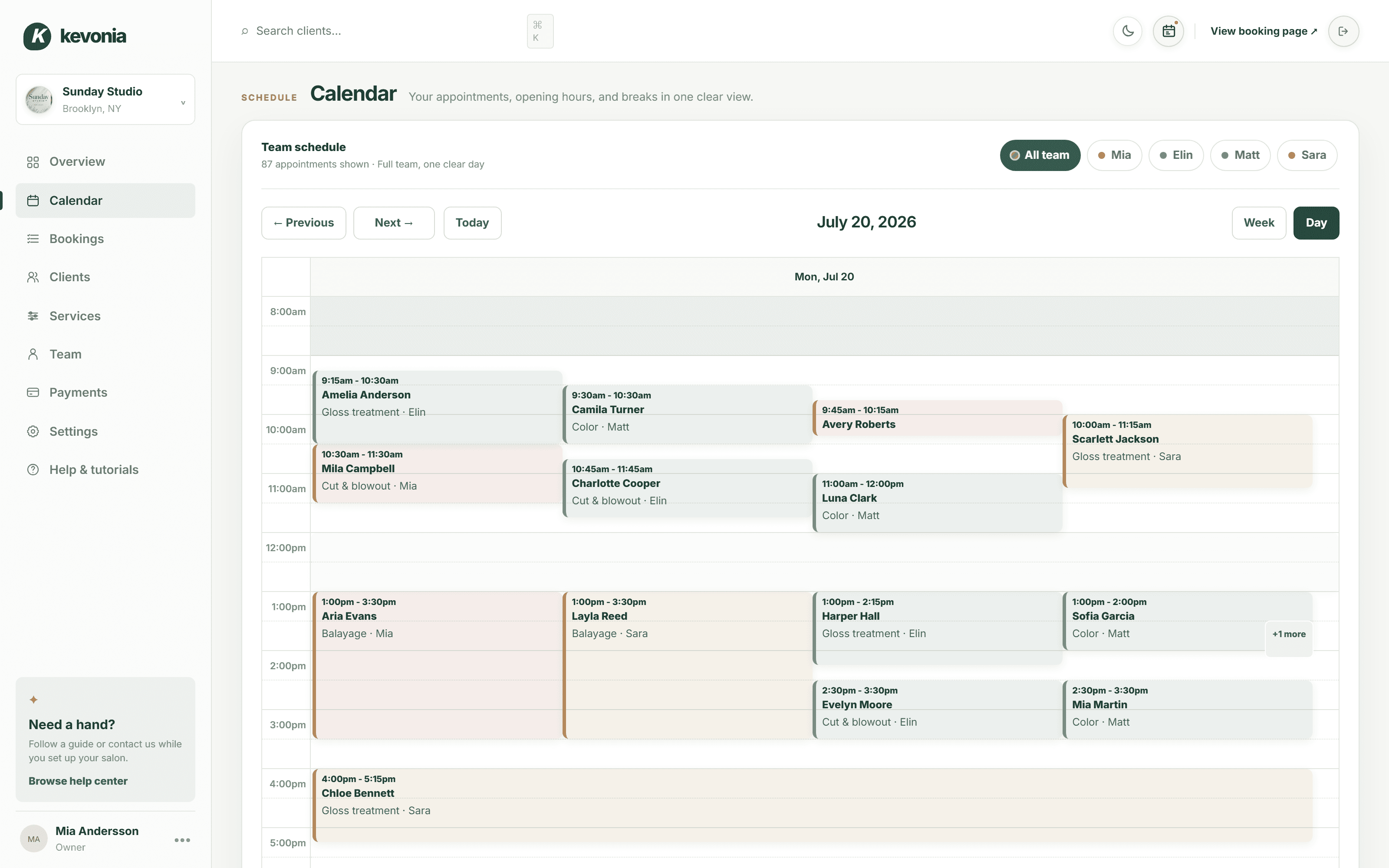
Kevonia fits a salon or spa that wants consultations to be bookable online without managing the entire process through phone calls and direct messages. Its branded booking page lets clients choose a service, professional, date, and time, while the workspace gives the team a calendar, service menu, availability rules, and client records. That is useful when different professionals handle different consultation types or when consultation slots must be limited by working hours, breaks, time off, and salon closures.
For a consultation workflow, set up each consultation as its own service with a duration, price, optional deposit, and assigned professionals. You can then create separate entries for a color plan, extension discussion, patch test, or treatment assessment instead of sending every inquiry into one generic calendar slot. Kevonia’s double-booking protection checks availability against hours, breaks, time off, and existing bookings, which helps when a consultation and a later service compete for the same professional’s time. For more detail, see Kevonia's esthetician scheduling software.
After the appointment, save the consultation notes and visit history on the client record, then update the booking status so the team can distinguish a completed consultation from an unconfirmed inquiry or a no-show. Kevonia also sends an automatic email reminder the day before an appointment and lets clients reschedule or cancel from that email within the salon’s notice window. For a business that offers free consultation appointments salon-wide, that combination keeps the process visible without requiring a separate spreadsheet for each professional.
Kevonia is not a marketing campaign platform, retail or inventory POS, native mobile app, or multi-location management system from one account. Its role here is narrower and practical: provide the booking page, calendar, service configuration, client records, availability controls, and Stripe card payments or deposits needed to schedule the consultation and the service that follows. The plan is US$49.99 per month, with unlimited team members, bookings, clients, and services, and there is a free 14-day trial with no credit card required to start; cancel before the trial ends and you are never charged.
Turn the conversation into a clear next step
The consultation should end with a decision, not a vague “we’ll be in touch.” Before the client leaves, summarize the recommended service, the expected duration, the likely price range or quote process, the preparation required, and the earliest realistic appointment. If the client is not ready, give them a written summary and tell them what information they need before booking.
- Book the recommended service while the client is present if the schedule and policy allow.
- Book a required test or second consultation before accepting the main service.
- Offer a lower-risk or lower-maintenance alternative when the original request is unsuitable.
- Decline the service when the professional cannot safely or responsibly provide it.
- Set a follow-up task only when someone on the team is actually responsible for contacting the client.
Do not convert every consultation into a sales pitch. A professional recommendation may be to wait, repair, grow out, remove previous product, consult a healthcare professional, or choose a different service. Clients are more likely to trust future recommendations when the salon shows that the consultation is for suitability and planning, not simply for filling the next open slot.
Measure the outcome with a few operational numbers: consultations booked, consultations completed, services booked within seven days, average time from consultation to service, cancellations, no-shows, and the percentage that required an additional test or second visit. Compare by consultation type and professional. A low conversion rate may mean the offer is attracting the wrong clients, the service description is unclear, the quote is too uncertain, or the next booking step is too difficult.
Common failure cases to plan for
A good consultation system includes the awkward cases. A client may request a celebrity photo that conflicts with their current hair history. A client may want a same-day transformation after a test has not been completed. A regular client may book a consultation with the wrong professional. A stylist may call in sick before the consultation. A client may book several free consultations at different salons and never respond afterward.
- If the requested result is unrealistic, explain the gap in terms of time, condition, maintenance, cost, or number of visits.
- If the required test is incomplete, do not let a full service proceed merely because the client traveled a long way.
- If the wrong professional is booked, move the appointment with the client’s permission and preserve the notes rather than starting over.
- If the professional is unavailable, offer a qualified replacement only when that person can review the service type and has appropriate expertise.
- If consultation abuse becomes a pattern, limit the number of complimentary appointments per client or require a deposit for future bookings.
A consultation policy should also explain whether the salon keeps inspiration photos, how long notes are retained, and who can access them. Keep records professional and avoid writing labels that could embarrass the client if they later request access. The safest record is one that another qualified team member can understand and use without guessing what the original professional meant.
The practical test is simple: can a new team member look at the booking, the service description, the client record, and the consultation outcome and know what happens next? If not, the salon is offering a conversation, not a repeatable consultation process.
Sources
Frequently asked questions
Should a salon charge for a consultation?+
Not always. A free consultation works well when it helps the client choose the right service and the appointment is short, clearly limited, and scheduled during protected consultation time. Charge, or require a deposit, when the appointment requires significant preparation, specialist planning, a long time block, or when missed consultations are creating a measurable cost. If you call it free, disclose any deposit and exactly how it is handled.
How long should a free salon consultation appointment be?+
Use the shortest duration that allows a responsible decision. Fifteen minutes may suit a focused repeat-client question or simple service selection. Twenty to thirty minutes is more realistic for a transformation, color history, extensions, tattoo concept, or treatment plan. Track how often the professional runs over and adjust the appointment length instead of allowing repeated schedule overruns.
Is a consultation the same as a patch test appointment booking?+
No. A consultation reviews the client’s goal, history, options, timing, and expected result. A patch test or other required test is a separate safety step unless your documented procedure specifically combines it with the consultation. For hair dye, follow product instructions and professional guidance; the FDA advises patch testing before dyeing and says salons should also perform the test.
What should a client bring to a salon consultation?+
Ask for a few useful items: reference photos, a realistic budget or maintenance preference, details of recent chemical or corrective services, and information about prior reactions or sensitivities. For color or extensions, current photos in natural light can help. Do not promise that photos alone are enough to approve a service; the professional still needs to assess the client in person.
How do I stop free consultations from taking over my salon calendar?+
Create separate consultation services with fixed durations, assigned professionals, and limited availability. Reserve specific consultation blocks instead of opening every hour. State what the appointment includes and excludes, use reminders, and require a deposit when the time block is valuable or the client has a history of missing appointments. Review completed consultations and conversion by type so you can remove or redesign low-value appointment types.
Can Kevonia schedule consultations and the service afterward?+
Yes. You can configure consultation types as services with durations, optional deposits, prices, and professional assignments. Kevonia provides a branded online booking page, team calendar, client records, availability rules, Stripe card payments and deposits, and an automatic email reminder the day before an appointment. The consultation and the follow-up service should still be separate bookings when they require different timing or safety steps.
More from the blog

Free Salon Booking Software: What to Choose in 2026
Free booking tools can be useful, but limits and payment fees matter. Compare the leading options and see when a predictable paid system makes more sense.

Why Clients Don’t Finish Booking Online: 9 Fixes
Clients may want the appointment but still abandon the booking page. Learn how to find the friction, fix the biggest problems, and recover more completed bookings.

How to Write Salon Service Descriptions That Get Booked
A practical guide to writing salon service descriptions that make clients feel confident, choose the right appointment, and book without calling your front desk.