Tattoo Deposit Policy: Set Rules Clients Can Follow
A tattoo deposit policy should protect booked time without creating avoidable disputes. Use this framework to set deposits, explain exceptions, and enforce the rules consistently.

Key takeaways
- Set the deposit according to the time and preparation you are protecting, not an arbitrary percentage.
- Spell out the deadline, reschedule limit, late-arrival rule, refund terms, and studio-cancellation rule before payment.
- Use a written acknowledgment and keep the booking, payment, reminder, and client communication together.
- Make reasonable exceptions for illness or emergencies without letting exceptions become an unwritten second policy.
- Kevonia connects optional service deposits, online booking, Stripe payments, reminders, and client records in one workspace.
What should a tattoo deposit policy say?
A tattoo deposit policy should tell a client exactly what payment secures, how much is due, when it can be moved, and when it is forfeited. It should also explain what happens if the artist or studio cancels. The short answer is usually: the deposit holds a specific appointment, is applied to the final tattoo price if the appointment goes ahead, and is kept after a late cancellation or no-show when the client has accepted those terms.
Do not bury the rules in an Instagram message after the client has paid. Show them before payment, require an affirmative acknowledgment, and send the same wording in the confirmation. A clear policy is not only friendlier; it gives your team one standard answer when a client calls from the parking lot saying they are 25 minutes late. Supporting details are available from written acknowledgment.
Choose the deposit amount without guessing
There is no universal deposit amount that fits every tattoo studio. A small appointment with little design work may need a modest fixed amount. A full-day booking, custom drawing, or multi-session project exposes the artist to more lost time, so the deposit may need to be higher. Ask what you are actually protecting: the reserved chair time, consultation and drawing work, supplies already ordered, or the difficulty of filling the slot at short notice.
For owners asking how much deposit for a tattoo, use a simple decision rule: the deposit should be meaningful enough to secure commitment but not so large that it looks like the entire service price before any tattoo is delivered. A fixed amount is easy for clients to understand. A percentage can work when service prices vary widely, but state whether the percentage is based on the estimate, the minimum charge, or the expected final balance.
- Fixed amount for standard appointments with predictable preparation.
- Higher fixed amount or staged payments for long sessions and multi-session work.
- A separate design fee when substantial drawing time is provided before the appointment, if your agreement explains whether that fee is refundable or credited.
- No deposit rule for walk-ins only when the walk-in process is genuinely separate from reserved appointments.
Do not call every upfront payment a deposit if it will never be credited toward the tattoo. If a payment compensates the artist for design work or reserves time but is not applied to the final balance, name that purpose plainly. Confusing a booking deposit with a design fee is a common source of arguments because the client may believe the full amount will be deducted later.
Write the rules clients actually need
A tattoo booking deposit should be tied to one client, one project, one artist, and one appointment or appointment series. Your wording can be firm without sounding hostile. State the operational details a client needs before paying, then apply them the same way across your team.
- Purpose: explain that the payment reserves time and is credited to the final tattoo balance when the agreed service is completed.
- Notice window: name the exact deadline for cancellation or rescheduling, such as 24, 48, or 72 hours before the appointment.
- Approved contact method: say whether clients must use the booking link, phone, email, or front desk. Do not make social-media direct messages the only official route.
- Rescheduling: state how many times the deposit can move, how far out the new appointment may be booked, and whether the same artist and project must remain attached.
- Late arrival: explain when the session may be shortened, rescheduled, or treated as missed. Include an instruction to call as soon as the client knows they will be late.
- No-show and late cancellation: state whether the deposit is forfeited and whether a new deposit is required to book again.
- Project changes: explain what counts as a minor adjustment versus a new concept, new placement, or substantially different size.
- Refunds: say when a payment is refundable, transferable, credited, or forfeited.
- Studio cancellation: promise a clear remedy if the artist or studio cannot provide the appointment, such as a transfer to a new date or a refund.
- Acknowledgment: require the client to confirm that they read and accepted the policy before submitting payment.
A tattoo studio deposit policy should also cover the awkward cases: the client arrives without required identification, arrives intoxicated or unwell, changes the design completely at the appointment, or cannot be tattooed safely because of a condition disclosed that day. The rule should not be “the deposit is always lost.” Explain which situations may require owner judgment and how the client should contact you.
Set a fair exception process
Picture a Saturday with two tattoo appointments, a fully booked calendar, and one client who wakes up sick. Treating that client exactly like a no-show may protect the letter of the policy while damaging a relationship and encouraging them to attend when they should stay home. Your policy can preserve the deposit for ordinary last-minute changes while allowing an owner-approved exception for illness, emergencies, unsafe travel, or a studio error.
The key is to define discretion before you need it. For example, say that exceptions are considered individually, are not automatic, and do not create a guarantee for future appointments. Record the reason, the decision, and any new deadline. If you waive a forfeiture, move the deposit once and write the new appointment date. Do not rely on memory or a private conversation between one artist and the client. For more detail, see Kevonia's salon reservation software.
Artist cancellations need their own rule. If your studio cancels, the client did not breach the agreement, so keeping the deposit without offering a meaningful remedy can create a preventable dispute. Give the client a choice between transferring the payment to a suitable replacement appointment or receiving a refund, subject to the agreement and applicable law.
Make the policy visible and enforceable
A policy is only useful if the client can see it before paying and your team can prove what was accepted. Put the full wording beside the payment button, not only in a footer. Repeat the key terms in the booking confirmation and reminder. The payment record should identify the client, appointment, amount, service, and policy version or acknowledgment.
- Use a required checkbox or equivalent acknowledgment before payment.
- Save the date and time of the acknowledgment, not just a screenshot of the policy page.
- Keep cancellation requests and rescheduling decisions with the booking record.
- Send a reminder early enough for the client to act before the cutoff.
- Train every artist and front-desk worker to use the same notice window and exception language.
- Do not edit an accepted policy after a dispute. Store the version that applied when the payment was made.
This is where many studios stop too soon. They collect a deposit but do not preserve the surrounding evidence. If a client later says the payment was unauthorized or the terms were hidden, a processor may need more than the charge itself. Stripe explains that businesses responding to disputes should gather relevant transaction and policy evidence, and a refund initiated by the business is different from a chargeback initiated through the customer’s bank.
Where Kevonia fits for tattoo studios
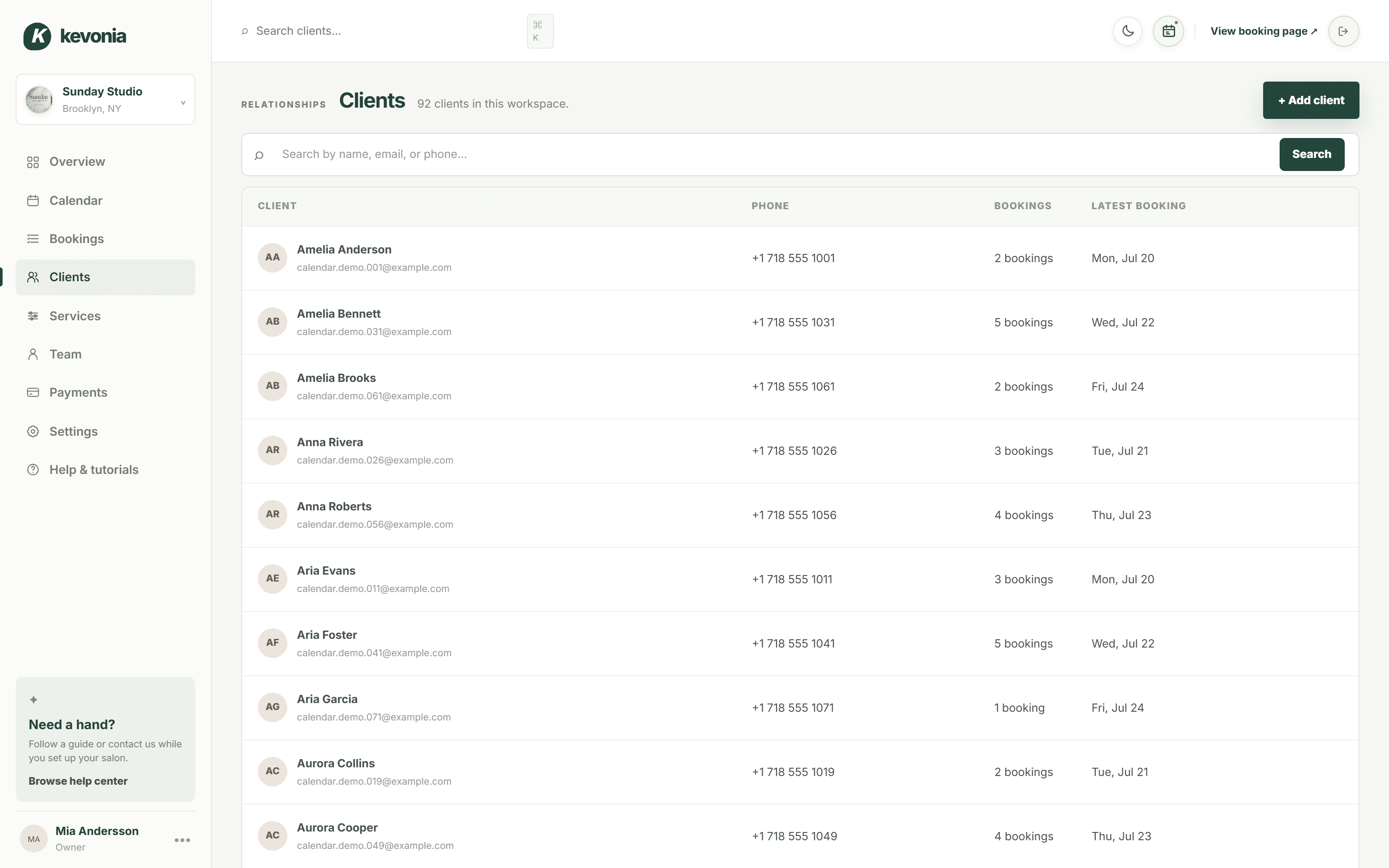
Kevonia fits when you want the policy connected to the booking process instead of managed across messages, spreadsheets, and separate payment notes. On a service, you can set a duration, cleanup or buffer time, price, assigned professional, and optional deposit. Clients use a branded online booking page to choose the service, professional, date, and time. For more detail, see Kevonia's tattoo booking software.
Payments and deposits are handled through Stripe, with payouts going to the salon or studio’s bank account. Kevonia also checks availability against hours, breaks, time off, and existing bookings, which matters when a long tattoo appointment could otherwise collide with another booking. The day-before email reminder gives the client a chance to reschedule or cancel within your notice window.
When a client cancels, you can see the booking status and cancellation history, and the salon can refund an online payment from the booking itself. Kevonia shows the Stripe processing fee on a refund so the real cost is visible, and the client is emailed automatically. Client records keep private notes and visit history together, which gives an owner a place to document an exception or repeated no-shows.
The practical difference is control without adding a separate deposit spreadsheet. You still decide the notice window, service rules, exceptions, and when a deposit is appropriate. Kevonia provides one plan at US$49.99 per month with unlimited team members, bookings, clients, and services, plus a free 7-day trial with no credit card required to start. Cancel before the trial ends and you are never charged.
Common mistakes that turn deposits into disputes
The usual advice is to make deposits nonrefundable, but that is not a complete operating policy. The harder question is what happens when the appointment cannot proceed because of your studio, a safety issue, a major design change, or a client who gives notice through the wrong channel. Write those decisions before they happen.
- Using “nonrefundable” without saying whether the payment is transferable with proper notice.
- Keeping a deposit when the studio cancels without offering a workable replacement or refund path.
- Applying a 48-hour rule to a full-day appointment that required more preparation and could never realistically be refilled in two days, without explaining why.
- Allowing one artist to waive the rule while another enforces it, creating a fairness problem.
- Treating a genuine illness as a normal no-show and encouraging clients to attend when they may be unsafe to tattoo.
- Taking a larger payment than the client thinks is a deposit, then failing to state how the unused balance will be handled.
- Changing the tattoo concept on the day and arguing about the deposit only after the client is in the chair.
- Using a payment link with no recognizable studio name or no receipt, which can make a legitimate charge look unfamiliar.
Review your wording whenever your booking flow, payment provider, cancellation window, or team structure changes. Also check local requirements before adopting a strict rule. Payment-provider guidance makes clear that cancellation and no-show practices should be disclosed before booking and that legal requirements can vary by location and business circumstances.
Sources
- Square: Create a clear cancellation policy for your business
- Square Support: Manage booking cancellations and prepayment policies
- Stripe: How to Handle Payment Disputes
- Phoenix Tattoo & Wellness: Appointment Policies
- Black Squirrel Tattoo: Deposit Policy
- Kevonia: Tattoo Booking Software
- Kevonia: Home page
- Kevonia blog: Salon Payment Dispute Chargeback
Frequently asked questions
Are tattoo deposits usually refundable?+
Usually, a deposit is not refunded after a no-show or cancellation inside the stated notice window. It may be transferred when the client gives enough notice, and it should normally be refunded or transferred when the studio cancels. Your written terms control the process, subject to applicable law.
Should a tattoo deposit come off the final price?+
If it is a true appointment deposit, say that it will be credited toward the final tattoo balance when the agreed appointment or project is completed. If the payment covers design work or a separate booking fee instead, explain that purpose and whether it is credited. Do not use one vague label for different charges.
What should a tattoo consultation deposit cover?+
A tattoo consultation deposit may hold the consultation time, compensate the artist for preparation, or secure a later tattoo appointment. State which one it does. If the consultation payment is credited toward the tattoo, say when that credit applies and what happens if the client does not proceed.
How much notice should clients give to reschedule?+
Choose a window that reflects the time you are protecting and how likely you are to refill it. Many studios use 24, 48, or 72 hours, but the number is less important than publishing it clearly and applying it consistently. Longer appointments and custom preparation may justify a different rule if you explain it before payment.
What happens if a client is late to a tattoo appointment?+
Set a specific late-arrival process. You might shorten the session if safe, reschedule and move the deposit when the client calls promptly, or treat the appointment as missed after a stated cutoff. Include an instruction to contact the studio immediately. A vague “late clients may lose their deposit” invites arguments.
Can I keep a deposit after a client changes the tattoo design?+
You can set a rule for substantial changes when the artist has already prepared a concept or reserved time, but distinguish minor adjustments from a completely new project. Tell the client before payment that a major change may require a new deposit or rescheduling. Owner discretion can handle unusual cases, but document the decision.
More from the blog

Lash Fill Policy: Set Rules That Prevent Booking Disputes
A lash fill policy should do more than say “book every two to three weeks.” Set clear eligibility, pricing, timing, and exception rules before a client arrives.

How to Set Staff Availability for a Salon Calendar
A practical guide to setting recurring hours, breaks, time off, service availability, and booking rules so clients see only appointments your salon can actually fulfill.

Using Google Calendar for Salon Bookings: Where It Works and Where It Breaks
Google Calendar can handle simple appointment scheduling, but salons often outgrow it when they need services, staff rules, deposits, reminders, and client records in one place.