Should Salons Offer Discounts? A Smarter Way to Decide
Discounts can fill empty appointments, attract first-time clients, or encourage rebooking—but only when tied to a clear business goal. Here is how to decide whether one makes sense for your salon.

Key takeaways
- Salons should offer discounts selectively, not automatically or continuously.
- A promotion should solve a measurable problem such as empty off-peak appointments, first-visit hesitation, or lapsed-client inactivity.
- Calculate the minimum profitable price before publishing an offer, then set an end date, eligibility rule, and follow-up plan.
- A value-added package, targeted off-peak offer, or rebooking incentive is often safer than a blanket percentage discount.
- Track bookings, revenue, rebooking, cancellations, and full-price return rate before deciding whether to repeat the promotion.
Should salons offer discounts? Start with the problem, not the percentage
Yes—but not as a permanent answer to weak demand. The better question is: what specific behavior do you want to change? A discount may help a new client try an unfamiliar salon, move appointments into quiet hours, bring back someone who has stopped booking, or encourage a client to book their next visit before leaving. If you cannot name the behavior, you are probably reducing your price without knowing what you are buying.
That distinction matters because a full-schedule salon can lose money by discounting appointments that would have sold at the normal rate. A salon with empty Tuesday afternoons may gain revenue from a targeted offer, while the same offer on Saturday morning simply gives away margin. The right answer depends on your capacity, service costs, client mix, and the reason your calendar has gaps.
When a salon discount is likely to help
Discounting works best when the appointment would otherwise be unlikely to happen, or when the lower price creates a valuable next step. For example, a new client may need a small first-visit incentive to overcome uncertainty. A quiet weekday offer can turn unused stylist time into revenue without changing your peak-hour pricing. A limited rebooking incentive can also make the next appointment easier to secure while the client is already engaged. We cover this in more depth in fill quiet weeks.
- New-client trial: Use a modest, one-time offer for a service that is easy to understand and deliver consistently.
- Off-peak scheduling: Apply the offer only to selected days, times, services, or professionals with available capacity.
- Lapsed-client return: Give an inactive client a reason to return, but make the offer expire rather than leaving it open-ended.
- Referral incentive: Reward an existing client only when a referred person completes a qualifying appointment.
- Rebooking prompt: Offer a small benefit for booking the next visit within a defined period.
- Package or add-on value: Include a treatment, consultation, or upgrade instead of lowering the core service price.
The strongest promotion is usually narrow enough that you can explain its purpose in one sentence. “Save on color services booked Tuesday through Thursday this month” is more controllable than “Everything is 20% off.” A targeted offer also gives you a cleaner result: you can compare the promoted appointments with similar non-promoted appointments instead of trying to interpret a storewide change. Supporting details are available from salon discount strategy.
When discounting hair services is the wrong move
A discount is a poor fix when the real problem is unclear service positioning, inconsistent results, weak availability, or a schedule that is already full at profitable times. If clients do not understand what a service includes, reducing the price may produce more questions rather than more bookings. If the appointment takes longer than planned, the discount can make an already underpriced service even less profitable. We cover this in more depth in service descriptions.
Be especially careful if your salon is positioned around expertise, customization, or premium results. Repeated price cuts can teach clients to delay booking until the next promotion, make a normal price feel inflated, and create tension when stylists are paid on commission. The problem is not that every discounted appointment is bad; it is that an indiscriminate discount can change the reference price clients use to judge your work.
- Your high-demand appointments are already selling at full price.
- You are discounting because a client asks, not because the business has an approved policy.
- The service has thin margins after labor, product, payment costs, and overhead.
- The promotion attracts people who are unlikely to return at the standard price.
- The team cannot explain the offer consistently or apply its terms accurately.
- You have not decided what happens when the promotion ends.
The usual advice to “run a promotion to get more clients” is wrong for a salon with a retention problem. If first-time guests already book but do not return, acquiring more first visits may increase the amount of follow-up work without improving the underlying result. In that situation, improve consultation quality, service consistency, rebooking conversations, and the next-appointment experience before paying for more demand.
Calculate the price floor before you publish the offer
Before choosing 10%, $15, or any other headline number, calculate the lowest price at which the appointment still makes business sense. Include the stylist’s pay or labor cost, product used, payment processing, laundry or consumables where relevant, and a reasonable share of operating overhead. The price floor is not the same as the price you want to charge; it is the point below which the appointment starts working against the salon. Supporting details are available from pricing and break-even planning.
For a simple test, compare the full-price contribution with the discounted contribution. Suppose a $100 service has $45 in variable delivery costs. At full price, $55 remains before fixed overhead. A 20% discount reduces the sale to $80, leaving $35. You would need substantially more discounted appointments to replace the contribution from the same number of full-price appointments. The exact break-even increase depends on your costs, but the direction is clear: a percentage discount can require a surprisingly large volume lift.
Do not calculate only the service price. A discounted appointment can also create value through a future full-price visit, an add-on, a retail purchase, or a referral. Those benefits should be treated as measured outcomes, not assumptions. If the promotion brings in a new client who returns twice at the standard price, it may be worthwhile. If the client disappears as soon as the offer ends, the first visit may have been expensive acquisition rather than profitable growth.
- Write down the normal service price and the proposed promotional price.
- Subtract labor, product, payment processing, and other variable costs from each price.
- Identify how many additional bookings are needed to replace the contribution lost per appointment.
- Set the maximum number of discounted appointments or the maximum promotional spend.
- Decide which result makes the offer successful: first booking, rebooking, full-price return, off-peak utilization, or referrals.
Choose the promotion format that matches the goal
The format matters as much as the amount. A first-visit discount and an off-peak discount should not be designed the same way because they solve different problems. A first-visit offer should be easy to redeem once and should lead naturally into a consultation and future booking. An off-peak offer should control the calendar by limiting eligible times rather than lowering every appointment price.
- First appointment only: Good for reducing hesitation, but limit it to new clients and one redemption per person.
- Specific service: Useful when you want to introduce a profitable treatment or fill capacity for one professional.
- Selected hours: Best when the problem is unused time, especially midweek or during predictable slow periods.
- Book-now, return-later offer: Tie the benefit to a future appointment instead of discounting today’s full-price service.
- Bundle: Combine services or an add-on at a clear package price while protecting the value of each individual service.
- Referral reward: Make the reward conditional on the new client completing an appointment, not merely submitting a name.
- Loyalty benefit: Use a structured reward for consistent behavior rather than negotiating one-off discounts.
Avoid stacking offers unless you have deliberately modeled the result. A new-client discount combined with a referral reward, free add-on, and waived deposit can turn a seemingly reasonable promotion into a large reduction in collected revenue. Write the terms before the team announces the offer: who qualifies, what services qualify, which times qualify, whether it applies to deposits, whether it can be combined, and when it ends.
Run the promotion without confusing clients or staff
A promotion should be operationally simple. Put the normal price, promotional price, eligibility, service limits, booking dates, appointment dates, expiration date, and cancellation terms in the same place. If the offer is advertised online, a client should not need to send several messages to discover that it applies only to one stylist on two afternoons. Supporting details are available from advertising pricing disclosures.
The Federal Trade Commission says price and sale claims must be truthful, and important conditions affecting the cost should be clearly disclosed near the advertised price. For a salon, that means avoiding a large “50% off” message followed by hard-to-find restrictions. If the offer is only for first-time clients, selected services, or certain hours, state that where the promotion appears—not only after the client has started booking. Supporting details are available from Federal Trade Commission guidance.
- Give the offer a short, specific name so staff can identify it in the booking record.
- Use one start date and one end date; do not leave a promotion open indefinitely.
- Define whether the discount applies before or after deposits, add-ons, taxes, and cancellation charges.
- Tell staff whether they may make exceptions. In most salons, the answer should be no unless an owner approves them.
- Create a response for clients who ask to extend the offer or apply it to a different service.
- Remove or deactivate the promotion when it ends so old posts do not keep generating disputes.
If you collect deposits or card payments online, test the client journey before promoting the offer. Confirm that the discounted service, professional, duration, deposit, and cancellation window appear correctly. A promotion that creates a payment mismatch or requires manual correction can consume the margin it was meant to create. Stripe’s documentation shows how discount codes can be restricted by eligible products, redemption limits, and expiration dates; those controls illustrate the level of specificity worth aiming for in your own process.
Measure whether the promotion actually worked
Do not judge a promotion by likes, coupon redemptions, or a busy week alone. A successful offer should produce the business result you defined while preserving enough contribution to justify the reduction. Track the promoted appointments separately from ordinary appointments, and compare what happened after the promotion with a similar period before it.
- Redemptions: How many eligible clients actually used the offer?
- Incremental bookings: How many appointments appear to have been created by the promotion rather than shifted from another day?
- Revenue and contribution: What did the salon collect, and what remained after variable delivery costs?
- Off-peak utilization: Did the promotion fill previously empty hours or simply replace full-price bookings?
- Rebooking: How many promoted clients booked again before leaving or within the next target period?
- Full-price return: How many returned after the offer ended without needing another discount?
- No-shows and cancellations: Did the promotion bring lower-commitment bookings or create extra schedule instability?
- Client quality: Did the promotion attract the type of client, service mix, and visit frequency the salon wants?
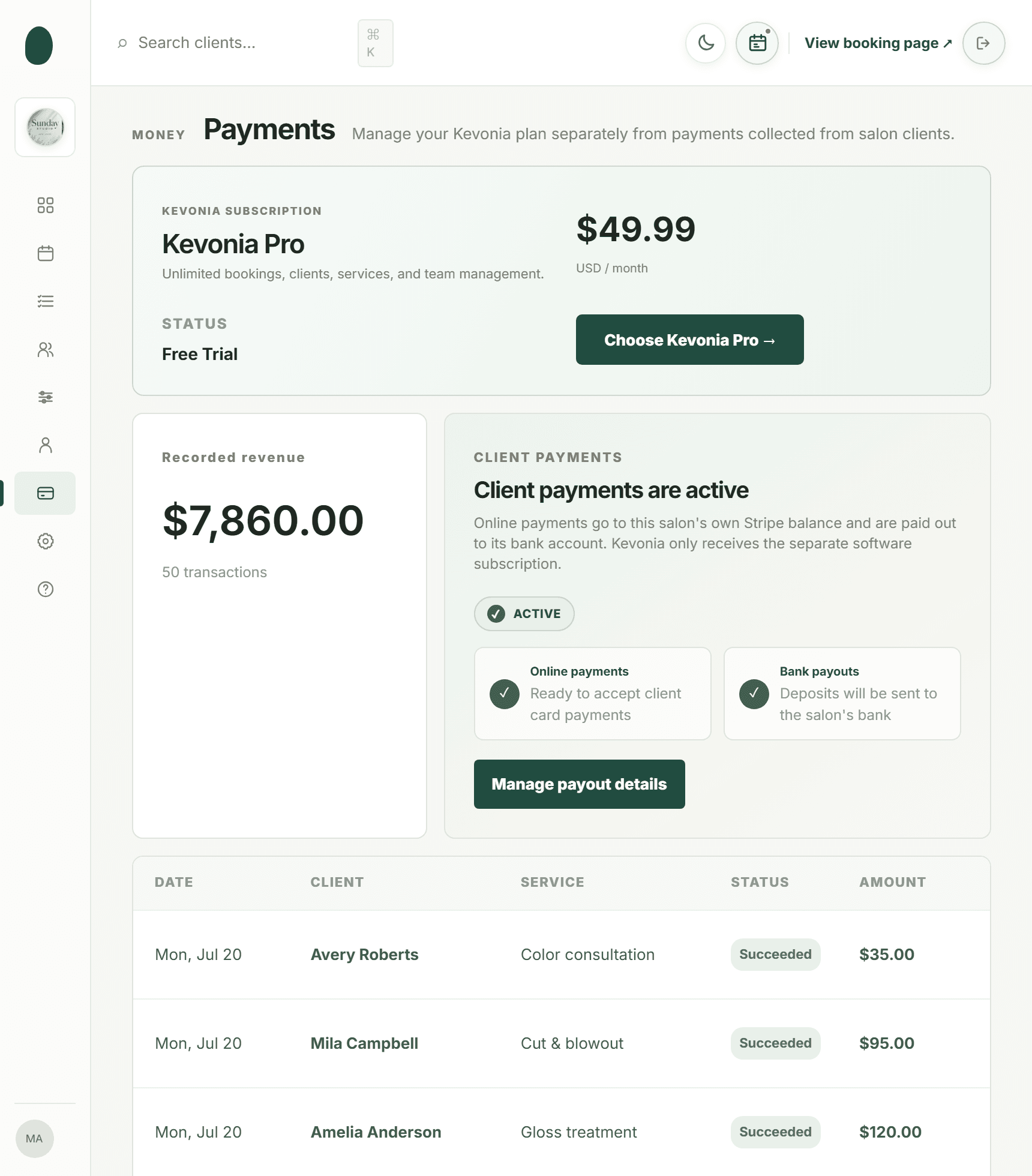
Set a review date before launch. For a short off-peak promotion, review results after the eligible appointments are complete. For a new-client offer, wait long enough to observe whether those clients return at the normal price. If you do not have reliable booking records, the first improvement may be measurement rather than discounting. A booking workspace such as Kevonia can give an owner a team calendar, client records, service menu, availability rules, payment information, booking statuses, and an overview of recent revenue and appointment activity in one place.
Use a simple decision rule: repeat the offer only if it met the stated objective without creating a worse problem elsewhere. If it filled empty slots but attracted no repeat visits, redesign the follow-up. If it generated bookings but displaced full-price appointments, narrow the eligible hours. If it brought excellent clients but the discount was too deep, reduce the incentive rather than abandoning the audience.
Where Kevonia fits for discount-based booking workflows
Kevonia fits salons and spas that want the booking operation behind a promotion to be organized and visible. It provides a branded online booking page where clients choose a service, professional, date, and time, plus a workspace with a team calendar, client records, service menu, availability rules, and Stripe payments. That combination helps an owner define which services and professionals are available, protect against double bookings, and see the appointment history connected to the client. For more detail, see Kevonia's hair salon booking software.
For a targeted offer, you can use the service menu to set duration, cleanup or buffer time, price, optional deposit, and professional assignment. Availability rules can account for weekday opening hours, breaks, time off, closures, booking windows, minimum notice, and time-slot intervals. Kevonia also sends an automatic email reminder the day before an appointment, and clients can reschedule or cancel from that email within the salon’s notice window. Those controls do not decide whether a discount is profitable; they help reduce the scheduling mistakes that can make a promotion harder to manage.
Kevonia is deliberately a salon and spa management system rather than a full marketing campaign platform. Its listed capabilities include online booking, calendars, records, services, availability, Stripe payments and deposits, reminders, cancellation history, booking statuses, refunds, client blocking, and business overview information. It does not currently offer marketing or SMS campaign tools beyond the booking reminder email, retail or inventory POS, a native mobile app, or multi-location management from one account. If you need an organized booking and payment foundation for a promotion, it may fit; if you need a campaign suite or multi-location system, assess that gap before choosing software. For more detail, see Kevonia's nail salon booking software.
The plan is US$49.99 per month with unlimited team members, bookings, clients, and services, with no per-booking commission. Kevonia offers a free 14-day trial with no credit card required to start; cancel anytime before the trial ends and you are never charged. For an owner testing a promotion workflow, that makes it possible to evaluate the calendar, client records, service setup, and Stripe payment process before committing to the monthly plan.
A practical decision: should salons offer discounts?
Should salons offer discounts when the calendar is not full? Sometimes—but first identify whether the empty space is a demand problem, a scheduling problem, a service-positioning problem, or a retention problem. A lower price cannot reliably solve all four. If you have unused capacity at specific times and a service with healthy delivery economics, a narrow off-peak promotion is a reasonable test. If your busiest times are full, protect the standard price and improve the value, convenience, or experience instead.
A discount should have four things before it goes live: a measurable objective, a profitable price floor, clear eligibility rules, and an end-of-promotion plan. The end plan is the part many salon owners skip. Decide how you will invite the client back at the normal price, what you will say if they request the discount again, and what evidence will make you repeat or stop the offer. Without that plan, a temporary incentive can quietly become your new price list.
The answer to are salon promotions worth it is therefore conditional. They are worth it when they create profitable behavior that would probably not happen at the normal price, especially in unused capacity or carefully chosen acquisition and retention situations. They are not worth it when they merely make already-likely appointments cheaper, hide an underpriced service, or fill the calendar with clients who do not return. Use discounts as controlled experiments—not as a substitute for knowing your numbers.
Sources
- Stripe — What Does Discount Mean for Businesses?
- U.S. Small Business Administration — Plan Your Business
- Federal Trade Commission — Advertising FAQs: A Guide for Small Business
- Federal Trade Commission — The Rule on Unfair or Deceptive Fees: Frequently Asked Questions
- Stripe Documentation — Add Discounts
- Kevonia — Home
- Kevonia — Salon Booking Program
- Kevonia — Hair Salon Booking Software
- Kevonia — Beauty Salon Booking Software
- Kevonia — Nail Salon Booking Software
- Kevonia Blog — How to Fill Quiet Weeks in a Salon
- Kevonia Blog — How to Write Salon Service Descriptions That Get Booked
- Kevonia Blog — How to Get Clients to Rebook
Frequently asked questions
Should a salon offer a first-time client discount?+
It can make sense if the goal is to reduce hesitation and earn a second visit, but keep it to one redemption and a clearly defined service or booking window. Calculate the minimum profitable price first, then track whether the client returns at the standard price. If first-time clients already book but rarely return, improve the consultation and rebooking process instead of adding more discounted first visits.
What is a good discount for a salon?+
There is no universal percentage that works for every salon. The offer should be based on your service margin, labor and product costs, available capacity, and objective. A small discount restricted to quiet hours may be more profitable than a larger discount available all week. In some cases, a bonus add-on or package is safer because it increases perceived value without lowering the headline price of the core service.
Are salon promotions worth it for attracting new clients?+
They can be, but judge the promotion by profitable repeat behavior rather than first-visit volume. Track the client’s first booking, service contribution, rebooking, full-price return, cancellation or no-show behavior, and referral activity. If the promotion attracts people who disappear when the regular price returns, the discount may be buying temporary demand rather than building a client base.
Should salons discount during slow days?+
A targeted slow-day offer is one of the more defensible uses of discounting because it can monetize capacity that would otherwise go unused. Restrict the offer to specific days, times, services, or professionals, and avoid making it available during appointments that normally sell at full price. Compare promoted bookings with similar slow-day bookings before and after the offer to see whether demand was actually incremental.
How can a salon stop clients from expecting discounts?+
Make the promotion temporary, specific, and visibly separate from the regular price list. State the end date, eligibility, and whether it can be combined with other offers. At the end, return to the standard price without negotiating individual exceptions. If clients are repeatedly asking for discounts, explain the value and consistency of the service, and consider a structured loyalty or rebooking benefit instead of ad hoc price reductions.
Can Kevonia help manage appointments booked through a promotion?+
Kevonia can support the booking workflow with a branded online booking page, service and professional assignments, availability rules, team calendar, client records, Stripe payments and deposits, reminders, cancellation history, booking statuses, and revenue and appointment overview information. It does not currently provide marketing or SMS campaign tools beyond the booking reminder email, so the promotion itself may need to be communicated through your existing channels.
More from the blog

How to Get New Salon Clients Without Wasting Your Marketing Budget
A practical client-acquisition system for salons: improve local search, create a clear first-visit offer, build referrals, and remove booking friction.

Google Ads for Salons: A Practical 2026 Guide
A practical guide to Google Ads for salons: campaign setup, local targeting, keywords, budgets, landing pages, conversion tracking, and the numbers that decide whether your ads are profitable.

Salon Profit Margin: How to Calculate and Improve Yours in 2026
What is a healthy salon profit margin? Learn the formulas, cost categories, break-even method, and practical ways to improve your salon’s bottom line in 2026.