Salon Profit Margin: How to Calculate and Improve Yours in 2026
What is a healthy salon profit margin? Learn the formulas, cost categories, break-even method, and practical ways to improve your salon’s bottom line in 2026.

Key takeaways
- Salon profit margin is the percentage of revenue left after the costs included in your calculation.
- Track gross margin, operating margin, and net margin separately because each answers a different management question.
- A reliable margin target depends on your service mix, payroll model, rent, utilization, retail sales, and owner compensation.
- The fastest improvements usually come from pricing, schedule utilization, labor planning, rebooking, and reducing no-shows.
- Use monthly service-level data and a break-even calculation instead of relying on one industry-wide average.
What salon owners actually want to know about profit margin
When a salon owner searches for salon profit margin, the practical question is usually not “What is the perfect industry number?” It is: “After paying my stylists, rent, supplies, software, taxes, and other bills, am I keeping enough money to make this business worth running?”
There is no single useful margin for every salon. A booth-rental salon, commission salon, owner-operated studio, luxury day spa, and multi-professional beauty business can have very different revenue and cost structures. The right approach is to calculate your own margin consistently, compare it with your goals, and identify the few costs or revenue leaks that are pulling it down.
What is salon profit margin?
Profit margin is the percentage of revenue that remains after subtracting a defined group of expenses. The basic formula is: profit margin = profit ÷ revenue × 100. For example, if a salon produces $40,000 in revenue and has $32,000 in costs included in the calculation, its profit is $8,000 and its margin is 20%.
The important word is defined. “Profit” can mean gross profit, operating profit, or net profit. If you compare your gross margin with another salon’s net margin, the numbers may look dramatically different even though both calculations are mathematically correct. Stripe’s explanation of gross and net profit makes the same distinction: gross profit focuses on direct costs, while net profit accounts for the broader cost of operating the business. (stripe.com)
For most salon owners, net margin is the clearest answer to “How much of each sales dollar do I really keep?” But gross margin and operating margin are valuable diagnostic tools. They show whether the problem is service pricing and direct labor, or whether overhead is absorbing an otherwise healthy service business.
- Gross margin: revenue minus direct service costs, divided by revenue.
- Operating margin: profit after direct costs and normal operating expenses, before certain non-operating items such as interest and taxes.
- Net margin: profit after all recorded business expenses, including operating costs, interest, and taxes where applicable.
- Owner-adjusted margin: a management view that includes a fair wage for the owner’s working hours, even if the owner currently takes irregular draws.
How to calculate your salon net profit percentage
To calculate your salon net profit percentage, choose one reporting period—usually a month or quarter—then use revenue and expenses from that same period. Start with collected or earned sales according to your accounting method. Exclude sales tax collected on behalf of the government because it is not money the salon keeps. Then subtract the costs required to deliver services and operate the business.
A simple monthly example might look like this: service revenue of $35,000, retail revenue of $5,000, and total revenue of $40,000. Direct service supplies, retail product cost, payment processing, and service-provider compensation total $20,000. Rent, utilities, insurance, payroll administration, marketing, cleaning, repairs, software, and other operating costs total $14,000. The resulting net operating profit is $6,000, or a 15% margin before any owner-specific adjustments you have chosen to show separately.
- Add service revenue, retail revenue, deposits recognized as revenue, and other legitimate business revenue for the period.
- Separate direct costs from overhead so you can see where the margin is being created or lost.
- Record payroll, commissions, contractor payments, supplies, rent, utilities, insurance, software, marketing, maintenance, taxes, and professional fees in the correct period.
- Subtract total expenses from total revenue to find profit.
- Divide profit by total revenue and multiply by 100.
- Repeat the calculation monthly and review a rolling three-month trend instead of reacting to one unusually busy or slow month.
Do not treat profit as the same thing as cash in your bank account. A salon can show a profit while cash is tied up in inventory, equipment purchases, debt payments, tax reserves, or unpaid invoices. The IRS also distinguishes ordinary operating expenses from personal expenses and emphasizes keeping business and personal records separate. Ask your accountant how equipment, prepaid expenses, owner draws, and taxes should appear in your own books. (irs.gov)
What is a healthy margin for a salon?
A healthy margin is one that pays for the owner’s work, covers taxes and reinvestment, withstands slower months, and leaves enough profit to justify the capital and risk involved. That means a margin that looks good on paper may still be too low if the owner is working full-time without paying themselves a market-based wage.
Instead of asking only “What is the average salon profit?” set three internal targets: a minimum survival margin, a planned operating margin, and a stretch margin. Your minimum should cover required bills and a tax reserve. Your planned target should fund maintenance, education, equipment replacement, and owner compensation. Your stretch target can support hiring, remodeling, expansion, or a stronger cash reserve.
There is also no universal answer to how profitable is a hair salon because the economics change with appointment volume, service prices, product usage, labor model, and occupancy. Current Bureau of Labor Statistics data shows that compensation levels in the barber, hairstylist, and cosmetology workforce vary by occupation and location, which is one reason a salon’s payroll structure must be part of its own calculation rather than copied from a generic benchmark. (bls.gov)
A useful test is to compare your actual result with the return you need from the business. If your salon has a 10% margin but the owner is working 50 hours a week and delaying repairs, the margin is not necessarily healthy. If a small owner-operated studio has a lower overhead base and the owner pays themselves separately for services, the same percentage may have a very different meaning.
The costs that usually determine salon profitability
Most margin problems come from a small number of categories rather than every expense being slightly too high. Separate costs into fixed, variable, and mixed expenses. The SBA describes fixed costs as costs that generally do not change with sales volume, variable costs as costs that move with production or services, and semi-variable costs as a combination of both. That framework works well for salons. (sba.gov)
- Labor: employee wages, payroll taxes, benefits, commissions, overtime, contractor payments, and paid non-service time.
- Occupancy: rent, common-area charges, utilities, property-related fees, repairs, and cleaning.
- Service delivery: color, disposables, gloves, towels, laundry, waxing supplies, sanitation products, and other consumables.
- Retail: the wholesale cost of products sold, shrinkage, damaged goods, expired items, and display costs.
- Revenue collection: card-processing fees, refunds, chargebacks, discounts, promotions, and deposits that are not ultimately retained.
- Customer acquisition and retention: advertising, memberships, referral rewards, education events, and other marketing costs.
- Administration: insurance, licenses, bookkeeping, payroll services, software, phones, internet, legal work, and accounting.
- Capital and financing: equipment purchases, leasehold improvements, loan interest, and planned replacement reserves.
Payroll deserves special attention because it can be both a direct service cost and a fixed or mixed overhead cost. A commission paid only when a service is completed behaves differently from a guaranteed salary, and a salaried employee who has many empty appointment blocks may cost the business more per completed service than the monthly payroll report suggests. Analyze payroll against completed service revenue and productive hours, not payroll alone.
Do not hide owner labor. If the owner performs services, record the service revenue and assign a reasonable labor cost in the management report. Otherwise, the salon may appear highly profitable simply because the owner is working for free. This adjustment is especially important when deciding whether to hire another stylist or open a second location.
Use break-even analysis to find the sales level you need
Margin tells you what happened; break-even analysis tells you what must happen next. The SBA’s formula for break-even sales dollars is fixed costs divided by contribution margin. Contribution margin is the portion of each sales dollar left after variable costs. (legacy.sba.gov)
For a salon example, suppose monthly fixed costs are $18,000 and your blended contribution margin is 60%. Your break-even revenue is $30,000 because $18,000 divided by 0.60 equals $30,000. If your average completed appointment produces $100 in revenue, you need roughly 300 completed appointments per month before the business reaches break-even, before allowing for differences among services.
A blended calculation is useful for planning, but service-level analysis is better for decisions. A 30-minute haircut, a three-hour color appointment, a lash fill, and a retail sale each consume different amounts of labor, supplies, and calendar capacity. Calculate revenue and direct cost per service, then compare contribution per appointment hour. A service with a high ticket price may be less attractive than a lower-priced service if it takes much longer and leaves a large cleanup or processing gap.
- List monthly fixed costs and convert quarterly or annual bills into monthly amounts.
- Estimate variable cost for each major service, including direct labor where appropriate.
- Calculate contribution margin by service or use a conservative blended percentage.
- Divide fixed costs by contribution margin to find required monthly revenue.
- Convert required revenue into appointments using realistic average ticket and working-day assumptions.
- Add a cushion for cancellations, seasonality, repairs, and expenses you cannot predict perfectly.
Run at least three scenarios: conservative, expected, and strong. For example, model what happens if appointments fall by 15%, if average ticket rises by 8%, or if one professional leaves. This turns a margin target into an operating plan instead of a number you inspect after the month is over.
Seven practical ways to improve salon profit margin
Improving margin does not automatically mean raising prices or cutting staff. Start with changes that increase the value of existing capacity, then address costs that do not support revenue or client experience.
- Price services from actual time and cost. Include consultation, setup, cleanup, processing time, supplies, labor, and the value of the professional’s skill. Review the service menu at least quarterly when costs or demand change.
- Measure revenue per productive hour. A full calendar is not necessarily a profitable calendar if appointments are heavily discounted, run over time, or require excessive unpaid cleanup.
- Reduce gaps between appointments. Use realistic service durations, buffer rules, and appointment sequencing so a professional’s day does not contain avoidable dead time.
- Improve rebooking. A client who leaves with a suitable next appointment is generally less expensive to retain than a new client is to acquire. Track rebooking by professional and service type.
- Control no-shows and late cancellations. Require deposits for selected high-risk services, make the policy visible during booking, and review repeat no-show patterns before deciding whether to restrict online booking.
- Audit product usage. Measure color and consumable usage by service rather than cutting supplies blindly. Waste reduction should protect results while improving cost per appointment.
- Review retail as a separate profit center. Track revenue, wholesale cost, discounting, shrinkage, and sell-through so unsold inventory does not quietly absorb cash.
- Schedule labor to demand. Compare booked hours with paid hours by day and professional. A small adjustment to opening times or overlapping shifts can improve utilization without reducing service quality.
Pricing is often the cleanest place to begin, but do not make a blanket increase without checking your menu. A modest increase on services that are consistently full may produce more profit than a large discount campaign. Kevonia’s guide to pricing salon services can help you work through time, cost, positioning, and menu structure before changing prices.
No-shows deserve a measured response. A policy that is too loose can damage margin; one that is too aggressive can frustrate reliable clients. Start by separating first-time clients, long services, peak-time appointments, and clients with repeated no-shows. Then compare the revenue recovered through deposits or better reminders with the administrative effort and client friction involved.
The numbers to review every month
A monthly profit-and-loss statement is necessary, but it is not enough to explain why margin moved. Pair financial figures with operating metrics that show how the calendar and team produced the result. Kevonia’s overview screen can show today’s revenue against the same day last week, appointment and client counts, recent no-shows as a percentage of bookings, and a 30-day revenue trend. Those figures do not replace accounting, but they can help you spot operational changes sooner.
- Total revenue and revenue by service, professional, and retail.
- Average ticket, average service duration, and revenue per booked hour.
- Booked hours, available hours, utilization, and last-minute gaps.
- Payroll and contractor cost as a percentage of service revenue.
- Product and supply cost per service or per dollar of service revenue.
- New clients, returning clients, rebooking rate, and client retention.
- No-show and late-cancellation rate, including the revenue affected.
- Discounts, refunds, deposits retained, and payment-processing costs.
- Operating profit, net margin, cash balance, and tax reserve.
Review the numbers by professional carefully. A stylist with lower total revenue may be more profitable per hour if their schedule is efficient and their service mix has strong contribution. Conversely, a high-revenue professional may be underperforming if appointments routinely run long, require excessive product, or generate frequent discounts and rework.
For a broader dashboard, the Kevonia article on salon KPIs explains which metrics are worth tracking and how to avoid collecting numbers that do not lead to a decision.
Where Kevonia fits into margin management
Kevonia fits best when appointment operations are creating avoidable revenue loss or making margin analysis difficult. It provides a branded online booking page where clients choose a service, professional, date, and time, plus a shared team calendar with per-professional filters and color coding. Availability rules account for opening hours, breaks, time off, closures, booking windows, minimum notice, and slot intervals.
That matters to margin because the calendar is a capacity plan. Double-booking protection checks hours, breaks, time off, and existing bookings. Service settings can include duration, cleanup or buffer time, price, optional deposits, and professional assignment. When those details are accurate, your schedule is more likely to reflect the time and capacity you are actually selling rather than an optimistic calendar that creates delays and unpaid work.
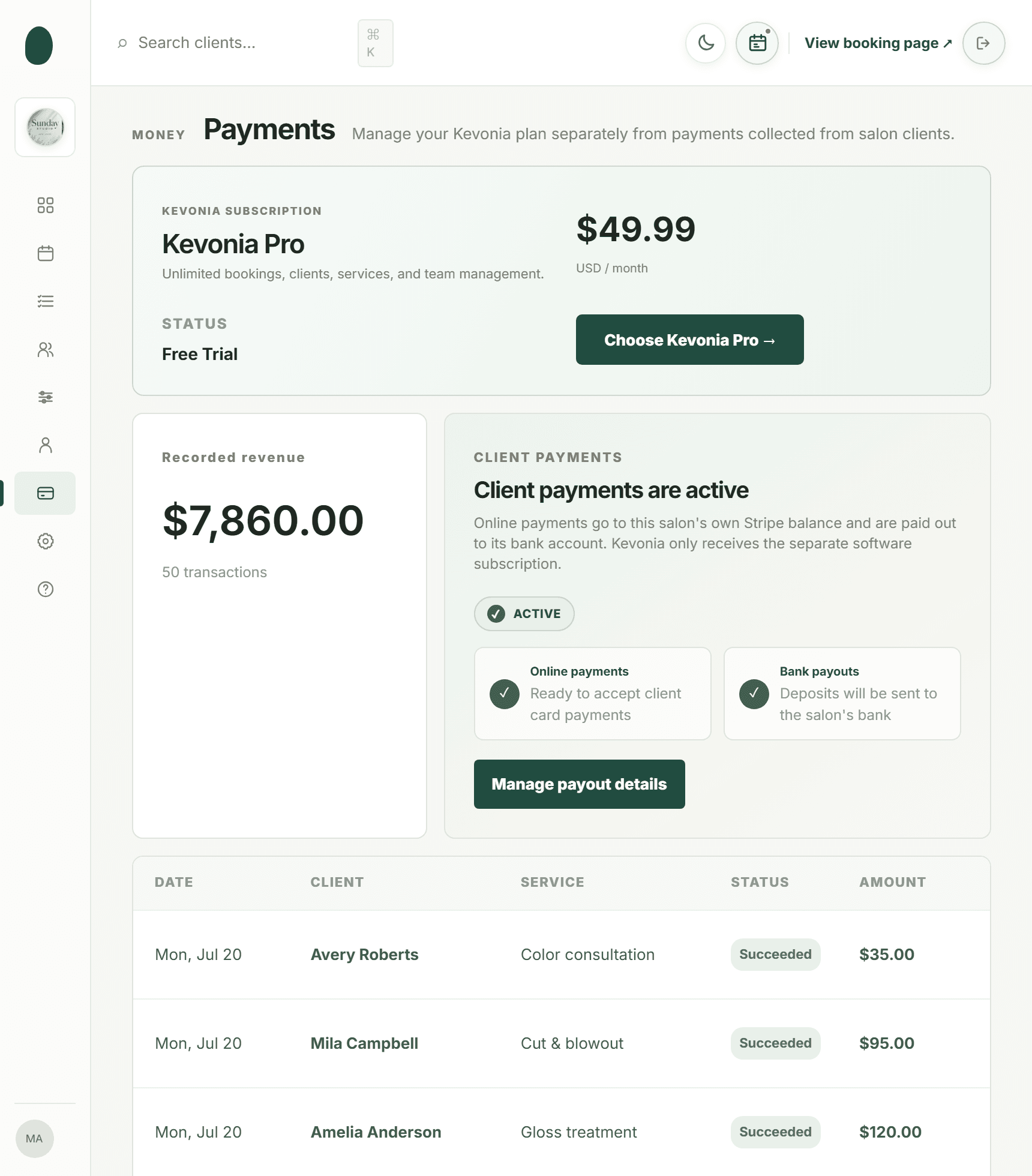
Kevonia also connects booking activity with client and payment workflows. Client records include visit history and private notes; Stripe payments can collect cards and deposits; the day-before reminder email lets clients reschedule or cancel within the salon’s notice window; and the salon can view no-show history, cancellation history, and booking status. These tools do not create profit by themselves, but they can reduce preventable gaps and make it easier to test whether deposits, reminders, or policy changes improve realized revenue. For more detail, see Kevonia's salon reservation software.
The economics are straightforward: Kevonia has one plan at US$49.99 per month, with unlimited team members, bookings, clients, and services and no per-booking commission. It includes a free 14-day trial with no credit card required to start; you can cancel anytime before the trial ends and never be charged. Compare that fixed software cost with the revenue from one recovered appointment, while still checking whether the workflow suits your salon.
Kevonia is not a substitute for accounting, inventory management, marketing campaigns, SMS automation, or multi-location financial consolidation. Its role is narrower and practical: organize availability, bookings, client records, deposits, reminders, statuses, and appointment-level information so the owner can operate the calendar with fewer preventable leaks. For more detail, see Kevonia's hair salon booking software.
Common margin mistakes to avoid
- Using revenue instead of profit. A $50,000 month is not automatically better than a $40,000 month if the extra sales required costly discounts, overtime, or excessive product usage.
- Comparing unlike salons. Booth rent, commissions, salaries, owner labor, retail, and occupancy can make two businesses with similar sales look completely different.
- Ignoring owner compensation. Free owner labor can make a struggling business appear profitable.
- Counting sales tax as revenue. Taxes collected for a government authority should not be treated as money available for payroll or distributions.
- Treating deposits as immediate profit. A deposit may be a liability or advance payment until the service is delivered, depending on the arrangement and accounting method.
- Mixing cash flow with profitability. Loan principal, equipment purchases, and owner draws affect cash but do not all appear as ordinary operating expenses in the same way.
- Cutting marketing, training, or maintenance without measuring the long-term effect. Some expenses protect retention, service quality, and future revenue.
- Making decisions from one month. Seasonality, holidays, weather, staff leave, and one unusually large repair can distort a single-period margin.
Keep tax treatment separate from management decisions. The IRS says deductible business expenses generally need to be ordinary and necessary, and some property or improvement costs may need to be capitalized rather than deducted immediately. Use your management report to understand the business, then rely on a qualified tax professional for filing treatment. (irs.gov)
A simple 30-day plan to improve your margin
If your current numbers are unclear, do not wait for a perfect accounting system. Build a reliable baseline first, then improve one driver at a time.
- Days 1–3: export or gather the last three months of revenue, payroll, supplies, rent, utilities, software, marketing, refunds, and payment costs.
- Days 4–7: separate fixed, variable, mixed, and owner-related costs. Confirm that sales tax and personal spending are not inflating revenue or expenses.
- Week 2: calculate gross margin, operating margin, net margin, average ticket, revenue per booked hour, and break-even revenue.
- Week 3: identify the two largest leaks. Typical examples are underpriced long services, empty peak-time slots, excessive paid non-service hours, high product waste, or repeat no-shows.
- Week 4: choose one pricing, scheduling, deposit, rebooking, or cost-control experiment. Define the expected result and review it after 30 days.
- At the end of the month: compare the result with the baseline and decide whether to continue, adjust, or stop the experiment.
The objective is not to chase the highest possible percentage at the expense of quality. A durable salon margin comes from a service menu clients value, a schedule the team can deliver reliably, compensation that keeps good professionals, and enough retained profit to maintain the business. Track the percentage, but manage the decisions underneath it.
Sources
- U.S. Small Business Administration: Plan your business and break-even analysis
- U.S. Small Business Administration: Break-even point
- Internal Revenue Service: Publication 334, Tax Guide for Small Business
- Internal Revenue Service: Publication 583, Starting a Business and Keeping Records
- Internal Revenue Service: Business and personal expenses
- Internal Revenue Service: Tangible property final regulations
- U.S. Bureau of Labor Statistics: Barbers, Hairstylists, and Cosmetologists
- Stripe: Gross vs. Net Profit
- Kevonia
- Kevonia beauty salon booking software
- Kevonia salon booking program
- Kevonia salon reservation software
- Kevonia hair salon booking software
- Kevonia: How to Price Salon Services
- Kevonia: Salon KPIs
Frequently asked questions
What is a good salon profit margin?+
There is no universal number that applies to every salon. A useful margin must pay for owner labor, taxes, maintenance, reinvestment, and the risk of slower months. Set a minimum survival target, a planned target, and a stretch target based on your own payroll model, rent, service mix, utilization, and owner compensation.
How do I calculate salon profit margin?+
Add revenue for the same period, subtract the expenses included in your chosen profit definition, divide the resulting profit by revenue, and multiply by 100. Calculate gross, operating, and net margins separately so you know whether the issue is direct service costs, overhead, or non-operating expenses.
What should be included in salon expenses?+
Include labor, payroll taxes, commissions, contractor payments, supplies, product costs, rent, utilities, insurance, cleaning, laundry, licenses, software, payment-processing fees, marketing, repairs, bookkeeping, professional fees, interest, and applicable taxes. Include a fair value for the owner’s service labor when evaluating whether the business is genuinely profitable.
Why is my salon busy but not profitable?+
Common reasons include underpriced long services, too much unpaid time, low revenue per booked hour, excessive discounts, high product waste, payroll that does not match demand, repeat no-shows, and rent or overhead that is too high for the current revenue level. Review profit by service and professional rather than looking only at total appointments.
How can booking software improve salon profitability?+
Booking software can support profitability by reducing scheduling gaps, preventing double bookings, collecting deposits, sending reminders, recording cancellations and no-shows, and showing appointment and revenue trends. It does not replace accounting or guarantee higher profit, so measure whether the specific workflow recovers appointments or saves administrative time.
Should I raise salon prices to improve my margin?+
Possibly, but review each service first. Check its total time, cleanup, supplies, direct labor, demand, and contribution per appointment hour. A targeted increase on consistently full or underpriced services is usually easier to evaluate than a blanket increase across the entire menu. Communicate the value clearly and monitor rebooking, cancellations, and demand afterward.
More from the blog

How to Price Salon Services: A Practical 2026 Guide
Set salon prices with a repeatable method instead of guessing. This guide covers costs, labor, profit margins, market research, service menus, deposits, and price reviews.

How to Fill Quiet Weeks in a Salon: 10 Practical Moves
Quiet weeks do not require panic discounting. Use this practical plan to reactivate clients, promote specific openings, improve booking access, and protect your margins.

Most Profitable Salon Services: A 2026 Owner’s Guide
The most profitable salon services are not always the most expensive. Learn how to compare labor, product cost, time, demand, and rebooking potential before changing your menu.