How to Price Salon Services: A Practical 2026 Guide
Set salon prices with a repeatable method instead of guessing. This guide covers costs, labor, profit margins, market research, service menus, deposits, and price reviews.

Key takeaways
- Price from your real cost per booked hour, not from a competitor’s number alone.
- Include labor, products, overhead, unpaid time, payment costs, taxes, and profit in your calculation.
- Use market research to position your prices, then validate them against demand and capacity.
- Review every service regularly and update your menu when costs, timing, or demand changes.
How to price salon services without guessing
If you searched for how to price salon services, you probably do not need another vague reminder to “know your worth.” You need a number you can defend: one that pays the professional, covers the portion of rent and operating costs used by the appointment, accounts for products and payment fees, and leaves enough profit to keep the salon healthy.
The most reliable approach is to calculate a minimum sustainable price first, compare that price with your local market and positioning, and then build a clear service menu around the result. The process below works for hair salons, barbershops, nail salons, spas, esthetician studios, tattoo studios, and other appointment-based businesses. For more detail, see Kevonia's salon and spa management software.
1. Start with the time a service actually uses
A service that takes 60 minutes on the calendar may consume much more than 60 minutes of paid or productive time. Include consultation, setup, shampooing, cleanup, laundry, sterilization, checkout, and the buffer before the next client. If a color appointment is booked for two hours but regularly occupies two hours and 20 minutes, pricing it as a two-hour service will quietly reduce your hourly revenue.
Create a simple worksheet for every service. Record the advertised duration, the average actual duration, cleanup or buffer time, the professional performing it, and the amount of time the station or treatment room is unavailable. Your service menu should reflect the time clients are reserving, not only the hands-on portion of the appointment.
For staff-paid salons, calculate labor using the employer’s real cost rather than the employee’s take-home wage. Add hourly pay or commission, employer payroll taxes, benefits, paid training, and other compensation costs that apply. For booth renters, suite owners, or independent professionals, replace payroll cost with the amount of income the appointment must generate for the professional and the business arrangement.
As a market reference, the U.S. Bureau of Labor Statistics reported a May 2025 national mean wage of $21.20 per hour for barbers, hairdressers, hairstylists, and cosmetologists. That figure is not a pricing recommendation, and it does not include every salon owner’s costs or self-employed earnings, but it can help you avoid treating labor as free when building your model. Use the BLS wage data and its state or area tools as a reference point, then use your own payroll or income target for the actual calculation. Supporting details are available from May 2025 national wage data.
Your productive-hour assumption matters just as much as your hourly target. A professional may be available for 40 hours per week but only have 28 to 32 bookable hours after breaks, admin, training, late arrivals, cancellations, and gaps between appointments. Pricing as if all 40 hours will be sold usually produces a menu that looks affordable but cannot support the business.
2. Calculate your minimum sustainable price
The core calculation is straightforward: minimum price equals direct service costs plus allocated overhead plus the labor or owner-income target, with profit added after those costs are covered. You can calculate it by service or, for a simpler model, by the booked hour and then multiply by the service’s realistic duration.
- List the service’s direct costs, including color, developer, wax, gloves, disposables, laundry, and any other materials used because the appointment occurred.
- Calculate the professional cost for the full service time, including setup and cleanup where applicable.
- Allocate monthly overhead across realistic booked hours, not theoretical opening hours.
- Add payment processing, booking-related costs, and a reasonable allowance for refunds, discounts, rework, or small wastage.
- Add your target profit or owner compensation requirement, then round the customer-facing price to a clear number.
For example, suppose a haircut takes 75 minutes from arrival through checkout. The professional cost is $32 for that time. Product and disposable costs are $4. Overhead allocated to the appointment is $18. Payment and other transaction costs average $3. Your cost before profit is therefore $57. If you want a 20% profit margin on the selling price, do not simply add 20% to $57; divide the cost by 1 minus the desired margin: $57 ÷ 0.80 = $71.25. A listed price of $72 or $75 may be more practical depending on your positioning and local demand.
That distinction is important. A 20% markup means cost multiplied by 1.20. A 20% margin means profit is 20% of the final selling price. They are not the same. If your cost is $57, a 20% markup produces $68.40, while a 20% margin requires $71.25. Choose one method and label your worksheet clearly so the team does not compare different numbers as if they were equivalent.
The U.S. Small Business Administration recommends separating fixed and variable costs and uses fixed costs divided by price minus variable costs to calculate break-even units. Apply the same logic to services: rent, insurance, software, and base salaries may be fixed or semi-fixed, while color, disposables, and transaction fees generally move with appointments. The SBA also notes that a small miscellaneous cushion can make a break-even estimate more realistic, which is useful for salons with unpredictable repairs, replacement tools, or product waste. Supporting details are available from SBA break-even analysis.
3. Build the cost model behind your salon pricing strategy
A useful salon pricing strategy begins with a complete cost list. Owners often remember rent and product, then forget the less visible expenses that determine whether a busy month was actually profitable. Review at least the following categories before setting or changing prices.
- Labor and compensation: wages, commissions, payroll taxes, benefits, owner pay, education, and paid non-service time.
- Occupancy: rent, common-area charges, utilities, cleaning, repairs, insurance, and security.
- Materials: color, chemicals, skincare products, nail products, towels, gloves, disposables, and treatment supplies.
- Equipment and technology: chairs, dryers, treatment beds, tools, maintenance, booking software, internet, phones, and payment hardware or services.
- Business administration: licenses, professional fees, bookkeeping, marketing, website costs, bank charges, and tax preparation.
- Capacity loss: cancellations, no-shows, late arrivals, consultations that do not convert, closing duties, and gaps that cannot be filled.
Divide annual or quarterly expenses into monthly amounts before allocating them. If an insurance bill is $1,200 per year, model it as $100 per month. If you replace a $600 tool every two years, set aside $25 per month. This prevents a low-expense month from making your service prices look more profitable than they are over a full year.
Keep the worksheet connected to actual records. The IRS says a business may choose any recordkeeping system that clearly shows income and expenses, and that records should support reported receipts, deductions, and credits. For a salon, that means retaining invoices, payroll information, product purchases, payment reports, refunds, discounts, and appointment records rather than relying on memory at tax time. Supporting details are available from IRS recordkeeping guidance.
Taxes require local advice because sales-tax, service-tax, payroll, and income-tax rules vary by location and business structure. Do not automatically add a generic tax percentage to every service without checking what applies in your state and municipality. Instead, make sure your pricing model produces enough cash flow for your tax obligations and review the treatment of tips, mandatory service charges, and deposits with your accountant.
4. Use local market prices as a positioning check
Once you know your cost floor, research comparable salons in the same geographic area and service category. The goal is not to copy the lowest number. The goal is to understand what clients can see, what they are comparing, and whether your planned price needs a clearer explanation of scope or value.
- Compare like with like: a basic haircut is not equivalent to a restyle, and a root touch-up is not equivalent to a full blonding service.
- Record duration, included steps, product limitations, finishing work, consultation time, and whether a blow-dry or style is included.
- Separate independent operators, budget chains, mid-market salons, and premium specialists instead of averaging all prices together.
- Check whether prices are starting prices, tiered by professional, or subject to a consultation or product usage adjustment.
- Look at availability and experience as well as price. A specialist with limited openings may be selling a different proposition from a walk-in-focused salon.
If your sustainable price is higher than several nearby competitors, investigate before discounting. You may have more overhead, longer service times, excessive product usage, or an unrealistic utilization assumption. You may also be targeting a more premium experience. In that case, make the difference visible through service descriptions, consultation quality, expertise, timing, convenience, and consistent results rather than pretending the services are identical. For more detail, see Kevonia's hair salon booking software.
If your sustainable price is lower than the market, do not reduce it automatically. A lower price can be useful during an intentional launch period, for a limited service, or for a professional building a portfolio. It can also mean you have room to improve margin, pay staff more, replace equipment, or invest in client experience. Your price should reflect your business goal, not merely the cheapest visible option.
5. Turn calculations into a clear salon price list
Clients do not see your spreadsheet. They see your salon price list and decide whether the service sounds clear, relevant, and worth booking. Make each listing specific enough that two clients are unlikely to interpret it differently.
- Name the result or service category in plain language.
- Show the starting price or exact price, depending on how predictable the work is.
- State the expected duration and what is included.
- Explain genuine variables such as extra product, additional length, extensions, corrective work, or a required consultation.
- Identify add-ons separately instead of hiding them inside an unexpectedly high final bill.
- State deposit, cancellation, late-arrival, and consultation requirements in the same booking flow or in an easy-to-find policy.
Use tiered pricing only when the difference is real and understandable. A junior, senior, and master level can work if each level reflects experience, demand, specialization, or a different appointment experience. It becomes confusing when clients cannot tell what changes. Likewise, avoid creating ten nearly identical variations of one service. A shorter menu with well-defined options is easier to maintain and easier for clients to book.
For variable services, price the decision point rather than promising a false fixed price. For example, “custom color consultation” can lead to a defined quote after evaluating hair history, desired result, time, and product needs. If you use starting prices, tell clients what may change the price before the appointment. Surprises damage trust more than a higher but transparent quote.
Deposits can protect capacity for long, expensive, or high-demand appointments, but they should be explained clearly. A deposit is not a substitute for correct pricing: a service priced below cost remains unprofitable even when the client pays a deposit. Treat the deposit, cancellation window, refund rules, and final balance consistently, and confirm that your local laws and payment terms support the policy. We cover this in more depth in taking deposits for salon appointments.
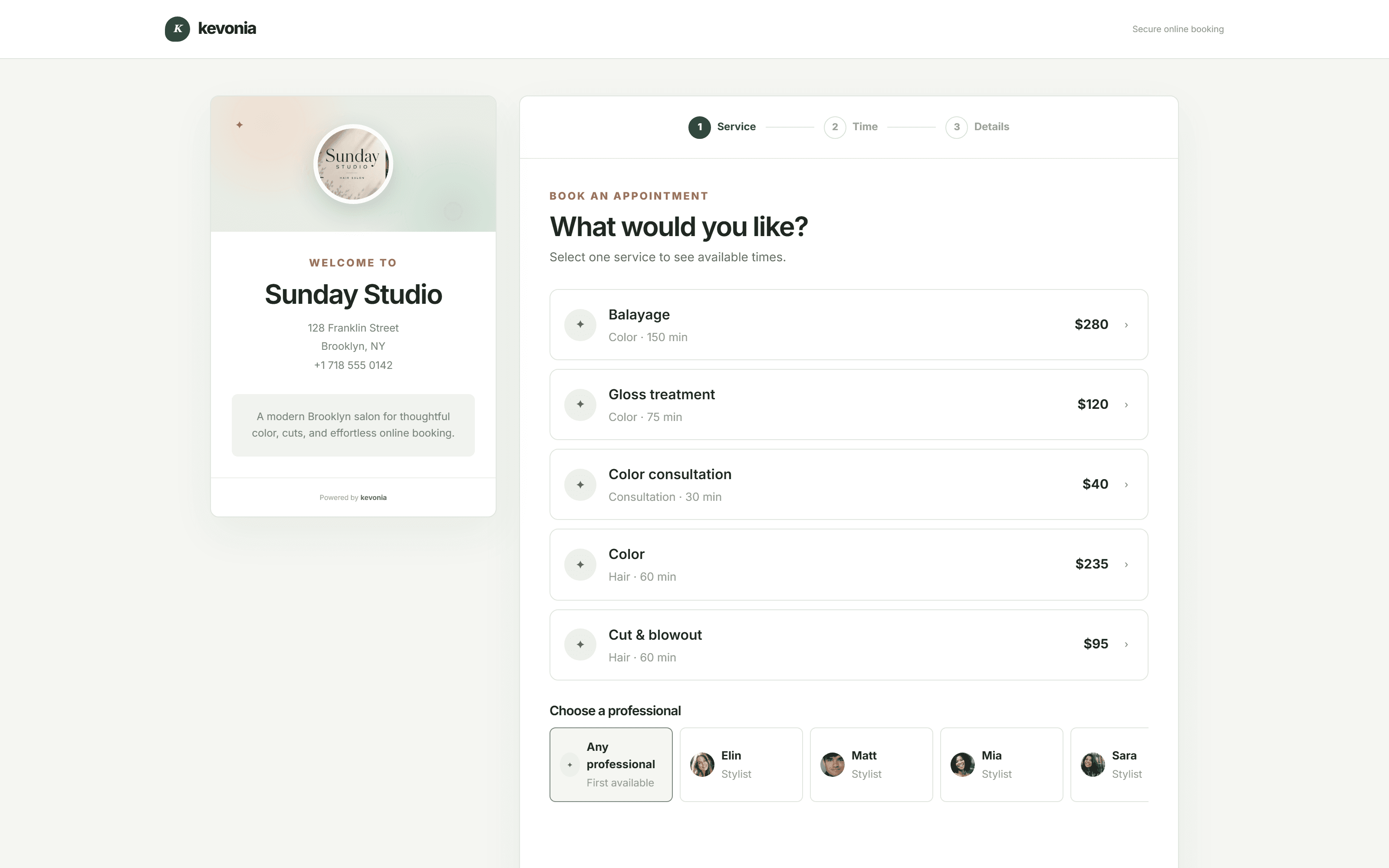
A booking system can reduce the gap between the price you calculate and the price clients actually understand. Kevonia’s service menu lets you set duration, cleanup or buffer time, price, optional deposit, and professional assignment, so the operational details behind the appointment can be represented in the booking flow. For more detail, see Kevonia's salon reservation software.
6. Test prices against demand, capacity, and break-even
A price is not proven because clients accept it once. Review whether it produces the revenue, utilization, and profit your business needs. Track each service for at least several weeks, and longer when demand is seasonal, before making a major conclusion.
- Bookings sold: how many appointments were completed, canceled, rescheduled, or left unfilled.
- Realized price: the listed price after discounts, corrections, refunds, complimentary services, and promotions.
- Revenue per booked hour: total service revenue divided by the actual time reserved, including buffers.
- Product cost per service: compare estimated usage with actual consumption, especially for color, extensions, waxing, and retail-sized treatment products.
- Rebooking and retention: a low-priced service that brings repeat visits may have a different role from a high-priced service booked once.
- Contribution to profit: revenue less direct labor, products, transaction costs, and the allocated overhead required to deliver it.
Use a simple decision rule. If a service has strong demand, long wait times, and weak revenue per booked hour, raise the price, shorten the service, reduce included steps, or create a higher-priced version. If it has low demand and low margin, investigate the offer before spending more on promotion. If it has low demand but strong margin, improve the description, photos, consultation process, or booking path before cutting the price.
Review prices after material cost increases, wage changes, rent changes, new equipment, changes in service timing, or a sustained shift in demand. A quarterly review is a useful minimum for many salons; high-volume color businesses may need a monthly review of product usage and realized revenue. Change one variable at a time when possible so you can see what actually improved the result.
To estimate break-even appointments, add monthly fixed costs and divide them by the average contribution from one appointment. If monthly fixed costs are $12,000 and the average appointment contributes $60 after direct costs, the salon needs 200 appointments to break even before owner profit or additional targets. This is a planning estimate, not a guarantee, because service mix, staffing, and capacity vary.
7. Where Kevonia fits into pricing and booking operations
Kevonia does not decide what your services should cost. It helps you put the pricing decision into a booking workflow that clients and professionals can use consistently. Its workspace includes a service menu, team calendar, client records, availability rules, and Stripe payments, while the branded booking page lets clients choose a service, professional, date, and time.
That is useful when your price depends on time and staffing. You can assign services to specific professionals, set duration and cleanup or buffer time, and apply opening hours, breaks, time off, salon closures, booking windows, minimum notice, and time-slot intervals. Double-booking protection checks availability against hours, breaks, time off, and existing appointments, helping prevent a pricing model from being undermined by overlapping bookings or unavailable staff. We cover this in more depth in staff availability rules.
Kevonia also supports optional deposits and card payments through Stripe, with payouts to the salon’s bank account. Stripe’s published standard pricing currently lists 2.9% plus 30 cents for a successful domestic card transaction, although the applicable rate depends on the payment setup and transaction type. Include the payment cost in your own worksheet rather than assuming every collected dollar is available as profit. Supporting details are available from Stripe’s published payment pricing.
For a salon owner comparing software cost with expected benefit, Kevonia has one plan at US$49.99 per month, unlimited team members, bookings, clients, and services, and 0% per-booking commission. It includes a free 14-day trial with no credit card required to start; if you cancel anytime before the trial ends, you are never charged. Those terms can be included in your overhead model as a fixed software expense rather than a percentage deducted from each appointment. For more detail, see Kevonia's Kevonia home page.
The practical difference is that your pricing worksheet remains the source of truth, while the booking system carries the approved service name, duration, price, deposit, professional assignment, and availability rules into the customer experience. That reduces manual updates when a salon has multiple professionals or services with different timing requirements.
8. How to communicate a price increase
When your calculations show that a price must increase, communicate the change before the client reaches checkout. Give the effective date, identify the affected services, and explain the scope of the service or business investment in plain language. You do not need to publish your entire cost model, but clients should not discover a different price only after the appointment begins.
- Update the booking page, printed menu, website, social profiles, and confirmation messages at the same time.
- Honor already-confirmed appointments under the terms you communicated, unless your local policy and client notice clearly allow otherwise.
- Train every professional to explain what is included and when a consultation or variable quote is required.
- Avoid apologizing for a price that supports proper timing, quality products, fair compensation, and reliable availability.
- Review discounts so they are intentional. A permanent discount often becomes the client’s real reference price.
Use specific language: “Beginning [date], our haircut price will be $X. The service includes consultation, shampoo, cut, blow-dry, and finishing. We are updating the price to reflect the appointment time and operating costs required to provide it consistently.” Keep the explanation accurate and short. Confidence usually comes from having a calculation behind the number.
The final test is whether your menu, calendar, and financial records agree. If the menu says 90 minutes but the calendar reserves 60, or if a discount is recorded differently from the price shown to the client, your reports will not help you make good decisions. A consistent system makes it easier to see which services are profitable and which need redesign.
Sources
- U.S. Small Business Administration: Break-even point
- Internal Revenue Service: Recordkeeping
- U.S. Bureau of Labor Statistics: May 2025 national employment and wage data
- Stripe: Pricing and fees
- Kevonia
- Kevonia salon booking program
- Kevonia hair salon booking software
- Kevonia salon reservation software
- Kevonia blog: How to take deposits for salon appointments in 2026
- Kevonia blog: How to set staff availability for a salon calendar
Frequently asked questions
What is the simplest formula for pricing a salon service?+
Start with direct labor, product and disposable costs, allocated overhead, payment costs, and any other cost caused by the appointment. Add your target profit using a margin calculation: selling price = total cost ÷ (1 − target margin). Then compare the result with local market prices and adjust the service scope, duration, or positioning if necessary.
Should salon prices be based on time or the service result?+
Use both. Time determines how much capacity the appointment consumes, so it must be included in the cost model. The result, expertise, specialization, convenience, and experience influence what clients are willing to pay. A price based only on time can undervalue expertise, while a price based only on perceived value can fail to cover a long appointment.
How often should I update my salon price list?+
Review it at least quarterly, and review product usage and realized revenue more often for services with volatile costs. Make a formal review after wage, rent, insurance, product, equipment, or payment-cost changes, and whenever a service takes substantially longer or demand changes.
How do I price a service when the product amount varies by client?+
Use a starting price only when you clearly define what it includes and what causes an adjustment. Track product usage by service and client characteristics such as length, density, or treatment history. For highly variable work, use a consultation and quote before reserving the full appointment, or create clearly defined tiers that match the additional time and product.
Should I charge separately for add-ons and extra time?+
Usually, yes, when the add-on uses meaningful time, product, or specialist labor. List it separately so clients understand the choice and staff can apply it consistently. For small steps that are essential to every version of the service, include them in the base price instead of creating a confusing series of fees.
Can booking software help me price salon services?+
It cannot determine your profitable price, but it can help enforce the operational details behind it. For example, Kevonia lets you set a service’s duration, cleanup or buffer time, price, optional deposit, and professional assignment, then apply availability rules and collect card payments or deposits through Stripe. Your financial worksheet should still determine the final price.
More from the blog

Going Independent as a Hairstylist: A Practical 2026 Guide
A step-by-step 2026 guide to going independent as a hairstylist, from choosing your business model and pricing services to moving clients, managing bookings, and staying organized.

Junior vs Senior Stylist Pricing: A 2026 Guide for Salon Owners
A practical guide to setting junior and senior stylist prices, choosing the right price gap, explaining the difference to clients, and reviewing tiers as your team grows.

Most Profitable Salon Services: A 2026 Owner’s Guide
The most profitable salon services are not always the most expensive. Learn how to compare labor, product cost, time, demand, and rebooking potential before changing your menu.