Going Independent as a Hairstylist: A Practical 2026 Guide
A step-by-step 2026 guide to going independent as a hairstylist, from choosing your business model and pricing services to moving clients, managing bookings, and staying organized.

Key takeaways
- Choose your independent setup based on control, fixed costs, and the client experience you want to deliver.
- Handle licensing, registration, insurance, banking, and taxes before opening your calendar.
- Build your business around repeatable services, realistic capacity, deposits, cancellation rules, and a simple booking path.
- Move clients professionally by communicating your new setup without misusing salon data or creating unnecessary conflict.
- Use Kevonia to give clients a branded 24/7 booking page while managing calendars, client records, availability, and Stripe payments in one workspace.
What you actually need to know before going independent
If you searched for going independent as a hairstylist, you probably do not need another motivational speech. You need to know whether you can replace your current income, what you must set up legally, how to keep clients from getting lost in the transition, and which tools will stop the business side from taking over your day.
The safest approach is to treat independence as a business launch, not simply a change of workplace. Your technical skill is the foundation, but your result will also depend on your location, pricing, schedule, policies, client communication, cash reserves, and ability to deliver a consistent booking experience.
Choose the independent model that matches your goals
Start by deciding where and how you will work. Your choice affects your fixed costs, control over the client experience, equipment responsibilities, and how quickly you need to fill your schedule. Do not sign an agreement until you understand exactly who controls the space, prices, appointments, payments, supplies, and customer records.
- Booth or chair rental: You pay a fixed rent and operate more like your own business. This can provide strong control over your hours, service menu, prices, and client relationships, but you must carry more responsibility for supplies, insurance, booking, taxes, and slow weeks.
- Private suite: You usually get greater privacy and branding control, but the monthly commitment and setup costs can be higher. Confirm what is included: utilities, laundry, reception, storage, cleaning, internet, signage, and maintenance.
- Home studio: This may reduce rent, but verify zoning, lease or homeowner restrictions, sanitation requirements, parking, client access, and whether your insurance covers business activity at home.
- Mobile or on-location services: Travel can differentiate your business, but your pricing must cover driving time, mileage, setup, cleanup, equipment wear, and cancellations caused by travel delays.
- Part-time transition: Keeping limited salon hours while testing an independent schedule can reduce risk. It can also create confusion if your availability, pricing, policies, and booking links are inconsistent, so define the boundaries clearly.
If you are leaving a salon to go on your own, compare the model using numbers rather than emotion. List the monthly rent, supplies, insurance, payment processing, software, laundry, education, marketing, taxes, and an owner pay target. Then calculate how many appointments you need at your average ticket to cover those costs. The SBA recommends separating startup costs from ongoing expenses and using the figures to estimate when the business may become profitable. (sba.gov)
Read your rental or suite agreement carefully. Look for notice periods, deposits, maintenance obligations, restrictions on branding, access hours, product sales, assistants, subcontractors, and what happens to fixtures or improvements when you leave. If the arrangement labels you an independent contractor but the salon controls your schedule, prices, appointments, tools, and daily work, get professional advice before relying on that label. Federal guidance says worker status depends on the real economic relationship, not simply a contract, LLC, EIN, or 1099. (dol.gov)
Build the financial plan before you announce your launch
Your first financial target is not a fully booked calendar. It is a business that can pay its obligations during an uneven month. Create a conservative forecast using your expected working days, realistic appointments per day, average service price, cancellation rate, product cost, and time reserved for cleaning, consultations, messages, education, and administration.
Use three scenarios: minimum, expected, and strong. For example, the minimum scenario might assume fewer appointments, several late cancellations, and no retail income. If the minimum scenario cannot cover rent and essential operating costs, delay the lease, reduce fixed commitments, or keep a transition schedule until the numbers improve. Capacity planning matters because a calendar that looks full can still produce weak profit if services are underpriced or cleanup time is missing.
- Write down one-time costs: license or registration fees, deposits, equipment, signage, photography, initial supplies, legal help, and launch marketing.
- Write down monthly costs: rent, utilities, insurance, software, phone, education, supplies, payment processing, accounting, and tax savings.
- Set an owner-pay goal separately from business expenses. Your personal income should not be whatever remains in the bank account.
- Create a cash reserve for slow periods, equipment replacement, unexpected repairs, and time away from the chair.
- Review the forecast every month against actual revenue, average ticket, booked hours, cancellations, and expenses.
Keep business money separate from personal money from the beginning. The SBA advises opening a business bank account when you begin accepting or spending money as the business, and the IRS says your records should clearly show business income and expenses. Use one account for business deposits and payments, save receipts, and reconcile it regularly instead of trying to reconstruct transactions at tax time. (sba.gov)
For pricing, calculate the full time and cost behind every service. A two-hour color appointment is not only the time spent applying color; it includes consultation, formulation, processing, washing, styling, cleanup, and the appointment slot you cannot sell to someone else. If you need help reviewing service prices, the Kevonia guide on pricing salon services can help you structure the calculation before you publish your menu.
Complete the legal and operational setup
Requirements vary by state, county, and city, so use this section as a checklist rather than legal advice. Confirm your cosmetology or barbering license status, establishment or salon requirements, sanitation rules, local business registration, tax registrations, zoning, signage rules, and any home-occupation restrictions that apply to your location. The SBA identifies business structure, registration, tax IDs, licenses and permits, banking, and insurance as core launch steps. (sba.gov)
- Choose a structure with an accountant or attorney who understands small service businesses. A sole proprietorship may be simple, while an LLC may provide a different liability and tax framework; the right choice depends on your situation and state rules.
- Register your business name if required. If you use a brand name that is different from your legal name, check whether a DBA or fictitious-name filing applies.
- Apply for an EIN when appropriate. The IRS provides EIN applications directly and says the number is free; do not pay a third-party website simply to submit the application. (irs.gov)
- Buy insurance that matches your risks. Discuss professional liability, general liability, property, home-based coverage, and any coverage required by your landlord or state.
- Open a business bank account and choose a recordkeeping system before the first client pays.
- Use a written agreement for space rental, shared expenses, client ownership questions, cleaning, access, and termination terms.
Taxes deserve a system, not a last-minute estimate. Self-employed owners generally handle income tax and self-employment tax themselves, and the IRS says estimated tax payments may be required when you expect to owe at least $1,000 when filing. Track revenue and expenses throughout the year, set aside money after every payout, and ask a tax professional whether your federal, state, and local obligations require additional filings. (irs.gov)
Do not confuse getting an EIN with proving that you are an independent contractor. The Department of Labor specifically notes that paperwork alone does not determine worker status. This matters when you rent inside another salon, share a front desk, or continue using the salon’s booking process and pricing rules.
Design a service menu that protects your time
Independence gives you permission to stop offering every service to every person. Start with a focused menu that reflects your strongest work, your available equipment, your processing time, and the clients you want to attract. Give each service a clear name, starting price or pricing method, expected duration, what is included, and what the client should do before arriving.
- Separate major services from add-ons so the booking process stays understandable.
- Add realistic buffer time for sanitation, cleanup, color formulation, consultations, and overruns.
- State whether a consultation is required for corrective color, extensions, chemical services, or major transformations.
- Set a minimum notice period for new clients or longer appointments if you need preparation time.
- Define what happens when a client arrives late, changes the service, or requests work that cannot safely be completed in the booked slot.
- Review your menu after the first 30 to 60 days using actual timing and profitability rather than guessing.
A simple booking path is part of the service itself. A client should be able to understand what to book, see your availability, choose the right professional if you later add a team member, and receive clear confirmation without a long exchange of direct messages. Kevonia’s hairdressing booking system supports a branded online booking page where clients choose a service, professional, date, and time. Its availability rules can account for weekday hours, breaks, time off, closures, minimum notice, booking windows, and slot intervals.
If your work includes consultations or deposits, make the rule visible before the client commits. A deposit should be connected to a specific service and cancellation policy, not introduced as a surprise after the appointment is requested. Test the full booking journey on your phone, including an appointment outside your hours, a time-off day, and a last-minute booking.
Move clients professionally without damaging trust
The hardest part of independence is often not finding a chair. It is moving client relationships into a new business without making clients feel pressured or putting your former salon in a difficult position. Review your employment agreement and local law before contacting clients, especially if it includes confidentiality, non-solicitation, non-compete, ownership, or notice provisions.
Use only client information you are entitled to use. Do not export a salon’s database, private notes, phone numbers, email list, payment details, or appointment history unless you have clear permission and a lawful basis. If clients contact you independently, give them your new booking link and explain the change in a calm, factual way.
- Tell regular clients your final date or transition date with the current salon as early as your agreement allows.
- Explain where you will work, what will change, what will stay the same, and how to book.
- Give clients one clear link instead of asking them to send a direct message for every appointment.
- Keep your tone respectful. Do not criticize the former salon or promise that every client must follow you.
- Send one reminder after the announcement, then let the client choose. Over-messaging can feel like pressure.
- Create a fresh record for each client in your own system, including preferences and notes they provide to your new business.
A hairstylist starting own business clients may be tempted to keep every old process exactly the same. Resist that if the old process depended on a receptionist, a shared phone, or salon-wide policies. Decide what your new business promises and make the booking, cancellation, consultation, and payment steps match that promise.
Create policies that prevent avoidable losses
Policies are not there to punish good clients. They give you a consistent answer when a client cancels during your busiest week, arrives 25 minutes late for a color service, disputes a deposit, or repeatedly books and disappears. Publish the policy before the appointment and apply it consistently.
- Cancellation window: State how much notice is required and what happens inside that window.
- Late arrivals: Explain whether the service will be shortened, changed, rescheduled, or charged when the remaining time is not enough.
- No-shows: Define the charge or deposit outcome and the point at which online booking may be restricted.
- Deposits: State the amount or method, when it is applied, and when it is forfeited or refunded.
- Service adjustments: Explain how clients can contact you if they are unhappy and how quickly they should do so.
- Payments: State accepted payment methods, when payment is due, and how refunds are handled.
Automate the repetitive parts, but keep judgment for exceptions. Kevonia can collect card payments and deposits through Stripe, send an automatic email reminder the day before, and let clients reschedule or cancel from that email within your notice window. You can also see cancellation history, restore a cancellation, refund an online payment from the booking, and email the client automatically when you issue the refund. That gives an independent stylist a record of what happened instead of relying on scattered messages.
If fake bookings become a problem, require a deposit for higher-risk services, increase minimum notice, and review no-show patterns. Blocking a client should be a deliberate last step based on documented behavior, not a reaction to one frustrating conversation. Keep your policy short enough that a client can understand it before booking.
Where Kevonia fits when you work independently
Kevonia fits best when you want to operate under your own salon or studio brand without assembling separate tools for the calendar, client information, services, availability, and online booking. It provides a branded booking page at kevonia.com/your-salon that stays open 24/7, plus a workspace for the operational details behind each appointment.
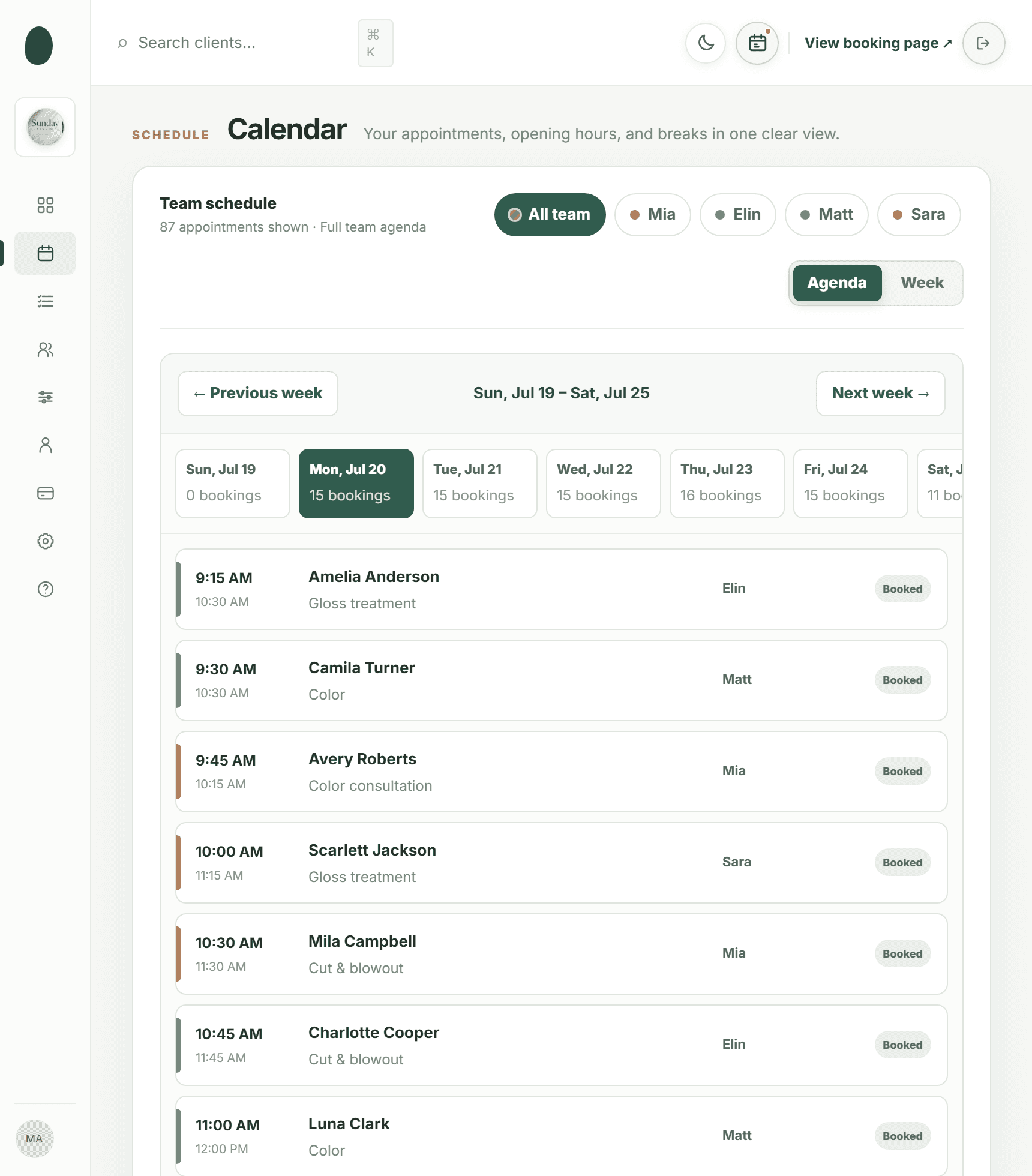
For a solo hairstylist, the useful distinction is that the system is not only a public calendar. You can set service duration, cleanup or buffer time, price, optional deposit, and professional assignment. Double-booking protection checks hours, breaks, time off, and existing bookings. Client records let you search by name, email, or phone and keep private notes and visit history. If you later add professionals, the team calendar supports week and day views, filters, and color coding.
Kevonia is also designed for owners who want predictable pricing as the business grows. It has one plan at US$49.99 per month, with unlimited team members, bookings, clients, and services, no per-booking commission, and no per-seat charge. The free trial lasts 14 days, requires no credit card to start, and can be canceled before the trial ends without a charge. Evaluate it against your actual workflow: publish a few services, add your hours and breaks, test a deposit, and walk through a client cancellation before you decide whether it is the right fit.
There are boundaries to keep in mind. Kevonia is not a multi-location management system from one account, retail or inventory POS, a marketing or SMS campaign platform beyond the booking reminder email, or a native mobile app. If your independent business needs those specific capabilities, list them separately before choosing your operating stack. For a single location or growing team that mainly needs booking, scheduling, client records, service setup, availability controls, and Stripe payments, the fit is more direct.
Run the first 90 days like an experiment
Your first three months should answer practical questions: Which services fill fastest? Which appointments run over? How many clients rebook? Where do cancellations happen? Are you earning enough per working hour? Is your booking page clear on a phone? Treat the launch as a controlled test instead of assuming your first menu and schedule are permanent.
- Days 1–30: Confirm licenses, insurance, banking, policies, service timing, booking settings, client communication, and the physical setup. Personally test every booking and payment path.
- Days 31–60: Compare booked hours with completed hours, review cancellations and no-shows, ask clients where the process felt unclear, and adjust services that consistently overrun.
- Days 61–90: Review revenue, expenses, average ticket, rebooking, utilization, and owner pay. Decide whether to change prices, hours, deposits, service duration, or the rental arrangement.
- Every week: Reconcile payments, record expenses, check upcoming appointments, confirm supplies, and reserve time for business administration.
- Every month: Move the planned tax amount, review your cash reserve, inspect your policies, and identify one bottleneck to fix.
Track a small set of numbers consistently: completed appointments, revenue, average ticket, rebooking rate, cancellation rate, no-show rate, booked hours, completed service hours, and revenue per available hour. The goal is not to chase every metric. It is to see whether your calendar is producing the income and lifestyle you intended. Kevonia’s overview includes appointment and client counts, recent booking activity, no-shows as a percentage of the last 30 days’ bookings, and revenue trends that can help you spot patterns.
The strongest launch is usually the least complicated one: a legal setup you understand, a menu you can deliver on time, prices that cover the business, policies you will enforce, a clear booking link, and accurate records. Add tools and services only when they solve a demonstrated problem.
Sources
- U.S. Small Business Administration — Launch your business
- U.S. Small Business Administration — Calculate your startup costs
- U.S. Small Business Administration — Open a business bank account
- Internal Revenue Service — Estimated taxes
- Internal Revenue Service — Self-employed individuals tax center
- Internal Revenue Service — Employer identification number
- Internal Revenue Service — Get an employer identification number
- Internal Revenue Service — What kind of records should I keep?
- U.S. Department of Labor — Employment relationship under the FLSA
- U.S. Department of Labor — Myths about misclassification
- Kevonia — Hairdressing booking system
- Kevonia — Salon booking program
- Kevonia — Kevonia home page
- Kevonia — How many clients can a stylist see in a day?
- Kevonia — How to price salon services
- Kevonia — How to stop fake salon bookings in 2026
- Kevonia — Salon KPIs to track in 2026
Frequently asked questions
How much money should I have before going independent as a hairstylist?+
There is no universal number because rent, location, equipment, licensing, insurance, and service mix vary. Build a list of one-time costs and monthly costs, then create a conservative forecast that includes your personal pay target and a cash reserve. Test whether the business can cover essential expenses during a slow month, not only during a fully booked month. An accountant or small-business counselor can help you validate the assumptions.
Should I rent a booth, open a suite, work from home, or stay part-time first?+
Choose the model that gives you enough control without creating fixed costs you cannot support. Renting a chair first steps should include reviewing the agreement, confirming what you control, calculating the true monthly cost, and checking whether you own your client records and booking process. A part-time transition may reduce risk, while a private suite or home studio may offer more branding control but require more responsibility and compliance checks.
Can I take my salon clients with me when I leave?+
Do not assume the answer is yes. Review your employment agreement and local law for confidentiality, non-solicitation, non-compete, notice, and client-ownership terms. Do not copy a salon database or use private client information without permission. Communicate your new business professionally, provide a clear booking option, and allow clients to decide whether they want to follow you.
What business setup does an independent hairstylist need?+
At minimum, investigate your state and local license requirements, business registration, business name or DBA rules, tax registrations, insurance, banking, payment handling, and written policies. You may need an EIN depending on your structure and circumstances. Because requirements differ by location, confirm them with the relevant government agencies and a qualified accountant or attorney rather than relying on a generic checklist.
How do I stop cancellations and no-shows from hurting my income?+
Use a clear cancellation window, realistic minimum notice, deposits for appropriate services, an automatic reminder, and a consistent late-arrival policy. Keep records of cancellations and no-shows so you can identify patterns. Avoid making every client deal with a complicated process; a short policy that is visible before booking is easier to enforce. For repeated abuse, consider restricting online booking based on documented behavior.
What should my booking software do if I am working alone?+
It should let clients book the correct service at the correct duration, show only real availability, prevent conflicts, collect deposits or payments when needed, send reminders, and preserve useful client records. It should also support your policies for breaks, time off, closures, minimum notice, cancellations, and refunds. Kevonia provides those scheduling, booking, client-record, availability, reminder, and Stripe payment functions, but you should test the workflow with your actual services before committing.
More from the blog

How Much to Pay a Hairstylist in 2026: A Practical Guide
A practical 2026 guide to setting hairstylist pay. Compare hourly, commission, and hybrid models, calculate the real cost, and avoid common payroll mistakes.

Salon KPIs: 15 Metrics Every Salon Should Track in 2026
The right salon KPIs show where your money, time, and clients are going. Use this practical guide to choose metrics, calculate them, and act on the results.

How Much Does It Cost to Run a Salon? Build Your Real Monthly Budget
A salon may cost a few thousand dollars a month as a solo suite or tens of thousands with employees. Here is how to calculate your own number instead of relying on a generic average.