How Much to Pay a Hairstylist in 2026: A Practical Guide
A practical 2026 guide to setting hairstylist pay. Compare hourly, commission, and hybrid models, calculate the real cost, and avoid common payroll mistakes.

Key takeaways
- Use local market data, role expectations, and your salon’s service economics—not one national number—to set pay.
- A commission plan must define exactly what counts as sales, when commission is earned, and how refunds, discounts, tips, and no-shows are handled.
- Budget for the full employment cost, including paid non-service time, payroll taxes, supplies, benefits, training, and guaranteed minimums.
- Classify workers based on the actual working relationship, not simply the label in a contract or the way you pay them.
- Kevonia helps owners connect service pricing, professional assignments, availability, bookings, deposits, and payment records when reviewing stylist profitability.
The real question behind “how much to pay a hairstylist”
If you own a salon, you are usually asking two questions at once: what will attract and retain a capable stylist, and what can the business afford without destroying its margin? There is no single national rate that answers both. The right amount depends on experience, location, service mix, demand, schedule, benefits, supplies, and whether the stylist is an employee or genuinely in business for themself.
As a starting benchmark, the U.S. Bureau of Labor Statistics reported a median hourly wage of $17.21 for hairdressers, hairstylists, and cosmetologists in May 2025, with the lowest 10% earning below $13.00 and the highest 10% earning above $34.23. The data include tips and exclude self-employed workers, so they are useful context—not a ready-made pay scale for your salon. (bls.gov)
Start with a pay range, not one magic number
Before choosing a rate, write down what the role actually requires. A junior stylist who is building a book, assisting with shampooing, and receiving close supervision should not automatically have the same compensation as a senior colorist who handles consultations, corrections, rebooking, and complex services independently. Your pay range should reflect the value and responsibility of the role, not just the job title.
- Define the level: assistant, junior stylist, stylist, senior stylist, educator, or manager.
- List the services the person can perform without supervision.
- Record expected availability, including evenings, weekends, opening, closing, and holiday coverage.
- Decide whether the role includes consultations, retail recommendations, rebooking, mentoring, inventory tasks, or reception coverage.
- Separate guaranteed pay from variable pay, tips, bonuses, and benefits.
- Review the range against local job listings, your current team, and the revenue each role can realistically produce.
Use the BLS number as a broad national reference, then adjust for your city and business model. A high-cost metropolitan salon with strong demand, advanced color services, and paid education may need a substantially higher offer than a lower-cost salon hiring an entry-level stylist. Conversely, a commission plan can produce more than an hourly rate during a full book, but only if the stylist has enough demand and the rules are transparent.
For a deeper look at capacity and appointment volume, use the salon’s expected service hours rather than guessing from a full-time schedule. A stylist may be present for 40 hours but provide services for only 25 to 30 of those hours after setup, cleanup, breaks, cancellations, consultations, education, and administrative work. That difference matters when you test whether a proposed rate is affordable.
Choose the compensation model that fits your salon
Most salons use one of three approaches: hourly or salary-style guaranteed pay, commission, or a hybrid. None is automatically better. The best model is the one your team can understand, your payroll can support, and your pricing can fund during both busy and quiet weeks.
Hourly pay is straightforward. You pay for time worked, including time spent preparing, cleaning, consulting, attending meetings, or waiting during a slow period. It gives newer stylists predictability and gives owners a simple way to staff the floor. The tradeoff is that your labor cost continues when the book is light, so you need realistic scheduling and service pricing.
Commission ties compensation to service revenue or another clearly defined production measure. It can reward productivity and give experienced stylists a path to higher earnings, but it becomes confusing when owners do not define whether commission applies before or after discounts, refunds, deposits, product charges, taxes, or adjustments. A commission model also needs a process for slow days, training time, and appointments that are cancelled or marked as no-shows.
A hybrid model combines a guaranteed hourly rate with commission above a threshold, or a base rate with bonuses for rebooking, retention, or team goals. It can balance security and performance, but it has more moving parts. If you use one, show employees example paychecks for a slow week, an average week, and a strong week before they agree to the plan.
- Choose hourly when predictability, training, and shared floor coverage are central to the role.
- Choose commission when the stylist controls a meaningful book and your service prices support variable compensation.
- Choose hybrid pay when you want a guaranteed floor but also want production incentives.
- Avoid changing models casually; document the change, explain the reason, and confirm how existing bookings and earned commissions are treated.
How to calculate commission without losing money
The most common commission mistake is treating the advertised service price as the same thing as profitable revenue. Start with the amount the salon actually keeps from the service, then subtract the costs that belong in your model. For example, if a haircut is listed at $80 and you offer a 20% discount, decide whether commission is based on $80 or the $64 collected. Put that decision in writing before the first paycheck.
A clear hair stylist commission percentage is only useful when the commission base is clear. One workable formula is: commissionable service revenue × commission rate = service commission. You might exclude sales tax, pass-through fees, refunded amounts, and gratuities, while treating deposits as part of the service payment once the appointment is completed. The specific choices are yours, but ambiguity will create disputes.
Consider a stylist who completes $6,000 in commissionable service revenue in a pay period at a 40% rate. The service commission is $2,400 before any separate bonuses or deductions allowed by law and your written policy. If $500 of that revenue came from discounted or later-refunded appointments, the result changes depending on your stated rules. Run these examples before launching the plan, not after an employee challenges a paycheck.
- State whether commission is calculated on booked, completed, paid, or collected services.
- Explain how discounts, refunds, corrections, complimentary services, packages, gift cards, and deposits are handled.
- State whether retail sales, add-on services, and product charges are included or paid under a separate rate.
- Define when commission is earned and when it appears on payroll.
- Explain what happens to commission when a client cancels, no-shows, disputes a card payment, or receives a refund.
- Show how the plan works when commission is lower than the guaranteed minimum you must pay.
Do not use commission to disguise unpaid work. If a stylist must attend meetings, complete required training, open the salon, clean stations, or remain available under your direction, account for that time in the compensation plan and payroll process. A plan that looks generous on service tickets can feel unfair when a stylist spends several unpaid hours each week doing required work.
Build the full labor budget, not just the paycheck
To decide how much to pay a hairstylist, calculate the fully loaded labor cost. The paycheck is only one line. Add employer payroll costs, required insurance, paid leave or benefits, education, tools and supplies you provide, front-desk support, laundry, color waste, payment processing, and the cost of empty appointment time. If the stylist receives a guaranteed hourly rate, include the hours you expect to pay when the schedule is not full.
A simple planning example can expose problems quickly. Suppose a stylist is scheduled for 32 hours per week at $24 per hour. The direct scheduled wage is $768 per week before employer costs and benefits. If only 24 of those hours are realistically service-producing, the wage cost attached to each productive hour is $32 before supplies and other overhead. That does not mean the stylist is overpaid; it means your prices and utilization must support the complete operating model.
- Estimate scheduled hours per week.
- Estimate productive service hours after breaks, cleanup, consultations, education, and expected gaps.
- Forecast service revenue using realistic average tickets, not your highest-priced service.
- Subtract product cost, payment costs, discounts, refunds, and other service-level expenses.
- Add wages, commissions, payroll burden, benefits, education, and paid non-service time.
- Compare the result with the contribution margin your salon needs to cover rent, management, software, marketing, and profit.
This is also where service pricing matters. If a two-hour color appointment is priced too low, increasing the commission rate may make the service busier but less profitable. Review the service duration, cleanup or buffer time, product usage, and stylist pay together. Kevonia’s service menu lets you define duration, cleanup or buffer time, price, optional deposit, and professional assignment, which gives you cleaner booking data for this review.
For a broader margin review, compare labor decisions with rent, supplies, marketing, and other operating costs instead of judging pay in isolation. A profitable salon can pay well, but it must know which services and schedules create enough contribution to support that promise.
Employee, booth renter, or independent contractor?
The pay arrangement and the worker’s legal classification are related, but they are not the same decision. Calling someone a booth renter or independent contractor does not make that classification correct. The IRS says businesses should consider behavioral control, financial control, and the type of relationship, while the Department of Labor applies an economic-realities analysis under the Fair Labor Standards Act.
Questions that deserve professional review include who sets the schedule, prices, service standards, and policies; who supplies the tools and products; who controls the client relationship; whether the stylist can accept or decline work; whether the relationship is ongoing; and whether the stylist operates an independent business serving multiple clients or businesses. State and local rules may also apply, so do not rely on a generic salon contract downloaded from the internet.
The Department of Labor specifically notes that the label, a 1099 form, the place where work occurs, and the way a worker is paid do not by themselves determine status. If you control hiring, firing, scheduling, prices, pay rates, and day-to-day performance, those facts may point toward an employment relationship. Get advice from an employment attorney or qualified payroll tax professional when the facts are close.
- Do not choose contractor status merely to avoid payroll administration.
- Do not assume a signed agreement overrides the actual working relationship.
- Document who controls schedules, pricing, supplies, client records, and service standards.
- Check federal, state, and local requirements before making the arrangement.
- Revisit classification when the role, schedule, pricing authority, or business relationship changes.
Make the pay plan understandable to the team
A fair plan is not only mathematically workable; it is easy for a stylist to verify. Give each person a written compensation summary that shows the base rate or commission rate, pay period, overtime or premium-pay treatment where applicable, tips, bonuses, deductions, payroll dates, and examples. Avoid phrases such as “competitive commission” or “up to” unless the document explains exactly how the number is reached.
Define the salon pay structure before you hire. Explain whether the salon supplies color, backbar products, tools, education, uniforms, booking support, and marketing. Explain who owns the client records, who handles rebooking, and how appointments are reassigned when someone is absent or leaves. These details affect the value of the offer even when they do not appear as dollars on the wage line.
- Give a sample calculation for a slow, average, and strong pay period.
- Show how tips are recorded and paid.
- State how time off, sick days, training, meetings, and closing duties are handled.
- Explain how raises are earned: tenure, technical skills, service demand, retention, leadership, or a documented review.
- Set a review date, such as 60 or 90 days after starting and then at regular intervals.
- Invite questions before the stylist begins taking clients, not after the first disputed paycheck.
Track performance with more than sales. Useful measures include completed service revenue, average ticket, rebooking rate, retention, utilization, cancellations, no-shows, correction work, client feedback, and contribution margin by service. A stylist with a smaller book but excellent retention and low rework may be more valuable than someone producing a larger but unstable sales total.
Where Kevonia fits into the pay decision
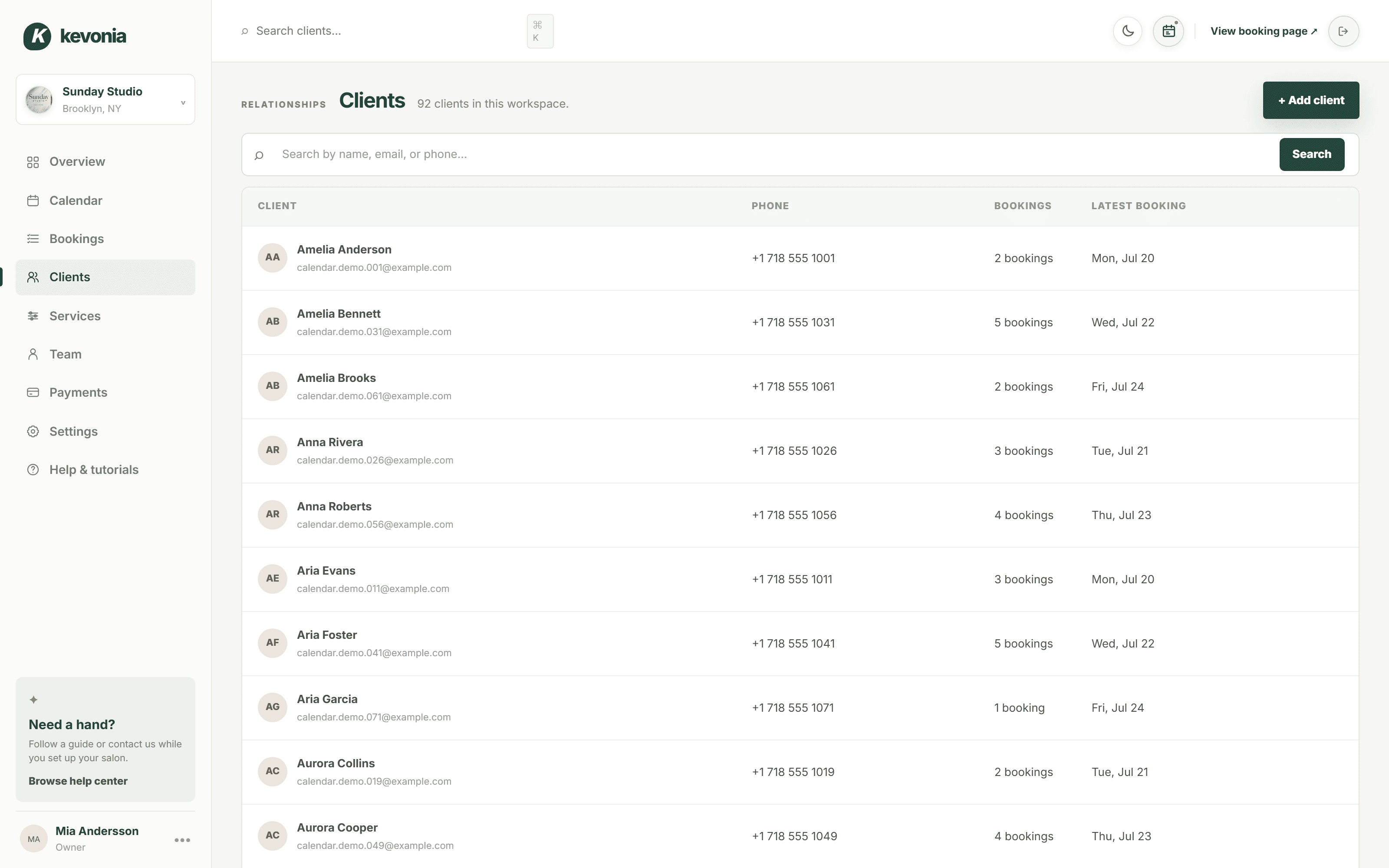
Kevonia is most useful when you are connecting compensation decisions to actual appointment and payment activity. It provides a branded online booking page plus a workspace with a team calendar, client records, a service menu, availability rules, and Stripe payments. That gives an owner one operational place to review who is booked, what service is being performed, when it is scheduled, and whether an online payment or deposit was collected.
For a multi-stylist salon, the team calendar includes week and day views, professional filters, and color coding. Double-booking protection checks hours, breaks, time off, and existing bookings. Those controls matter to payroll planning because an overbooked calendar can create service delays and burnout, while an underfilled calendar can make a guaranteed wage harder to support.
You can assign services to specific professionals and set duration, cleanup or buffer time, pricing, and optional deposits. Clients choose a service, professional, date, and time through the booking page. The resulting schedule is more useful for compensation reviews than a simple total of appointments because it reflects service type, assigned professional, expected time, and payment status.
Kevonia also records booking statuses such as needs confirmation, awaiting payment, booked, checked in, completed, no-show, and cancelled. Online payments and deposits are processed through Stripe and paid out to the salon’s bank account. If a refund is needed, the salon can issue it from the booking, see the Stripe processing fee shown for the refund, and have the client emailed automatically. That visibility helps you reconcile commissionable revenue instead of paying from an unreliable appointment count.
The product is a single plan at US$49.99 per month with unlimited team members, bookings, clients, and services, and no per-booking commission. It includes a free 7-day trial with no credit card required to start; cancel anytime before the trial ends and you are never charged. For an owner comparing software cost with labor administration time, those terms make the expense easy to include in the monthly operating budget.
Review the plan after 30, 60, and 90 days
Do not wait for an annual review to discover that a pay plan is failing. After the first 30 days, check whether the stylist understands the rules, whether scheduled hours match actual work, and whether the service menu and booking times are realistic. After 60 days, review revenue, utilization, rebooking, cancellations, no-shows, product usage, and payroll cost. At 90 days, decide whether the role, rate, schedule, training, or pricing needs to change.
- If the stylist is consistently full, review whether prices and compensation still reflect demand and skill.
- If the stylist is underbooked, investigate availability, service mix, consultation quality, local demand, and marketing before cutting pay.
- If payroll is high but revenue is healthy, inspect product waste, idle hours, discounting, and service duration.
- If revenue is weak and the stylist is busy, check whether the menu is underpriced or appointments are taking too long.
- If disputes keep occurring, rewrite the compensation policy with examples instead of adding informal exceptions.
Keep the conversation specific. Bring the stylist’s actual schedule, completed services, pay calculations, cancellations, and client retention data. Ask what is preventing better performance and what support would help. A compensation review should improve the business and the person’s earning opportunity, not become a surprise judgment based on impressions.
The short answer to how much to pay a hairstylist is therefore: enough to be competitive for the role and location, structured so strong work can lead to higher earnings, and low enough—after every labor and operating cost—to leave the salon with a sustainable margin. Start with evidence, write the rules, and revisit the numbers as demand changes.
Sources
- U.S. Bureau of Labor Statistics: Barbers, Hairstylists, and Cosmetologists Occupational Outlook Handbook
- U.S. Bureau of Labor Statistics: National Employment and Wage Data, May 2025
- U.S. Department of Labor: Fact Sheet 13, Employment Relationship Under the Fair Labor Standards Act
- Internal Revenue Service: Independent Contractor or Employee?
- Kevonia: Hair Salon Booking Software
- Kevonia: Hairdressing Booking System
- Kevonia: Salon Booking Program
- Kevonia: Home page
- Kevonia blog: How Many Clients Can a Stylist See in a Day?
- Kevonia blog: Salon Profit Margin: How to Calculate and Improve Yours in 2026
Frequently asked questions
What is a reasonable starting point for hairstylist pay in 2026?+
Use the latest local market evidence first, then compare it with the role’s skill level and expected schedule. As a national reference, the BLS reported a May 2025 median hourly wage of $17.21 for hairdressers, hairstylists, and cosmetologists, including tips. That figure excludes self-employed workers and does not account for your local cost of living, benefits, paid non-service time, or salon-specific responsibilities, so it should not be copied directly into an offer.
Is hourly pay or commission better for a hairstylist?+
Hourly pay is easier to understand and protects income when the stylist is training, cleaning, consulting, or waiting during a slow period. Commission can reward production and create more upside for an established stylist with a reliable book. A hybrid plan can provide a guaranteed floor plus an incentive. Choose the model your pricing, demand, payroll process, and team expectations can support consistently.
What commission rate should a salon pay a hairstylist?+
There is no universal rate that works for every salon. First calculate the service revenue left after discounts, refunds, product costs, payment costs, and other expenses you include. Then test several rates against realistic utilization and average tickets. Put the commission base in writing, including how tips, deposits, gift cards, no-shows, refunds, complimentary services, and discounted appointments are treated.
Should commission be based on booked revenue or collected revenue?+
For most salons, collected or completed service revenue is easier to reconcile than booked revenue because bookings can be cancelled, refunded, discounted, or changed. Whatever basis you choose, define when commission is earned and how adjustments are handled. A written example is more valuable than a general promise because it shows what happens in ordinary and unusual cases.
Can I pay a hairstylist as an independent contractor?+
Only if the actual relationship meets the applicable legal tests. The IRS and Department of Labor look at control, financial independence, the nature of the relationship, opportunity for profit or loss, permanence, investment, and other facts. A contract, 1099 form, or commission arrangement does not automatically create contractor status. Consult a qualified professional when the classification is uncertain.
How can booking software help me decide whether stylist pay is affordable?+
Reliable booking and payment records let you compare scheduled time, service type, assigned professional, completed revenue, deposits, refunds, cancellations, and no-shows. Kevonia combines a branded booking page, team calendar, service menu, availability rules, client records, and Stripe payments. That can make a pay-plan review more concrete than relying on appointment counts or handwritten totals.
More from the blog

Going Independent as a Hairstylist: A Practical 2026 Guide
A step-by-step 2026 guide to going independent as a hairstylist, from choosing your business model and pricing services to moving clients, managing bookings, and staying organized.

How Much Does It Cost to Run a Salon? Build Your Real Monthly Budget
A salon may cost a few thousand dollars a month as a solo suite or tens of thousands with employees. Here is how to calculate your own number instead of relying on a generic average.

How Much Rent Can a Salon Afford in 2026?
There is no single rent number that works for every salon. Use your realistic revenue, total occupancy cost, staffing model, and break-even point to set a safe monthly limit.