How Many Clients Can a Stylist See in a Day?
A stylist may see anywhere from 4 to 12 clients in a day, depending on service length, setup time, breaks, and the salon’s schedule. Here’s how to calculate a realistic target.

Key takeaways
- Most stylists can realistically serve about 4 to 12 clients per day, but service mix matters more than the headline number.
- Calculate capacity from available service minutes, then subtract breaks, cleanup, consultation, and recovery time.
- A full calendar is not automatically a healthy or profitable calendar; monitor revenue, rebooking, no-shows, and staff fatigue together.
- Use service durations, buffer time, availability rules, and double-booking protection to turn a capacity target into a workable schedule.
- Kevonia gives salon owners a team calendar, service menu, availability rules, client records, online booking, and Stripe payments in one workspace.
The Short Answer: There Is No Single Daily Client Limit
If you searched “how many clients can a stylist see in a day,” you probably want a planning number—not a vague answer that every salon is different. As a practical starting point, a stylist working a seven- to eight-hour shift may see roughly 4 to 8 clients when services are mostly cuts, blowouts, or other appointments lasting 45 to 90 minutes. A stylist focused on quick cuts or express services may see 8 to 12 or more. A colorist, bridal stylist, or specialist doing long appointments may serve only 2 to 5 clients.
The right target is the number of appointments a stylist can complete accurately, on time, and repeatedly without skipping breaks or damaging the client experience. For most owners, the useful question is not “What is the maximum possible?” It is “What daily schedule produces reliable work, healthy staff, and enough revenue?”
Typical Clients Per Day by Service Mix
Service length is the biggest factor in daily capacity. Two stylists can work the same eight-hour shift and serve very different numbers of clients because one performs 30-minute haircuts while the other handles color corrections and extension consultations. Use the ranges below as planning benchmarks, not promises or quotas.
- Quick cuts, trims, or basic barber services: about 8–12 clients in a full service day.
- Cuts with shampoo, styling, or consultation: about 5–8 clients.
- Blowouts, silk presses, or styling appointments: about 4–8 clients, depending on hair length and density.
- Color, highlights, balayage, or chemical services: about 2–5 clients.
- Extensions, corrective color, bridal work, or complex transformations: about 1–3 clients.
- Nail, lash, facial, massage, or spa services: often about 4–8 clients, depending on treatment length and sanitation requirements.
These ranges assume the stylist is not booked every minute from opening to closing. The U.S. Bureau of Labor Statistics notes that personal appearance workers need time-management skills, physical stamina, and cleanliness in addition to technical ability. It also notes that schedules commonly include evenings and weekends, so a “full day” should be defined by the actual shift rather than by a standard office schedule. (bls.gov)
How to Calculate Your Salon’s Daily Capacity
Instead of copying another salon’s number, calculate your own salon capacity from the minutes that are genuinely available for client work. Start with the stylist’s scheduled hours, then remove time that cannot be sold as a service.
- Convert the shift into minutes. An eight-hour shift equals 480 minutes.
- Subtract unpaid or protected breaks, lunch, opening tasks, closing tasks, and any staff meeting time.
- Subtract a realistic allowance for consultations, checkout, cleaning, laundry, restocking, and moving between stations.
- Add the service duration and cleanup or buffer time for every appointment type.
- Divide the remaining service minutes by the average appointment block. Round down, because a partial appointment is not a bookable client.
The basic formula is: daily client capacity = usable appointment minutes ÷ average appointment block. For example, a stylist with 480 scheduled minutes might reserve 45 minutes for breaks and 35 minutes for opening, closing, cleanup, and unavoidable admin. That leaves 400 minutes. If the average booked appointment takes 60 minutes including a 10-minute reset, the theoretical capacity is 6.6 appointments, so six clients is the sensible maximum for that shift.
The formula becomes more useful when you calculate it by service rather than using one average. A salon that books a 30-minute haircut, a 75-minute partial highlight, and a 150-minute full color should not treat each appointment as one identical unit. Record the actual time from client arrival through station reset, then review whether the service menu reflects reality. Kevonia’s service menu lets you set duration, cleanup or buffer time, price, optional deposit, and which professionals can perform each service, which helps convert your capacity assumptions into bookable appointment blocks. Explore the salon booking program for a practical way to organize those rules.
Three Realistic Daily Schedule Examples
A few scenarios make the calculation easier to apply. These examples use an eight-hour shift, but the same method works for a six-hour stylist, a part-time nail professional, or a spa therapist working a longer weekend day.
- Cut-focused stylist: Six 60-minute haircut appointments, one 30-minute break, and 60 minutes spread across consultation, cleanup, late arrivals, and closing tasks. This is a steady six-client day with some protection against running behind.
- Mixed-service stylist: Two 60-minute cuts, one 90-minute color refresh, one 150-minute highlight, and one 60-minute blowout. The stylist sees five clients, but the service revenue and workload are not equivalent to five basic haircuts.
- Nail professional: Four 90-minute manicure or pedicure appointments plus one 60-minute express service, with sanitation, room turnover, and a meal break included. Five clients may be a better operating target than trying to squeeze in seven rushed services.
- Spa or treatment specialist: Three 90-minute treatments, a 60-minute consultation or follow-up block, and protected breaks. Three clients can fill most of the day once setup and room turnover are counted.
- High-volume barber schedule: Ten 30-minute cuts over a seven-hour service window, with a longer break and short gaps for cleaning and late arrivals. This can work when services are standardized, but it is a poor model for detailed consultations or complex transformations.
Notice that the client count alone does not tell you whether the day was good. Five high-value appointments may produce more revenue and less physical strain than nine short services. Compare clients served with average ticket, service revenue per booked hour, rebooking, no-shows, and overtime before deciding that a stylist is underperforming.
Maximum Capacity Versus Sustainable Capacity
Your maximum capacity is what fits mathematically. Your sustainable capacity is what a stylist can deliver week after week while maintaining quality, health, and professional energy. Those numbers should not be identical.
Salon work combines standing, repetitive hand movements, sustained concentration, client communication, sanitation, and emotional labor. OSHA guidance for nail salon professionals recommends frequent breaks when possible, changing positions, pacing the work, and stretching between sessions. Although the guidance is written for nail work, the underlying scheduling lesson applies broadly: a calendar that leaves no room to change position or recover is a risk-management problem, not an efficiency victory. (osha.gov)
- Create a protected meal or recovery period instead of relying on an empty slot that clients can book.
- Leave longer buffers after corrective color, chemical services, or appointments with a history of running over.
- Avoid scheduling demanding services back-to-back all day when the physical posture or hand movement is repetitive.
- Use a shorter target on days when the stylist has training, inventory work, mentoring, or a late closing shift.
- Treat frequent late finishes, rushed consultations, and skipped breaks as evidence that the target is too high.
For owners, the goal is not to fill every minute. A sustainable schedule can improve punctuality, reduce rework, protect retention, and make it easier for a stylist to recommend the next appointment with confidence. In practice, a calendar operating at 80% to 90% of theoretical capacity may outperform a calendar packed to 100% that regularly creates delays and complaints. That percentage is a management target to test, not a universal industry standard.
How to Set a Practical Daily Target
Set a target separately for each professional and each shift pattern. A senior stylist who performs long color services should not inherit the same appointment count as a barber who specializes in 30-minute cuts. The target should also reflect the professional’s availability, not just the salon’s opening hours.
- List the services each professional actually performs and the real time each one consumes.
- Review four to eight weeks of completed appointments, including late starts, overruns, cancellations, and no-shows.
- Calculate the average appointment block by service, including cleanup and buffer time.
- Choose a normal target and a peak-day target. Do not make the busiest Saturday the standard for every weekday.
- Set a minimum gap for meals, bathroom breaks, station reset, and unexpected client needs.
- Review the target monthly and whenever prices, service durations, staffing, or opening hours change.
A simple rule is to book to the target, not to the theoretical maximum. For example, if the math says a stylist can fit eight 45-minute appointments but the last two weeks show regular 10-minute overruns, set seven as the normal target and investigate the cause. The answer may be inaccurate service durations, too little buffer, consultation work that is not represented in the booking, or a need for better client preparation.
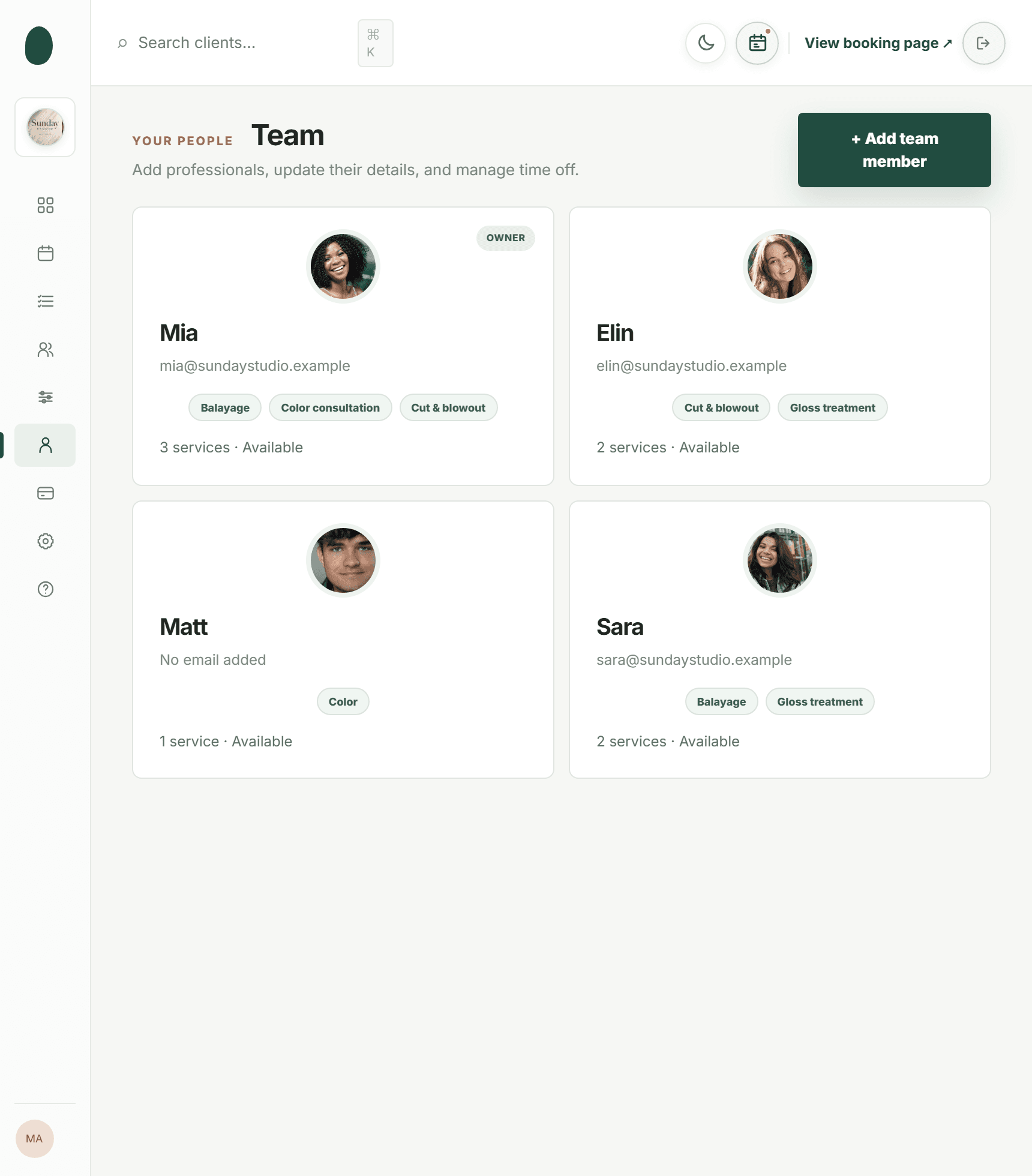
If your team has different schedules, use per-professional availability rather than one generic calendar. Kevonia supports opening hours by weekday, multiple breaks, staff time off, salon closures, booking windows, minimum notice, and time-slot intervals. Its team calendar also provides week and day views with professional filters and color coding. For more detail on the setup process, see the guide to staff availability when you are building a workable schedule.
Increase Completed Clients Without Overbooking
If a stylist is consistently below target, do not immediately add more appointments. First identify where the available minutes are going. Capacity often improves through clearer service design and fewer avoidable gaps rather than through a faster pace.
- Standardize consultation questions so the stylist can identify timing, hair history, and service suitability before the appointment begins.
- Use accurate service durations for different levels of complexity instead of one time block for every version of a service.
- Add cleanup or buffer time where the next client would otherwise inherit the previous appointment’s delay.
- Offer online booking so clients can choose an eligible service and professional without waiting for a phone response.
- Require a deposit for selected high-duration or high-risk appointments if that fits your business policy.
- Use reminders and clear cancellation terms to reduce preventable empty slots.
- Keep a short waitlist or callback process for cancellations, but do not promise a same-day opening until the schedule is confirmed.
- Review whether checkout, payment, rebooking, or record updates are taking time away from the service block.
Double-booking is not a capacity strategy unless the service can genuinely be performed concurrently without lowering quality or creating a safety problem. If a color processes while the stylist starts a suitable haircut, that may be intentional scheduling. If two clients both need the stylist’s hands at the same time, it is simply an overbooked calendar. Any concurrent-service policy should be documented by service, skill level, and available support.
A booking system should also check the schedule before confirming an appointment. Kevonia’s booking flow checks availability against hours, breaks, time off, existing bookings, and other rules. That is especially useful when several professionals have different schedules or when you are managing nail salon booking software alongside hair, spa, or beauty services.
Where Kevonia Fits in the Capacity Planning Process
Kevonia is useful when your challenge is turning a staffing target into a schedule clients can actually book. It provides a branded online booking page at kevonia.com/your-salon, open around the clock, where clients choose a service, professional, date, and time. Behind that page, the workspace includes a team calendar, client records, service menu, availability rules, and Stripe payments.
The difference is practical rather than theoretical: you define how long a service takes, who can perform it, when each professional is available, and what buffers or notice rules apply. Clients then see the slots that fit those settings instead of requesting any time that appears open on a simple calendar. The system also helps owners review completed appointments, no-shows, client totals, and revenue trends when deciding whether a target should change.
Kevonia may fit a small salon, barbershop, nail salon, spa, med spa, esthetician studio, lash studio, beauty clinic, wellness studio, or massage practice that wants one workspace for scheduling and client information. It does not provide multi-location management from one account, retail or inventory POS, marketing or SMS campaign tools beyond the booking reminder email, or a native mobile app, so confirm that the rest of your operating requirements are covered elsewhere.
The plan is US$49.99 per month with unlimited team members, bookings, clients, and services, no per-booking commission, and no per-seat charge. The trial is free for 14 days, no credit card is required to start, and you can cancel anytime before the trial ends without being charged. Those terms matter when you are testing whether better scheduling improves utilization and revenue before committing to a longer operating change.
Measure Whether Your Daily Target Is Working
After setting a target, measure outcomes for at least several weeks. A stylist who sees six clients may be fully booked and profitable, while another who sees six may have too many gaps or too much unpaid work between appointments. Look at the whole day, not just the number of names on the calendar.
- Completed clients: How many appointments were actually completed, excluding cancellations and no-shows?
- Booked hours: How many hours were reserved, and how many were delivered as services?
- Average ticket: What did the average completed client spend before or after discounts?
- Revenue per booked hour: Is the service mix paying appropriately for the time consumed?
- Rebooking rate: How often does a client leave with a future appointment?
- No-show and late-cancellation rate: How much planned capacity disappears without revenue?
- On-time completion: How often does the stylist finish within the scheduled block?
- Overtime and skipped breaks: Is the target creating hidden labor or health costs?
- Client feedback and rework: Are rushed services producing corrections, complaints, or refunds?
A useful salon utilization rate compares time booked or completed with the time genuinely available for appointments. Define the denominator carefully: if you include lunch, meetings, and blocked time that was never meant to be bookable, the result will look worse than the operation really is. If you exclude every cleanup and recovery period, it will look better than the day feels.
Use the results to adjust one variable at a time. You might add a 10-minute buffer to color services, shorten an express service only after testing the workflow, move a break to a predictable time, or change the number of online slots released each day. Kevonia’s overview screen can show appointments, new and total clients, no-shows as a percentage of recent bookings, revenue comparisons, and a 30-day revenue chart, giving owners a practical starting point for that review.
Sources
Frequently asked questions
How many clients can a stylist see in a day?+
A realistic range is about 4 to 8 clients for many full-service stylists, 8 to 12 for quick-cut or express-service schedules, and 2 to 5 for colorists or specialists handling long appointments. Calculate your own target using usable appointment minutes divided by the average service block, including cleanup and buffer time.
Can a stylist see 10 clients in one day?+
Yes, if the services are short, standardized, and scheduled across a long enough service window. Ten 30-minute cuts is very different from ten color appointments. Confirm that the plan includes breaks, sanitation, consultation, checkout, late arrivals, and enough time to finish without regular overtime.
How many appointments per day salon owners should schedule per stylist?+
Start with each stylist’s service mix and shift length rather than assigning one salon-wide quota. A cut-focused stylist may have a target near 6 to 10 appointments, while a colorist or treatment specialist may have a target near 2 to 5. Review completed work, revenue per booked hour, rebooking, no-shows, and overtime before changing it.
Should every stylist be booked 100% of the day?+
No. A completely full calendar leaves no room for breaks, cleanup, consultation, late arrivals, corrections, or unexpected client needs. Book to a sustainable target below the mathematical maximum, then adjust service durations and buffers when the data shows repeated delays or unused time.
How do I calculate salon capacity for a mixed service menu?+
Calculate each appointment block using service duration plus cleanup or buffer time, then place those blocks into each professional’s actual available minutes. Do not divide the day by one average if the menu contains short cuts, medium styling services, and long color or treatment appointments. Test the schedule against real completed appointment times.
Can booking software help me see more clients without overbooking?+
Yes, if it uses accurate service durations, professional assignments, availability rules, breaks, time off, and existing-booking checks. Kevonia lets you configure those scheduling details, publish a branded online booking page, maintain client records, and accept Stripe payments and deposits. Software cannot make an unrealistic service block workable, but it can prevent avoidable scheduling errors.
More from the blog
What to Do When a Stylist Calls in Sick: A Salon Owner’s Plan
A stylist calling in sick can disrupt a full day of appointments. Use this practical plan to protect clients, reassign services, communicate clearly, and prevent repeat problems.
What to Do When a Stylist Leaves Your Salon in 2026
A stylist’s departure can disrupt appointments, client relationships, and revenue. Use this practical 2026 checklist to protect the salon and give clients a smooth transition.

Junior vs Senior Stylist Pricing: A 2026 Guide for Salon Owners
A practical guide to setting junior and senior stylist prices, choosing the right price gap, explaining the difference to clients, and reviewing tiers as your team grows.