Junior vs Senior Stylist Pricing: A 2026 Guide for Salon Owners
A practical guide to setting junior and senior stylist prices, choosing the right price gap, explaining the difference to clients, and reviewing tiers as your team grows.

Key takeaways
- Price stylist levels around skill, demand, speed, service complexity, and business results—not tenure alone.
- A clear tier system usually works better than arbitrary discounts or unexplained price differences.
- Review pricing with real service-time, rebooking, correction, and profitability data at least quarterly.
- Publish the difference between levels so clients understand what they are choosing before they book.
- Use booking software to assign prices, availability, deposits, and appointment records consistently across the team.
What clients and owners really want to know about junior vs senior stylist pricing
When someone searches for junior vs senior stylist pricing, they usually want a practical answer to two questions: how much should the price difference be, and what should the client receive for paying more? For salon owners, the decision is not simply about charging more for experience. It is about matching price to demand, technical ability, appointment time, supervision, service consistency, and the value a stylist currently creates.
There is no universal national price list that makes one stylist level correct for every salon. A useful tier system gives clients a choice, pays the business for higher complexity and demand, and gives newer stylists a clear path to grow. The best structure is easy to explain, profitable after labor and product costs, and simple for the front desk or online booking page to apply accurately.
What the stylist levels should mean
Start by defining the levels in terms of observable responsibilities rather than vague labels. “Junior” should not mean unlicensed, unsafe, or incapable. In most salons, a junior stylist may be fully licensed but still building speed, consultation skills, repeat demand, or confidence with advanced services. A senior stylist usually brings stronger consistency, more complex technical judgment, a larger returning clientele, or higher demand for limited appointment times. We cover this in more depth in how to pay a hairstylist.
- Junior or associate: developing speed, repeat clientele, consultation confidence, and service range. May need defined service limits, education support, or a review process.
- Intermediate or stylist: independently delivers the salon’s core services at the expected quality and timing, with a growing book of repeat clients.
- Senior or master: consistently handles advanced consultations, corrective or complex work, high demand, education responsibilities, or leadership duties.
- Specialist: an optional tier for a particular skill, such as blonding, extensions, textured hair, bridal styling, or corrective color. Use it only when the expertise is real and easy to explain.
Do not automatically promote someone because they have been employed for a certain number of months. Tenure can be part of the decision, but it should be supported by evidence such as completed services, rebooking, consultation quality, timing accuracy, client retention, correction rates, retail or add-on performance where applicable, and the stylist’s ability to work without avoidable supervision. A written level rubric makes promotions less personal and easier to defend. We cover this in more depth in salon services.
The Bureau of Labor Statistics reports that earnings for hairdressers, hairstylists, and cosmetologists vary by experience, responsibility, performance, tenure, and geographic area. That supports using several measures for a tier decision instead of treating years in the industry as the only measure of value. (bls.gov)
How much more should a senior stylist cost?
For many salons, a sensible starting point is a 10% to 25% difference between adjacent stylist levels for the same service. That is a planning range, not a rule. A smaller gap can make sense when junior and senior stylists perform nearly identical services in similar appointment times. A larger gap can make sense when the senior stylist has substantially higher demand, works faster without reducing quality, handles corrective work, or provides a scarce specialty.
For example, if a standard haircut is $60 with a junior stylist, a 15% increase would place the senior price at $69. If a partial highlight is $140 at the junior level, a 25% increase would make the senior price $175. These examples are not recommended market prices; they show how to test the spread while keeping the difference visible and understandable.
- Calculate the junior price from the service’s required time, labor, product, overhead, payment costs, and target margin.
- Estimate what the senior stylist adds: higher demand, greater speed, more advanced technique, stronger retention, or a premium specialty.
- Test a price gap that is meaningful to the business but not so large that clients perceive the junior option as inferior or the senior option as unjustifiable.
- Compare the expected price increase with actual booking demand. If senior appointments remain full while junior capacity is open, the gap may be too small or the junior offer may be poorly explained.
- Review the result after four to eight weeks using revenue per booked hour, rebooking, cancellations, corrections, and client feedback.
Price the appointment, not just the title. A senior stylist taking three hours for a color correction should not be compared directly with a junior stylist taking 90 minutes for a haircut. Track revenue per available hour and contribution after product cost. A stylist who charges less but takes much longer may be less profitable than a stylist with a higher ticket and tighter timing. We cover this in more depth in how many clients a stylist can see.
Build salon price tiers by stylist without confusing clients
The client should see a choice, not an internal ranking exercise. Use plain-language descriptions on the menu: “Our junior stylists are licensed professionals building their clientele and may take additional time for some services. Our senior stylists have more experience with advanced techniques and are in higher demand.” Adjust the wording to match your team, but explain the practical difference before the client selects a provider.
- Show the stylist level beside the provider’s name wherever the client chooses a professional.
- Keep the service name consistent across levels when the service itself is the same; place the level-based price beside it.
- Explain whether the level changes the included consultation, appointment length, technique, products, or simply the provider’s experience and demand.
- State that complex work may require a consultation or a revised quote before the service begins.
- Train the front desk to recommend based on the client’s goals, budget, timeline, and desired level of expertise—not only on who has an opening.
Avoid calling the lower tier a “discount” unless you truly intend to position it as a promotion. A junior price is usually a regular price for a different provider level, not a temporary sale. That distinction protects the stylist’s credibility and prevents clients from waiting indefinitely for a discount. It also makes promotions easier to manage because a promotional offer can be layered onto an established price structure.
A graduated pricing salon should also decide how to handle a client who books a junior stylist but needs senior-level intervention. Set a policy before it happens. The stylist might complete the service with guidance, pause for a consultation, transfer the appointment, or recommend a future booking with a senior provider. Tell the client what is happening and confirm any price change before additional work begins.
Set different levels by service, not only by stylist
A single blanket percentage across every service is easy to administer, but it may not reflect how value is created. The gap between levels may be modest for a basic trim and wider for blonding, extensions, corrective color, or a transformation where consultation and technical judgment carry more risk. Some services may not need level pricing at all if the salon wants one consistent price for a tightly standardized process.
- Haircuts: consider demand, consultation quality, finishing skill, and time accuracy.
- Color: consider formulation judgment, correction experience, sectioning precision, and the cost of mistakes or rework.
- Blonding and corrective services: use a consultation, realistic timing, and a deposit when appropriate; do not promise a result solely because a stylist is senior.
- Extensions: price by method, hair cost, maintenance requirements, and specialist training rather than by title alone.
- Blowouts and basic styling: a smaller level difference may be enough when the service is standardized and easy to supervise.
- Spa, nail, barber, or beauty services: apply the same logic, but define skill criteria for the actual discipline instead of copying hair-stylist labels.
Keep the service menu operationally precise. Each service should have a duration, cleanup or buffer time, price, and assigned professionals. If a junior stylist is still approved only for certain services, the booking system should prevent clients from selecting unavailable combinations. This is where a service menu with per-professional assignment can reduce manual corrections and make level-based pricing easier to maintain. For more detail, see Kevonia's hair salon booking software.
If a service is priced by time, disclose what is included. For example, “two-hour dimensional color appointment” is clearer than a low starting price that changes after the client arrives. Starting prices may be useful for consultations, but they should not hide the factors that cause the final amount to move.
Compensation, commission, and legal caution
Client pricing and stylist compensation are related but not identical. You can use a tiered client menu while paying stylists through hourly wages, commission, bonuses, a hybrid plan, or another structure that fits your business and local requirements. Before changing compensation, calculate the effect on payroll, paid time, training, product usage, discounts, redo work, and the time spent on non-service duties.
Do not assume that calling a stylist an independent contractor makes the arrangement one. The IRS says worker classification depends on the relationship and the degree of control and independence, including behavioral, financial, and other evidence. If you are unsure, get advice from a qualified tax professional or employment attorney; the pricing tier itself does not determine classification. (irs.gov)
- Write the level criteria separately from the pay formula so a promotion does not automatically create an unintended payroll commitment.
- Model best-case and slow-booking scenarios before raising a senior stylist’s menu price.
- Tell stylists how client discounts, refunds, redo appointments, deposits, tips, and complimentary services affect their compensation.
- Document who can approve a price override and why. Frequent unexplained overrides make the tier system impossible to evaluate.
- Check state and local wage, licensing, employment, commission, and disclosure requirements before implementation.
The safest business conversation is: “Here is what this level means, here is how the client price is calculated, here is how your compensation works, and here is what evidence supports progression.” That gives the stylist a development target instead of making the price increase feel like a personal judgment.
Where Kevonia fits into level-based pricing
Kevonia is useful when a salon has multiple providers, different prices by professional, or a mix of junior and senior appointment types. Its branded online booking page lets a client choose a service, professional, date, and time. In the workspace, the salon can maintain a team calendar, client records, a service menu, availability rules, and Stripe payments in one place.
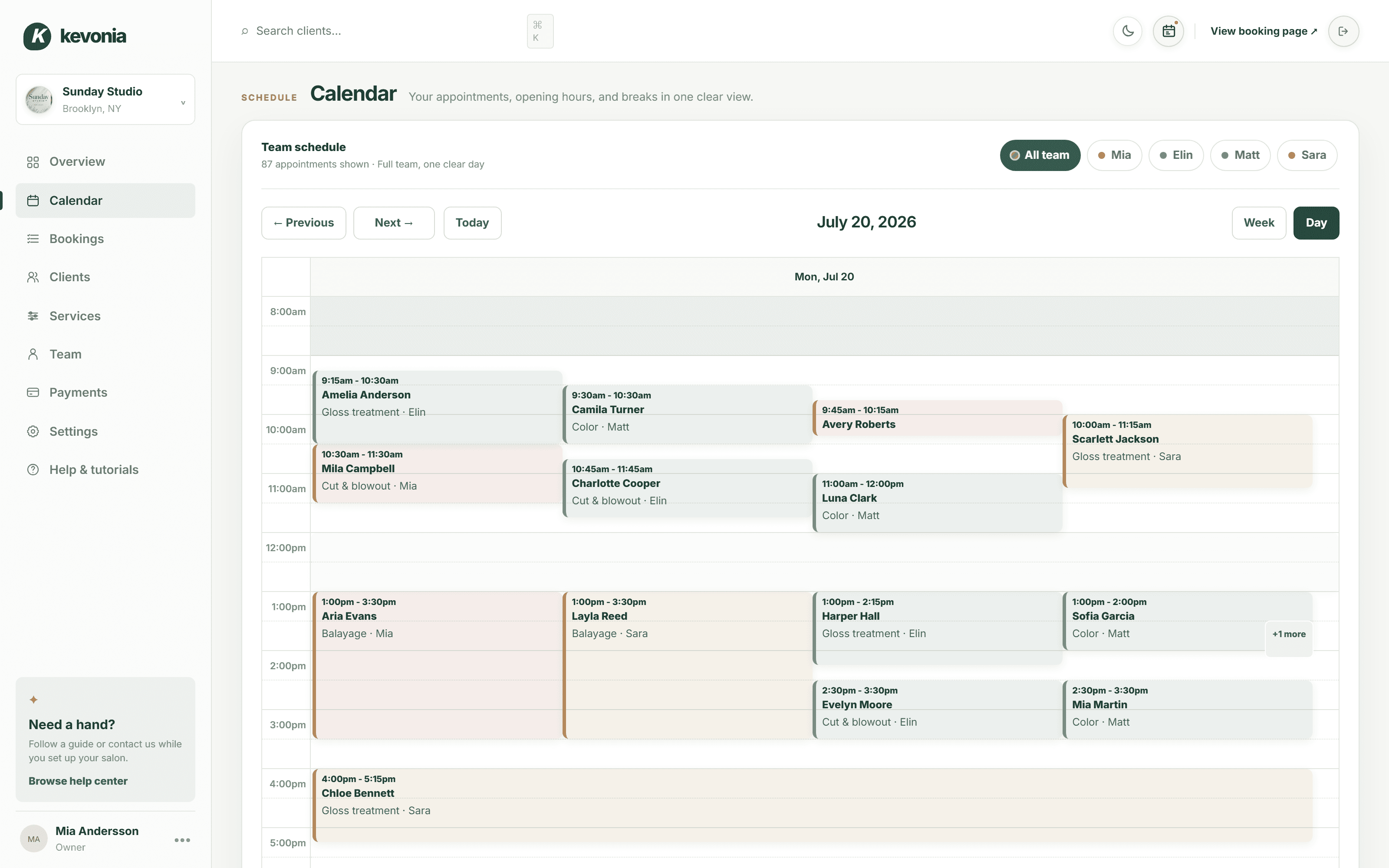
For a pricing-tier setup, the owner can create services with a duration, cleanup or buffer time, price, optional deposit, and per-professional assignment. That allows a junior stylist to be assigned only to approved services while a senior stylist can be assigned to a broader or more advanced menu. The team calendar includes per-professional filters and color coding, which helps the owner review whether higher-priced providers are filling their available hours.
Kevonia’s booking safeguards also matter when levels have different timing. Double-booking protection checks hours, breaks, time off, and existing bookings before an appointment is accepted. Automatic reminder emails are sent the day before, and clients can reschedule or cancel from the email within the salon’s notice window. Those controls do not decide whether a price is fair, but they help the salon apply the rules consistently after the price menu is set.
Kevonia uses one plan at US$49.99 per month, with unlimited team members, bookings, clients, and services, and no per-booking commission. The free trial lasts 7 days, requires no credit card to start, and can be canceled before the trial ends without a charge. For a salon comparing software costs, the relevant question is whether the system removes enough manual scheduling and payment work to justify that fixed operating expense.
Measure whether the pricing tiers are working
Do not judge the system by whether every client chooses the senior stylist. The purpose is to allocate demand, protect margin, create a progression path, and give clients a transparent choice. Review the results by stylist and service, because a tier that works for haircuts may fail for color or specialty work.
- Revenue per booked hour: compare the money generated with the actual appointment time, including processing, cleanup, and buffers.
- Utilization: check how much of each stylist’s available schedule is booked, not just the total number of appointments.
- Rebooking: measure whether clients return to the same stylist and service level within your normal cycle.
- Correction and redo rate: a low price is not profitable if it creates unpaid remediation or dissatisfied clients.
- Average ticket: separate service revenue, deposits, add-ons, discounts, refunds, and tips so the comparison is meaningful.
- No-shows and cancellations: look for patterns by service, stylist, day, notice window, and deposit requirement.
- Upgrade and transfer patterns: track how often clients move from junior to senior, or require a senior consultation after starting with a junior.
Review the data monthly, but change prices less often unless there is a clear problem. A new stylist may need time to build demand. If you raise the price after one quiet week, you will mistake normal booking variation for a pricing failure. A quarterly level review is usually enough for established stylists; a new team member may need a shorter coaching cycle without an automatic price change.
Use client comments carefully. “The senior stylist was worth it” may indicate strong value, but “I did not know the price would change” signals a communication problem. Record the reason for overrides, transfers, and refunds. Over time, those notes show whether the tier is solving a capacity problem or merely moving confusion from the booking page to the front desk. We cover this in more depth in salon payment disputes.
Common mistakes to avoid
Level pricing fails when the label is doing all the work. A client cannot evaluate “senior” if the salon never explains what the title means, and a stylist cannot progress if the owner keeps the criteria subjective. Build the system around decisions you can observe, explain, and review.
- Using seniority as the only justification. Time in the industry matters, but it does not replace measured performance or specialty skill.
- Making the junior tier artificially cheap. If the price does not cover the service cost and training time, the salon is subsidizing every appointment.
- Charging the same price for very different appointment lengths. A three-hour service and a 60-minute service need different capacity assumptions.
- Allowing every stylist to perform every service before they are ready. Assign services deliberately and update them as skills are verified.
- Changing prices without changing the online menu. A mismatch between the booking page, front desk, and checkout creates avoidable disputes.
- Treating a senior promotion as permanent without review. Demand, speed, specialization, and market conditions can change.
- Hiding the price difference until checkout. Clients should know the provider-level price before they commit to the appointment.
- Ignoring the client’s goal. A senior stylist may be the right choice for corrective work, but a junior stylist may be entirely appropriate for a straightforward maintenance service.
If you are introducing tiers for the first time, pilot them with one or two services, train the team, and review the booking flow on a phone before publishing the full menu. Ask someone unfamiliar with the salon to book each level. If they cannot tell why the prices differ or what is included, revise the wording before launch.
Frequently asked questions about junior and senior stylist pricing
These are the questions owners most often need to answer before publishing a level-based menu.
How do I choose the price difference between a junior and senior stylist? Start with the senior stylist’s extra demand, technical range, speed, and consistency. Test a 10% to 25% gap, then compare revenue per booked hour, utilization, rebooking, corrections, and client response. The correct gap is the one that improves capacity and margin without creating an unclear client experience.
Should junior stylists charge less for every service? No. Use a lower level price only where the stylist is approved to perform the service and where the business can still cover its costs. A standardized blowout may need little separation, while corrective color or extensions may require a larger difference or a senior-only assignment.
Can I call a stylist senior because they have more years of experience? You can use experience as one criterion, but define the level with additional evidence. Consider technical results, consultation skill, timing, repeat demand, specialty capability, corrections, client retention, and leadership responsibilities. Years alone do not tell the client what value they will receive.
How should I explain the difference to clients? Use a short description on the booking page and repeat it when staff recommend a provider. Explain that junior stylists are licensed professionals building experience or demand, while senior stylists may offer more advanced expertise, faster execution, or higher-demand availability. Tell clients about any consultation, starting price, deposit, or possible transfer before work begins.
Should I use level-based pricing for booth renters or independent contractors? Pricing does not answer the classification question. Review the actual working relationship, control, independence, payment structure, and applicable state and federal rules with a qualified professional. The IRS specifically warns that worker status depends on the facts of the relationship, not simply the label used by the business. (irs.gov)
Should senior stylist pricing include a deposit? It can, especially for long, high-cost, or high-demand appointments. Set the deposit and cancellation rules before the client books, apply them consistently, and make the amount visible. If you accept online payments, remember that a refund may not appear on a customer’s bank statement immediately; Stripe says refunds typically take five to 10 business days to process and appear, depending on the customer’s bank. (docs.stripe.com)
Sources
- U.S. Bureau of Labor Statistics: Barbers, Hairstylists, and Cosmetologists
- Internal Revenue Service: Independent Contractor or Employee?
- Internal Revenue Service: Worker Classification 101
- Stripe Documentation: After a Payment Link Payment
- Kevonia
- Kevonia hair salon booking software
- Kevonia salon booking program
- Kevonia salon reservation software
- Kevonia live demo
- How to Pay a Hairstylist: A Practical Guide
- How to Price Salon Services: A Practical 2026 Guide
- How Many Clients Can a Stylist See in a Day?
- Salon Payment Dispute Chargeback: What to Do in 2026
Frequently asked questions
How do I choose the price difference between a junior and senior stylist?+
Start with the senior stylist’s extra demand, technical range, speed, and consistency. Test a 10% to 25% gap, then compare revenue per booked hour, utilization, rebooking, corrections, and client response. The correct gap is the one that improves capacity and margin without creating an unclear client experience.
Should junior stylists charge less for every service?+
No. Use a lower level price only where the stylist is approved to perform the service and where the business can still cover its costs. A standardized blowout may need little separation, while corrective color or extensions may require a larger difference or a senior-only assignment.
Can I call a stylist senior because they have more years of experience?+
You can use experience as one criterion, but define the level with additional evidence. Consider technical results, consultation skill, timing, repeat demand, specialty capability, corrections, client retention, and leadership responsibilities. Years alone do not tell the client what value they will receive.
How should I explain the difference to clients?+
Use a short description on the booking page and repeat it when staff recommend a provider. Explain that junior stylists are licensed professionals building experience or demand, while senior stylists may offer more advanced expertise, faster execution, or higher-demand availability. Tell clients about any consultation, starting price, deposit, or possible transfer before work begins.
Should I use level-based pricing for booth renters or independent contractors?+
Pricing does not answer the classification question. Review the actual working relationship, control, independence, payment structure, and applicable state and federal rules with a qualified professional. The IRS specifically warns that worker status depends on the facts of the relationship, not simply the label used by the business.
Should senior stylist pricing include a deposit?+
It can, especially for long, high-cost, or high-demand appointments. Set the deposit and cancellation rules before the client books, apply them consistently, and make the amount visible. If you accept online payments, allow time for refunds to appear because processing can take several business days.
More from the blog

When to Hire Your First Stylist: A Salon Owner’s Guide
Hiring your first stylist is a capacity and cash-flow decision, not just a sign of growth. Use this practical checklist to know when demand, finances, and systems are ready.

What to Do When a Stylist Calls in Sick: A Salon Owner’s Plan
A stylist calling in sick can disrupt a full day of appointments. Use this practical plan to protect clients, reassign services, communicate clearly, and prevent repeat problems.

Acuity Scheduling Alternative: What Salon Owners Should Compare
Looking for an Acuity Scheduling alternative? Compare Acuity with Kevonia on pricing, booking fees, salon workflows, team scheduling, payments, and switching risks.