How Much Rent Can a Salon Afford in 2026?
There is no single rent number that works for every salon. Use your realistic revenue, total occupancy cost, staffing model, and break-even point to set a safe monthly limit.

Key takeaways
- A salon should set rent from realistic collected revenue, not optimistic sales projections.
- Start with a rent target around 5% to 10% of revenue, then test it against payroll, supplies, taxes, and owner pay.
- Your true occupancy cost includes more than base rent: add common-area charges, utilities, insurance, maintenance, and required build-out costs.
- A lease is affordable only when the salon can still pay staff, cover operating costs, pay the owner, and build a cash reserve.
- Use a conservative break-even calculation before signing, and stress-test the salon at 20% below projected revenue.
How Much Rent Can a Salon Afford? Start With the Number That Pays the Bills
The practical answer is usually a rent target of about 5% to 10% of collected monthly revenue, with the lower end safer for a new salon, a commission-heavy team, or a location with high payroll and product costs. That is a planning range, not a rule. A salon doing $40,000 per month may be able to support $2,000 to $4,000 in base rent; a salon doing $100,000 per month may support more, but only if its staffing, pricing, occupancy, and cash flow support it.
The better question is not simply how much rent can a salon afford. It is: what monthly occupancy cost can the business carry after paying the team, supplies, taxes, insurance, software, debt, owner compensation, and a reserve for slow months? The answer should come from your own numbers and a conservative revenue forecast, not from the asking rent on a desirable storefront.
Use a Rent Percentage as a Starting Point, Not a Verdict
Many owners search for a salon rent percentage of revenue because it is easy to apply. A useful starting range is 5% to 10% of collected service and retail revenue. For a brand-new salon, staying near 5% to 7% gives you more room to survive ramp-up. An established salon with strong demand, high average tickets, and reliable rebooking may tolerate 8% to 10%. Above that, the location must produce enough extra revenue to justify the added cost.
Use collected revenue rather than booked revenue. A $60,000 appointment schedule is not the same as $60,000 deposited into the business if appointments are cancelled, marked no-show, discounted, refunded, or left unpaid. If your salon collects $45,000 in a normal month, a 7% rent target is $3,150—not $4,200 based on a $60,000 projection.
- New salon or uncertain demand: target roughly 5% to 7% of realistic collected revenue.
- Established salon with steady utilization: target roughly 7% to 10%.
- High-cost market or premium concept: exceed 10% only when pricing, demand, and margins clearly support it.
- Booth-rental or chair-rental model: analyze the rent burden against the salon’s retained share, not the total money passing through the business.
- Seasonal salon or spa: use an average of at least 12 months, then test the weakest three months separately.
The percentage should also be calculated against the revenue the salon actually keeps. In a commission model, the owner may collect the full service price but pay a large portion to providers. In a booth-rental model, the owner may receive fixed rent from providers but carry different risks. If you are comparing those structures, the discussion of booth rent versus commission can help you model the revenue that remains available for occupancy and overhead.
Calculate the Full Occupancy Cost, Not Just the Advertised Rent
The number on the listing is often only the beginning. Salon lease costs may include base rent plus common-area maintenance, property taxes, building insurance, utilities, trash, internet, repairs, security, janitorial service, and required maintenance. Ask the landlord for the last 12 months of pass-through charges and the current estimate for the next year. A space that looks inexpensive at $3,000 in base rent can become a $4,200 monthly obligation after additional charges.
Separate one-time costs from monthly occupancy costs. Build-out, plumbing, electrical work, signage, permits, furniture, deposits, legal review, and moving expenses may not appear in the monthly rent, but they still affect whether the location is affordable. Convert major one-time costs into a monthly planning amount over the first 12 to 24 months so you can see the real burden while the salon is still building its client base.
- Base rent and scheduled annual increases.
- Common-area maintenance, property taxes, and building insurance charges.
- Utilities, internet, waste removal, cleaning, security, and pest control.
- Commercial liability, property, and workers’ compensation insurance.
- Lease-required repairs, maintenance contracts, and compliance work.
- Leasehold improvements, furniture, equipment, permits, signage, and deposits.
- Interest or loan payments used to fund the build-out.
- Rent during a construction or pre-opening period when the salon cannot yet produce normal revenue.
Tax treatment should not be the reason you accept an unaffordable lease. The IRS generally treats rent for business property as a business expense when the property is used in the business, but special rules can apply to related-party arrangements, advance rent, lease terms, and improvements. Have your tax professional review the actual agreement rather than assuming every payment has the same treatment. Supporting details are available from IRS guidance on business rent expenses.
Build the Affordability Test From Your Monthly Revenue
Before negotiating a space, create three revenue cases: conservative, expected, and strong. The conservative case should reflect the first year or the weakest realistic season, not your best month. Estimate appointments by provider, available hours, utilization, average service ticket, retail sales, deposits actually collected, discounts, refunds, and no-shows. Then subtract the costs that rise with sales, such as commissions, credit-card fees, color, disposables, laundry, and other service supplies.
A simple monthly model is: collected revenue minus variable costs equals contribution margin; contribution margin minus fixed costs equals operating profit. Rent belongs in fixed costs. The U.S. Small Business Administration identifies lease payments, salaries, property taxes, insurance, interest, and depreciation as examples of fixed costs, while some labor, materials, utilities, and service fees may be variable or mixed. That classification matters because a salon must pay fixed costs even during a quiet month. Supporting details are available from SBA break-even guidance.
For example, suppose a salon expects $50,000 in collected monthly revenue. Assume $18,000 for commissions and payroll-related costs that vary with production, $4,000 for supplies and payment-related costs, and $12,000 for non-rent fixed overhead. That leaves $16,000 before rent, owner pay, debt repayment, taxes, and profit. A $4,000 occupancy cost may be possible; a $9,000 obligation leaves much less room for the owner and for a revenue dip.
Do not treat owner pay as whatever happens to be left over. Add a realistic owner wage or draw to the model, along with taxes and debt payments. If the lease works only when the owner works unpaid hours, delays maintenance, or skips reserve contributions, the space is not truly affordable.
- Estimate conservative monthly collected revenue.
- Subtract commissions, wages tied to production, supplies, refunds, payment fees, and other variable costs.
- Subtract payroll taxes, insurance, administrative costs, marketing, software, debt payments, owner compensation, and a reserve contribution.
- Add the proposed base rent and every expected occupancy charge.
- Check whether the remaining amount is positive and whether it meets your profit target.
- Repeat the calculation with revenue 10%, 20%, and 30% below the expected case.
Translate the Rent Into Appointments and Provider Capacity
A rent number becomes easier to judge when you express it in appointments. If your average collected ticket is $100 and your contribution after provider pay and service costs is $45, an additional $3,000 of monthly occupancy cost requires about 67 extra appointments just to cover that cost. That is roughly 17 additional appointments per week. If the new location requires more than your available capacity, the rent is depending on a forecast the salon cannot physically deliver.
Run the same calculation by provider. A six-station salon with four active providers is not a six-provider revenue machine. Account for vacancies, part-time schedules, time off, training, late starts, cleanup, and the hours that clients actually want. The Bureau of Labor Statistics reports that schedules for barbers, hairstylists, and cosmetologists can include evenings and weekends, but a salon still needs to determine its own usable capacity and demand rather than assuming every open hour will sell. Supporting details are available from BLS occupation and wage data.
Pricing can change the result. A salon with a $75 average ticket may need far more appointments to support the same rent than a salon with a $150 average ticket, but the higher-ticket salon may also require longer appointments, more expensive products, and more senior providers. Compare contribution per booked hour, not just the service price. A service that produces $50 after direct costs in one hour is more useful for rent planning than a $100 service that occupies three hours. We cover this in more depth in service pricing by stylist level.
- Average collected ticket per appointment.
- Average appointment duration, including cleanup and turnover time.
- Contribution dollars after provider compensation and direct service costs.
- Realistic billable hours per provider per week.
- Expected utilization during the first six months.
- Number of appointments required to cover the proposed occupancy cost.
Test the Lease Against Slow Months and Break-Even
A lease should survive more than an average month. Create a stress test using the lowest revenue you could reasonably experience after opening. Reduce appointments, lower utilization, delay hiring, and increase supply costs if those are plausible risks. Then ask whether the salon can pay rent, wages, taxes, insurance, debt, and essential vendors without using credit cards or personal savings every month.
The SBA’s break-even framework is useful here: fixed costs divided by contribution margin gives the sales level needed to cover costs. For a salon, contribution margin should reflect the revenue left after costs that move with each service. If monthly fixed costs are $30,000 and the contribution margin is 60%, the salon needs $50,000 in monthly sales to break even before any additional profit target. If you want $6,000 in operating profit, the required sales rise to $60,000 because ($30,000 + $6,000) divided by 60% equals $60,000. Supporting details are available from break-even point calculation.
Add a cushion to the result. The SBA notes that break-even estimates are not a substitute for actual accounting and suggests allowing for miscellaneous expenses that are difficult to predict. For a salon, that cushion can cover equipment repairs, a slow opening, a provider departure, an unexpected closure, chargebacks, or a jump in product costs. A lease that reaches break-even exactly under the expected case is fragile. Supporting details are available from SBA guidance on estimating miscellaneous costs.
- Expected case: the revenue and staffing plan you believe is achievable.
- Conservative case: lower utilization, fewer providers, and slower client acquisition.
- Stress case: at least 20% below expected revenue or the actual low season, whichever is more severe.
- Exit case: what happens if the salon needs to downsize, sublease, assign the lease, or close before the term ends?
Negotiate the Lease Around Risk, Not Just Monthly Price
A lower base rent does not automatically make a lease safer. A long term with steep annual increases, a large personal guarantee, unclear pass-through charges, or no early-exit option can create more risk than a slightly higher rent with better protections. Ask for the entire occupancy obligation in writing and model every scheduled increase before signing.
Review whether the lease includes a rent-free build-out period, a delayed commencement date, a cap on operating-expense increases, renewal options, assignment and sublease rights, signage rights, parking, permitted services, hours of operation, exclusive-use protections, repair responsibilities, and rules for plumbing, ventilation, chemicals, laundry, and equipment. These details can affect both your opening cost and your ability to operate the services your business sells.
If the landlord proposes percentage rent, calculate it separately from fixed rent and understand exactly what revenue is included or excluded. The IRS notes that rent paid as a percentage of gross receipts is not automatically unreasonable for tax purposes, but that does not mean the structure is commercially favorable for your salon. Have a commercial lease attorney and accountant review the deal before you commit. Supporting details are available from IRS rent and percentage-of-receipts guidance.
- Request a complete estimate of base rent and additional occupancy charges.
- Model every annual increase over the full initial term and renewal options.
- Negotiate a build-out or rent-abatement period when opening work prevents normal operations.
- Limit or clarify personal guarantees, repair obligations, and pass-through expenses.
- Confirm permitted services, signage, parking, access hours, and utility capacity.
- Ask what happens if you sell the business, need to sublease, or must leave early.
Where Kevonia Fits in the Rent Decision
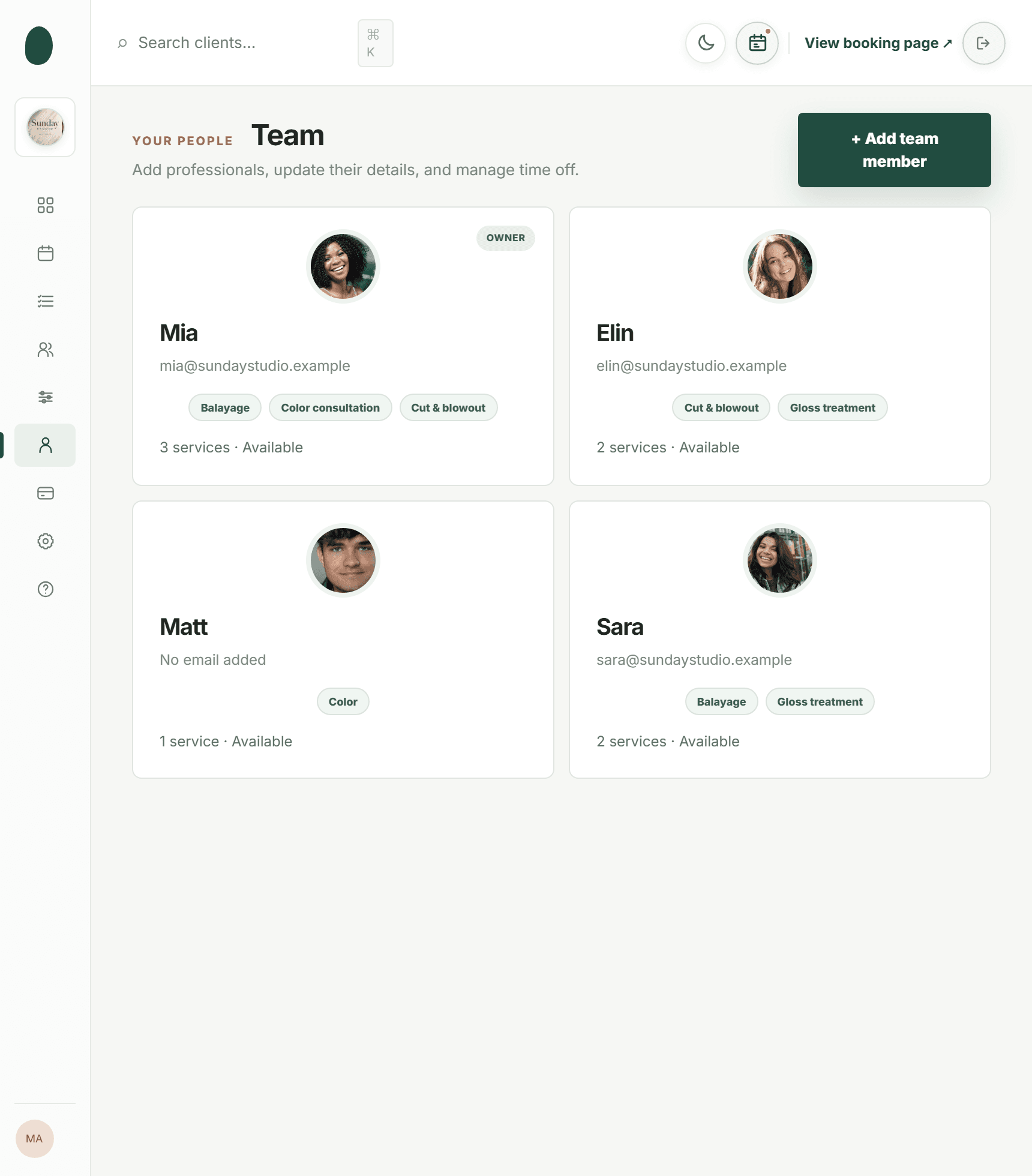
Rent planning depends on reliable operating data: how many appointments were completed, which providers produced them, how often clients returned, and how much revenue was actually collected. Kevonia gives salons and spas a branded online booking page plus a workspace with a team calendar, client records, service menu, availability rules, and Stripe payments. That makes it easier to compare your capacity and collected activity with the revenue assumptions behind a lease. For more detail, see Kevonia's barber shop appointment software.
For example, the team calendar shows week and day views with per-professional filters and color coding. Availability rules can account for opening hours, breaks, staff time off, salon closures, booking windows, minimum notice, and time-slot intervals. Double-booking protection checks hours, breaks, time off, and existing bookings. Those controls help you estimate usable capacity instead of counting every theoretical chair-hour as revenue potential. For more detail, see Kevonia's salon reservation software.
Kevonia’s overview screen can show today’s revenue against the same day last week, appointments, bookings made in the last 30 days, total and new clients, no-shows as a percentage of recent bookings, and a 30-day revenue chart. The owner can hide revenue figures for front-desk use. These are practical signals for rent planning, especially when you are checking whether a new space is producing consistent demand rather than one unusually strong week. For more detail, see Kevonia's salon management workspace.
The software costs US$49.99 per month on one plan, with unlimited team members, bookings, clients, and services and no per-booking commission. It includes a free 7-day trial with no credit card required to start; cancel anytime before the trial ends and you are never charged. Treat the subscription as one small line in the operating model, not as a substitute for a full lease analysis. For more detail, see Kevonia's Kevonia salon and spa management software.
A Practical Decision Rule Before You Sign
Use this sequence before accepting a space. First, calculate realistic collected revenue from your current business or a documented opening plan. Second, calculate the contribution margin after provider compensation and direct service costs. Third, list every fixed cost, including a real owner wage and reserve contribution. Fourth, add the complete occupancy cost. Finally, test the result against a slow month and a staffing disruption.
- Write down the conservative monthly revenue number.
- Set a target occupancy percentage and convert it to dollars.
- Add base rent, pass-through charges, utilities, insurance, maintenance, and lease-related financing.
- Calculate the appointments and booked hours needed to cover occupancy cost.
- Check whether your current team and available hours can produce that volume.
- Stress-test revenue at 20% below plan and include a repair or provider-loss scenario.
- Have an accountant and commercial lease attorney review the final assumptions and agreement.
- Do not sign until the salon can pay the lease without relying on best-case sales.
The right location can improve visibility, convenience, pricing power, and recruiting. But those benefits only matter if the business captures enough additional contribution to pay for them. If the proposed rent requires a major increase in appointments, a new provider, or higher prices, identify exactly how that change will happen and how long it will take. If you cannot explain the path in numbers, negotiate a safer lease or keep looking.
For a deeper profitability framework, review the guide to calculating and improving salon profit margin. Rent is only one line item, and a salon that controls occupancy but loses money through weak pricing, excess payroll, no-shows, or underused hours has not solved the larger problem.
Sources
- U.S. Small Business Administration: Break-even point
- U.S. Internal Revenue Service: Publication 334, Tax Guide for Small Business
- U.S. Bureau of Labor Statistics: Barbers, Hairstylists, and Cosmetologists
- Kevonia
- Kevonia salon booking program
- Kevonia salon reservation software
- Kevonia barber shop appointment software
- Kevonia home page
Frequently asked questions
What percentage of revenue should a salon spend on rent?+
Use roughly 5% to 10% of collected monthly revenue as an initial planning range. A new or uncertain salon should usually aim toward the lower end. Include pass-through charges and other occupancy expenses, not just base rent. Then test the result against payroll, supplies, owner pay, debt, taxes, and a slow month.
How much rent can a salon afford if it makes $50,000 per month?+
A starting range of 5% to 10% would be $2,500 to $5,000 per month, but that does not prove the lease is affordable. If commissions, payroll, supplies, fixed overhead, debt, taxes, and owner compensation already consume most of the $50,000, the safe rent may be below that range. Use contribution margin and break-even math before deciding.
Should salon rent be based on gross revenue or profit?+
Use collected gross revenue to create a preliminary rent range, but make the final decision from profit and cash-flow projections. Revenue alone ignores provider pay, product costs, payment fees, payroll taxes, insurance, debt, and owner compensation. A rent percentage can be a screening tool; it should not replace a complete monthly model.
What counts as salon occupancy cost?+
Start with base rent, then add common-area charges, property taxes, building insurance, utilities, trash, cleaning, security, repairs, maintenance contracts, commercial insurance, and any required lease-related services. Also account for the monthly effect of build-out costs, deposits, equipment financing, and rent paid before the salon opens.
How do I know whether a high-rent location is worth it?+
Calculate the additional contribution the location is expected to produce, not just the extra sales. Compare the new location with your current or alternative space using appointments, average ticket, provider hours, utilization, direct costs, and occupancy cost. The location is worth the premium only if the expected incremental contribution covers the added cost with a reasonable cushion.
Should I include a slow season when calculating affordable salon rent?+
Yes. Use at least 12 months of history when available and identify the weakest three months. For a new salon, build a conservative opening case and stress-test revenue at 20% below the expected plan. If the business cannot pay essential costs during a plausible slow period, the lease is too aggressive or the salon needs more cash reserves and a safer structure.
More from the blog

Booth Rent vs Commission: Which Salon Model Is Better in 2026?
Booth rent and commission create very different salon businesses. Compare cash flow, control, taxes, staffing, and client ownership before choosing a model.

How Much Does It Cost to Run a Salon? Build Your Real Monthly Budget
A salon may cost a few thousand dollars a month as a solo suite or tens of thousands with employees. Here is how to calculate your own number instead of relying on a generic average.

How Much to Pay a Hairstylist in 2026: A Practical Guide
A practical 2026 guide to setting hairstylist pay. Compare hourly, commission, and hybrid models, calculate the real cost, and avoid common payroll mistakes.