Booth Rent vs Commission: Which Salon Model Is Better in 2026?
Booth rent and commission create very different salon businesses. Compare cash flow, control, taxes, staffing, and client ownership before choosing a model.

Key takeaways
- Booth rent offers more predictable income and less payroll administration, but usually gives the salon owner less control over the professional’s business.
- Commission gives you more control over the client experience and brand, but you carry more responsibility for payroll, taxes, slow periods, and team management.
- The payment percentage is only one part of the decision; supplies, booking, cancellations, rebooking, marketing, and empty-chair risk can change the result.
- A written agreement and correct worker classification matter more than the label you put on the arrangement.
- Kevonia can support either model with online booking, team scheduling, client records, service rules, deposits, and Stripe payments at one flat monthly price.
Booth Rent vs Commission: What Are You Actually Choosing?
If you searched for booth rent vs commission, you probably want a practical answer: which setup gives your salon the best combination of profit, control, and stability? The short answer is that booth rent is usually simpler and more predictable for the salon owner, while commission is usually better when you want to build one coordinated team and control the customer experience.
Neither model is automatically more profitable. The right choice depends on your service prices, chair utilization, local labor rules, supply costs, booking ownership, and how much responsibility you want to take for hiring and managing professionals. Before changing models, run the numbers and confirm the legal requirements in your state or city.
How Booth Rental and Commission Work
In a booth-rental arrangement, a professional typically pays the salon a fixed amount for access to a station, room, or workspace. The professional may collect payment from clients directly, set their own prices, choose their schedule, purchase some or all of their supplies, and manage their own taxes and business expenses. The salon owner receives rent whether that professional has a busy week or a quiet one.
In a commission arrangement, the salon pays the professional a percentage of the revenue from services performed. For example, if a stylist performs $1,000 in services during a pay period and the agreed commission is 50%, the stylist receives $500 before any other applicable payroll deductions. The salon keeps the remaining $500 to cover overhead, supplies, administrative work, taxes, and profit.
Commission can be calculated in several ways, so the contract needs to be precise. You may pay a percentage of service revenue, a different percentage for retail sales, a tiered percentage after a revenue threshold, or a percentage that changes based on whether the client came from the salon or the professional. Decide how discounts, gift cards, tips, refunds, no-shows, packages, memberships, and deposits affect the calculation.
The key distinction is not simply fixed rent versus a percentage. It is the overall business relationship. The IRS looks at behavioral control, financial control, and the type of relationship when determining whether someone is an employee or independent contractor. A contract calling someone a booth renter does not, by itself, settle the question. The IRS explains the factors in its guidance on an independent contractor versus an employee.
The Financial Difference: Fixed Rent vs Variable Payroll
Booth rent creates a relatively straightforward revenue forecast. If you rent six stations for $250 per week and all six are occupied, your scheduled rental income is $1,500 per week. That income does not automatically rise when a renter becomes fully booked, but it also does not fall when the renter has a slow week. Your main financial risk is vacancy: an empty station produces no rent until you fill it.
Commission revenue moves with the team’s production. Suppose four commission professionals generate $2,000 each in service sales during a week, for total service revenue of $8,000. At a 50% commission rate, $4,000 goes to the professionals and $4,000 remains with the salon before overhead and employer costs. If the team generates only $4,000, the salon’s share falls to $2,000.
That example can make commission look less attractive, but the variable model may produce more upside when the salon has strong demand, high prices, and productive professionals. The salon can earn more as revenue grows without renegotiating station rent. The trade-off is that the salon also absorbs more operational costs and may have less cash available during slow periods.
Do not compare rent with commission using only the amount deposited into your bank account. Build a monthly contribution calculation for each model.
- Expected service revenue or station rent.
- Payroll, employer payroll taxes, workers’ compensation, and benefits where applicable.
- Color, backbar, disposables, laundry, equipment maintenance, and other service supplies.
- Booking, payment processing, software, insurance, rent, utilities, cleaning, and administrative costs.
- Discounts, refunds, chargebacks, deposits that are applied to services, and unpaid cancellation balances.
- The value of your own time spent recruiting, scheduling, training, collecting rent, handling payroll, and resolving disputes.
- The cost of empty chairs, unused rooms, late cancellations, and professionals who leave with their client relationships.
For a deeper pricing calculation, use the principles in this practical guide to pricing salon services. Your service menu needs enough margin to support the model you choose, not just cover the professional’s payout.
Booth Rent: Advantages, Drawbacks, and Best-Fit Salons
Booth rent can work well when your primary business is operating a professional workspace rather than directing every detail of the services performed inside it. It is often attractive to established stylists, barbers, estheticians, nail professionals, and other service providers who already have repeat clients and want control over their own schedule and pricing.
- More predictable salon income when stations remain occupied.
- Less exposure to a renter’s slow weeks and seasonal fluctuations.
- Less need to calculate service commissions for every appointment.
- Potentially lower payroll administration when the arrangement genuinely qualifies as independent contracting.
- A clear offer for experienced professionals who want to operate their own small business.
- A model that can be easier to scale by filling available stations rather than adding employees.
The drawbacks are substantial if you want a unified salon brand. Renters may set different prices, use different products, maintain different cancellation rules, and communicate with clients through separate channels. They may also bring their own clients, collect their own payments, and leave with those client relationships. That can make the salon feel like several independent businesses sharing a building.
- Income is capped by the agreed rent unless you charge for additional services or space.
- A vacant station creates an immediate revenue gap.
- You may have less authority over pricing, hours, dress standards, products, and client policies.
- The customer experience can become inconsistent from one professional to the next.
- Shared supplies, cleaning, laundry, utilities, and front-desk work can create arguments unless responsibility is documented.
- A renter who appears independent on paper may still be treated as an employee if the actual relationship shows significant salon control.
Booth rent is most defensible as a business model when the professional is genuinely running an independent business: setting meaningful aspects of the work, maintaining business records, bearing business expenses, making services available to the public, and controlling how the services are delivered. Local law can impose additional requirements, so have a qualified professional review the arrangement before you rely on it.
Commission: Advantages, Drawbacks, and Best-Fit Salons
Commission is usually the stronger fit for a salon that wants one brand, one service standard, and one client journey. You can recruit newer professionals, provide training, coordinate schedules, promote the salon as a whole, and use revenue sharing to align compensation with production. It also gives the owner more room to decide how the business is presented to clients.
- The salon can offer a consistent menu, price structure, booking process, and cancellation policy.
- Professionals can benefit from salon-generated demand instead of relying entirely on personal clientele.
- The owner can coordinate training, service standards, opening hours, and coverage more closely.
- Revenue can grow when team production grows, without a fixed rent ceiling.
- The salon can build a shared client database and make rebooking easier across the team.
- Commission may be easier to explain to professionals who want support with space, supplies, systems, and customer acquisition.
The disadvantages are mainly financial and administrative. You are exposed to slow periods, no-shows, paid non-service time, supply inflation, payroll obligations, and the cost of keeping the team busy. A commission plan also needs careful reporting. If professionals do not trust the numbers, disagreements over discounts, tips, retail, refunds, or client ownership can damage the relationship quickly.
A clear salon commission structure should answer practical questions before the first pay period: Is the percentage based on booked revenue or collected revenue? Are tips excluded? Who pays for color corrections? Are deposits counted when collected or when redeemed? What happens when a client uses a gift card? Is retail commission separate? When does a tier change take effect? Put the answers in writing and show professionals sample calculations.
- You want to control the salon’s brand and client experience.
- The salon supplies products, equipment, booking, marketing, or administrative support.
- You are willing to manage payroll and employment responsibilities.
- You have enough demand or a realistic plan to generate appointments for the team.
- You want to develop junior professionals rather than only lease space to established businesses.
- You plan to track production, retention, utilization, and compensation consistently.
Worker Classification and Agreements: The Risk Owners Cannot Ignore
The biggest mistake is treating booth rent as a tax shortcut or commission as a label that avoids employment obligations. Federal agencies examine the real relationship. The IRS says the substance of the working relationship controls, not simply what the contract calls it. The Department of Labor likewise describes an economic-reality analysis that considers whether the worker is economically dependent on the business or operating their own business.
For example, calling someone a renter does not necessarily make the arrangement independent if the salon sets all of their hours, requires a particular method of service, controls prices, supplies the tools, assigns their clients, prohibits outside work, and closely supervises the details of their work. Conversely, paying an employee on commission does not make that employee an independent contractor. Commission describes how someone is paid; it does not decide their legal status.
If you hire employees, learn how to pay salon stylists in a way that accounts for payroll withholding, wage rules, tips, overtime where applicable, and required records. The exact obligations depend on your location and the facts of the job. Ask a payroll professional or employment attorney for advice instead of copying a contract from another salon.
- Decide whether you are offering employment or independent workspace, based on the actual operating model.
- Check federal, state, county, and city rules for worker classification, wage payment, licensing, booth rental, and salon ownership.
- Write a detailed agreement covering rent or compensation, supplies, products, hours, space, payment collection, tips, deposits, cancellations, refunds, cleaning, insurance, taxes, and termination.
- Use separate records for rent, payroll, client payments, tips, deposits, and reimbursements.
- Review the arrangement whenever your business changes, especially if you add scheduling control, mandatory meetings, shared pricing, or salon-provided tools.
- If classification remains unclear, ask the IRS about Form SS-8 and obtain professional advice.
Where Kevonia Fits in Either Model
Kevonia does not choose your compensation model or determine whether a professional is an employee or independent contractor. It fits underneath the business model you have already chosen by giving the salon a shared booking and scheduling workspace. The product includes a branded online booking page at kevonia.com/your-salon, a team calendar, client records, a service menu, availability rules, and Stripe payments.
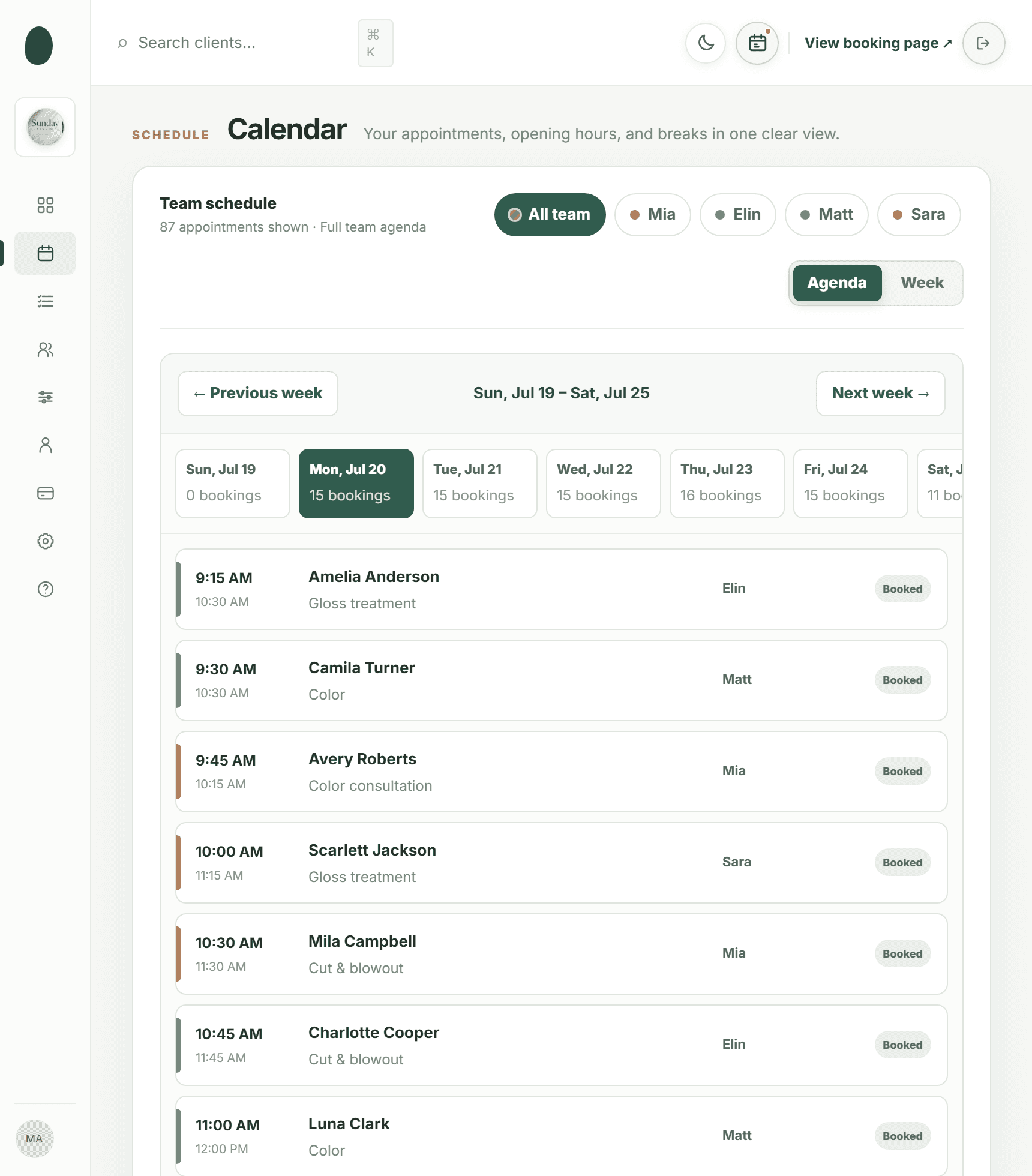
For a commission team, the week and day calendar lets you filter by professional and use color coding to see coverage. You can define services with duration, cleanup or buffer time, price, optional deposits, and per-professional assignments. Double-booking protection checks hours, breaks, time off, and existing bookings, which helps prevent scheduling mistakes when multiple professionals share the same calendar.
For a booth-rental salon, you can still use a shared client-facing booking process while keeping professional assignments and availability clear. Each professional’s opening hours, breaks, time off, and booking rules can be configured in the workspace. Whether that is appropriate for your agreements depends on who controls the booking process and how the professionals operate in practice. For more detail, see Kevonia's salon reservation software.
Kevonia also supports card payments and deposits via Stripe, with payouts to the salon’s bank account. That is useful when the salon is the payment recipient, but it does not replace your responsibility to document how money is allocated between the salon and professionals. Stripe’s documentation explains that payment platforms can route funds and manage payouts in different ways, so confirm that your payment workflow matches your agreements and accounting process.
Kevonia has one plan at US$49.99 per month, with unlimited team members, bookings, clients, and services. There is no per-booking commission and no per-seat charge. The trial is free for 14 days, no credit card is required to start, and you are never charged if you cancel anytime before the trial ends. That pricing can make the software cost easier to include in either a fixed-rent budget or a commission operating budget.
How to Choose the Better Model for Your Salon
Start with the business you want to operate, not the model that sounds easiest on a spreadsheet. A booth-rental salon is closer to a property and workspace business. A commission salon is closer to a managed service business. Both can work, but they require different systems, expectations, and management habits.
- Define your desired level of control. Do you want to set prices, service standards, schedules, products, cancellation rules, and customer communication? If yes, commission employment may align more naturally with the operation, subject to legal advice.
- Estimate demand by professional. Use realistic booked hours and average ticket values, not your best month. Include quiet seasons, new hires, vacation, cancellations, and ramp-up time.
- Calculate the owner’s contribution. Compare rent or commission income after supplies, payroll costs, payment costs, software, utilities, insurance, cleaning, and administrative labor.
- Decide who owns the client relationship. Clarify whether clients belong to the salon, the professional, or the customer relationship is shared. Address records, contact permissions, rebooking, and what happens when someone leaves.
- Choose your payment workflow. Decide who collects money, who receives tips, who handles refunds, how deposits are applied, and how revenue is reconciled.
- Check operational fit. If your team needs one calendar, shared standards, coordinated promotions, and coverage, commission may be easier to manage. If professionals need autonomy and already have clientele, booth rent may be more attractive.
- Review the legal model before launch. Have an accountant, payroll specialist, or attorney verify classification and local requirements.
A hybrid model can be tempting, but it is also easy to make confusing. For example, you might offer fixed rent to established professionals and employ newer team members on commission. If you do this, keep the agreements, policies, payment flows, and expectations genuinely distinct. Do not give renters employee-style control rules while giving employees contractor-style tax treatment.
Use a 90-day review after launch. Track occupied stations, booked hours, average ticket, rebooking rate, cancellations, supply cost per service, revenue per professional, rent collection, payroll cost, and owner hours. If the model is profitable only when you ignore your own time or unpaid expenses, it is not actually profitable.
Common Mistakes That Make Either Model Fail
Most problems do not come from choosing booth rent or commission in the abstract. They come from leaving important details undefined. A salon can have a financially attractive model and still lose money through poor booking controls, unclear payment ownership, uncollected rent, excessive discounts, or avoidable no-shows.
- Setting commission percentages without calculating supplies, payroll taxes, paid time, and overhead.
- Setting booth rent below the real cost of the space, utilities, cleaning, equipment, and administrative support.
- Assuming a professional’s 1099 status is valid because the agreement uses the word renter or contractor.
- Failing to explain who owns the client record and who may contact clients after a professional leaves.
- Allowing separate calendars and booking links to create overlaps, double bookings, or inconsistent appointment rules.
- Ignoring deposits and cancellations when calculating actual collected revenue.
- Changing the percentage, rent, service prices, or supply responsibility informally instead of updating the agreement.
- Using a shared payment account without a reliable process for tips, refunds, chargebacks, and professional reconciliation.
- Promising marketing, reception, supplies, or guaranteed clients without pricing those commitments into the model.
- Choosing a model based on what another salon does without comparing local wages, rent, licensing, taxes, and customer demand.
The operational fix is documentation. Give every professional a written explanation of how appointments are booked, how money is collected, how changes are approved, how cancellations are handled, and how their compensation or rent is calculated. Then use the same process every pay period or rental cycle.
The Bottom Line for Salon Owners
Choose booth rent when predictable station income, professional autonomy, and lower day-to-day production management are more important than controlling one unified service operation. Choose commission when you want to build a managed team, provide a consistent customer experience, and participate in the upside of higher service revenue.
The best answer to booth rent vs commission is not a universal percentage. It is a model that matches your actual relationship with professionals, produces enough margin after every cost, and is clear enough that the team understands how the business works. Run both scenarios using conservative numbers, verify classification and local rules, and write the agreement before you fill the chairs.
If your main challenge is organizing appointments rather than deciding compensation, Kevonia gives salons, barbershops, spas, tattoo studios, nail salons, esthetician and lash studios, med spas, and wellness businesses one workspace for booking and calendar operations. Its flat US$49.99 monthly plan includes unlimited team members, bookings, clients, and services, with no per-booking commission.
Sources
- IRS — Independent contractor (self-employed) or employee?
- IRS — Type of relationship
- U.S. Department of Labor — Fact Sheet 13: Employment Relationship Under the FLSA
- Stripe Documentation — Platforms and marketplaces with Stripe Connect
- Kevonia — Salon booking program
- Kevonia — Hair salon booking software
- Kevonia — Salon reservation software
- Kevonia — Beauty salon booking software
- Kevonia — How to prevent double bookings in a salon
- Kevonia — How to price salon services
- Kevonia — Barbershop booking software
Frequently asked questions
Is booth rent or commission more profitable for a salon owner?+
It depends on utilization, pricing, costs, and management time. Booth rent usually gives you more predictable income per occupied station, while commission can produce more upside when professionals generate strong revenue. Compare both models after supplies, payroll costs, taxes, payment costs, software, rent, utilities, discounts, cancellations, and your own administrative time.
Can a salon employee be paid on commission?+
Yes. Commission is a compensation method, not a worker classification. An employee may be paid a percentage of service revenue and still be an employee with applicable payroll withholding, wage, overtime, tax, and recordkeeping responsibilities. Confirm the details with a payroll professional familiar with your state’s rules.
Does booth rental automatically make a stylist an independent contractor?+
No. The actual relationship matters more than the label in the agreement. If the salon controls how the professional works, sets detailed requirements, provides key tools, controls pricing and schedules, or treats the person like staff, the arrangement may raise classification concerns. Review the IRS and Department of Labor guidance and obtain professional advice.
What should a booth-rental agreement include?+
Include the rent amount and due date, the space provided, term and termination rules, access hours, utilities, equipment, supplies, cleaning, insurance, licenses, payment collection, tips, deposits, refunds, cancellations, client records, pricing authority, advertising, taxes, and responsibility for damage or chargebacks. Also state what happens when rent is late or the professional leaves.
What commission percentage should a salon pay?+
There is no universal percentage that works for every salon. Start with the revenue your prices can support after supplies, payroll taxes, benefits, payment costs, overhead, front-desk work, booking, training, and profit. Decide whether the percentage applies to collected service revenue, retail, tips, discounts, gift cards, deposits, and refunds, then show sample calculations before hiring.
Can Kevonia calculate commission or collect booth rent?+
Kevonia’s listed capabilities are booking and salon operations: a branded online booking page, team calendar, client records, service menu, availability rules, deposits, and Stripe card payments with payouts to the salon’s bank account. It does not replace payroll, tax, rent collection, commission accounting, or legal advice. Use your own accounting or payroll process for those responsibilities.
More from the blog

How Much Rent Can a Salon Afford in 2026?
There is no single rent number that works for every salon. Use your realistic revenue, total occupancy cost, staffing model, and break-even point to set a safe monthly limit.

Mangomint Alternative: When Kevonia Is the Better Fit
Looking for a Mangomint alternative? Compare Mangomint’s per-location, per-user model with Kevonia’s flat plan and decide which platform fits your salon or spa.

How Much to Pay a Hairstylist in 2026: A Practical Guide
A practical 2026 guide to setting hairstylist pay. Compare hourly, commission, and hybrid models, calculate the real cost, and avoid common payroll mistakes.