Most Profitable Salon Services: A 2026 Owner’s Guide
The most profitable salon services are not always the most expensive. Learn how to compare labor, product cost, time, demand, and rebooking potential before changing your menu.

Key takeaways
- High-ticket services are profitable only when their price covers labor, products, cleanup, and unused capacity.
- Color, extensions, corrective work, skin treatments, and repeat maintenance services can perform well when properly priced and scheduled.
- Measure contribution profit per booked hour, not just the listed service price.
- Use deposits, accurate service durations, buffers, and client records to protect the profit your menu creates.
- Kevonia helps salons manage service details, availability, bookings, deposits, payments, and performance visibility in one workspace.
What salon owners really mean by “most profitable”
When salon owners search for the most profitable salon services, they usually want a practical answer to a harder question: which services should receive more promotion, better booking availability, and more staff training? The answer is not simply “the service with the highest price.” A $300 appointment that occupies four hours, uses expensive products, and requires extensive cleanup may contribute less profit than three $95 appointments completed efficiently.
Profitability is the money left after the costs directly connected to delivering the appointment, while overall business profit must also absorb rent, payroll taxes, software, insurance, utilities, education, laundry, supplies, and other overhead. This guide focuses on service-level decision-making: how much each appointment contributes, how reliably it fills the schedule, and whether the client returns. Your best menu is the one that combines healthy margins with realistic demand and repeatable delivery. We cover this in more depth in salon profit margin.
The salon services that often produce the strongest economics
There is no universal national ranking because prices, wages, licensing requirements, competition, room capacity, and client preferences differ by market. Still, several categories commonly deserve closer analysis because they can combine a meaningful ticket with repeat demand or relatively controlled material costs.
- Specialty color and corrective color: Balayage, blonding, vivid color, color corrections, and dimensional color can command premium prices. Their risk is time overruns, substantial product use, consultations, and rework. Profit improves when the menu separates consultation, color application, gloss, treatment, and extra-length or extra-density charges where appropriate.
- Hair extensions and extension maintenance: Initial installs can be high-ticket, while move-ups, maintenance, removal, and replacement appointments create recurring demand. Track hair cost separately from application labor, and do not treat the full ticket as service profit. Deposits and consultation requirements are especially important because inventory may be ordered for a specific client.
- Chemical texture and smoothing services: Keratin treatments, relaxers, perms, and similar services may generate strong revenue per appointment. They require careful timing, ventilation, consultation, product control, and compliance with applicable state and workplace requirements. A service that regularly runs longer than its listed duration is not as profitable as its menu price suggests.
- Advanced skincare and facial treatments: Customized facials, peels, dermaplaning, acne-focused treatments, and add-on masks can perform well when the provider is trained and the room is utilized consistently. Their economics improve when consumable usage is measured and clients are placed on a sensible maintenance schedule rather than treated as one-time buyers.
- Lashes, brows, waxing, and other maintenance services: These appointments may have lower individual tickets, but frequent rebooking, standardized timing, and modest product consumption can create excellent schedule economics. A tightly managed brow, lash-fill, or waxing service can outperform a premium service that leaves large gaps in the calendar.
- Special-occasion and event services: Bridal hair, makeup, formal styling, and group bookings can produce strong sales and referrals. They may also involve travel, trials, assistants, early start times, and coordination work. Price the complete experience, not just the minutes spent applying makeup or styling hair.
- Retail-supported service plans: A treatment can be more valuable when the client follows an at-home maintenance routine, but retail sales should be measured separately from service contribution. Avoid recommending products merely to increase the ticket; match products to the client’s stated goal and the service result you are trying to maintain.
The category with the highest price is not automatically the category with the best margin. For example, a salon may find that a carefully timed facial has a better contribution per hour than a long blonding appointment, while a barber may earn more from a fast haircut-and-beard schedule than from occasional premium transformations. The useful question is which salon services make the most money after the real cost of time and materials is included. For more detail, see Kevonia's hair salon booking software.
How to compare services using profit per booked hour
The most useful operating metric is contribution profit per booked hour. It shows what a service contributes before shared overhead, and it prevents long appointments from looking attractive only because their prices are large. The basic calculation is: service price minus provider labor, product cost, payment cost, and other appointment-specific costs, divided by the total time the service occupies. Supporting details are available from break-even analysis guidance.
Include the full blocked time, not only hands-on time. If a 90-minute facial requires 15 minutes of setup and cleanup, evaluate it as 105 minutes. If a color appointment is listed at three hours but routinely needs 30 minutes of consultation, processing, rinse, and reset time, use 3.5 hours. The U.S. Small Business Administration’s break-even framework separates fixed costs, variable costs, price, and contribution margin; applying that logic to each service gives you a more useful comparison than looking at gross sales alone. Supporting details are available from SBA break-even framework.
- Record the collected price before tax and tips. Treat gratuity as the client’s payment to the provider, not as salon revenue available to cover overhead.
- Estimate provider labor using the actual compensation model. For an hourly employee, use wage plus employer payroll costs where relevant. For commission or booth arrangements, use the amount the salon retains after the provider’s share.
- Measure product usage for several appointments. Weigh or count color, lightener, developer, wax, lash supplies, skincare products, extension hair, gloves, and disposables instead of relying on guesses.
- Add payment processing and appointment-specific costs. A percentage fee matters more on a high ticket, while a fixed fee matters more on a low ticket. Stripe’s published standard U.S. online domestic card rate is 2.9% plus 30 cents per successful transaction, but your actual arrangement and transaction type may differ.
- Divide the result by booked hours, including setup, cleanup, processing, and any required buffer. Compare the result with similar services performed by the same type of provider.
- Check repeat behavior and demand. A service that produces a strong contribution but sells twice a month may not deserve the same capacity as a dependable maintenance service.
Example: suppose a treatment sells for $180, uses $22 of product, costs the salon $58 in provider compensation and related labor, and has $5 in other direct costs. If it occupies 2.5 booked hours, its estimated contribution is $95, or $38 per booked hour, before rent and general overhead. That is the kind of salon revenue per hour figure that helps an owner decide whether to adjust pricing, reduce time, improve rebooking, or move the service to a different part of the schedule.
Pricing and scheduling changes that increase service profit
A profitable service can become unprofitable through weak pricing or poor calendar design. Before adding new treatments, audit the way clients book the services you already perform. A clear menu should tell the client what is included, how long to allow, who performs it, and when a consultation is needed. If the description is vague, providers absorb unpaid work and the next appointment starts late. We cover this in more depth in how to price salon services.
- Set a floor price from costs and target contribution, then validate it against local demand and positioning. Do not copy a nearby salon’s price without knowing its labor model, rent, experience level, or product costs.
- Use levels or tiers only when the difference is understandable. A senior-provider price, longer appointment, more complex formula, or premium product should be explained rather than presented as an arbitrary surcharge.
- Charge for complexity honestly. Extra length, density, corrective work, additional bowls, specialty hair, travel, or extended consultation time may justify a clear fee when disclosed before booking.
- Protect long or customized appointments with a consultation, deposit, or both. A deposit does not make a bad service profitable, but it reduces the damage from reserved time that is cancelled late or abandoned.
- Create buffers for services that commonly overrun. A realistic 15-minute buffer can protect the rest of the day; a permanently understated service duration hides capacity problems and creates an inaccurate profit calculation.
- Match demand to the calendar. Put dependable, shorter maintenance appointments into high-demand periods when appropriate, and use longer transformation services in blocks that reduce schedule fragmentation.
- Build a rebooking moment into checkout. The next appointment should be recommended based on the service’s maintenance cycle, not an automatic promise that every client needs to return in the same number of weeks.
A small price increase can be sensible when a service has full demand, rising product costs, or frequent overtime. But raising the price without fixing the underlying duration may only make the client’s invoice larger while preserving the same weak contribution per hour. Conversely, reducing a service from 90 minutes to 75 minutes through better preparation can improve profit without changing the client-facing price, provided the result and experience remain consistent.
What to measure for 30 days before changing your menu
Do not decide which treatments to promote from memory or from the busiest week of the year. Use a 30-day review, then compare it with a normal period. Separate services by provider where skill, speed, compensation, or clientele differs. A service may be profitable for one specialist and weak for another because the appointment takes different amounts of time.
- Bookings sold: Count completed appointments, not just appointments placed on the calendar.
- Collected service revenue: Exclude sales tax and separate tips, deposits, refunds, discounts, and retail where possible.
- Booked hours: Use the actual blocked calendar time, including buffers and required cleanup.
- Direct cost per appointment: Track labor, product, disposables, laundry, travel, and payment costs that change with the service.
- Contribution per booked hour: Rank services by this number, then investigate unusually high or low results.
- Rebooking rate: Note whether clients schedule the next visit and how long they take to return.
- Cancellation and no-show rate: A high-ticket service with frequent lost appointments may need a stronger booking policy or deposit.
- Provider utilization: Check whether the service fills a valuable time slot or mainly occupies a quiet period that would otherwise remain empty.
- Client outcome and rework: Complaints, corrections, redo appointments, and excessive follow-up reduce the original service’s true contribution.
The goal is not to delete every low-ranking service. Some services bring new clients into the business, support a package, fill quiet hours, or lead to more valuable recurring work. Keep a service when its strategic role is clear, but price and schedule it based on that role. A low-margin introductory service may be acceptable if it reliably leads to profitable maintenance appointments; it is not acceptable if it attracts price shoppers who never return and consumes your peak capacity.
Where Kevonia fits into a profitable service strategy
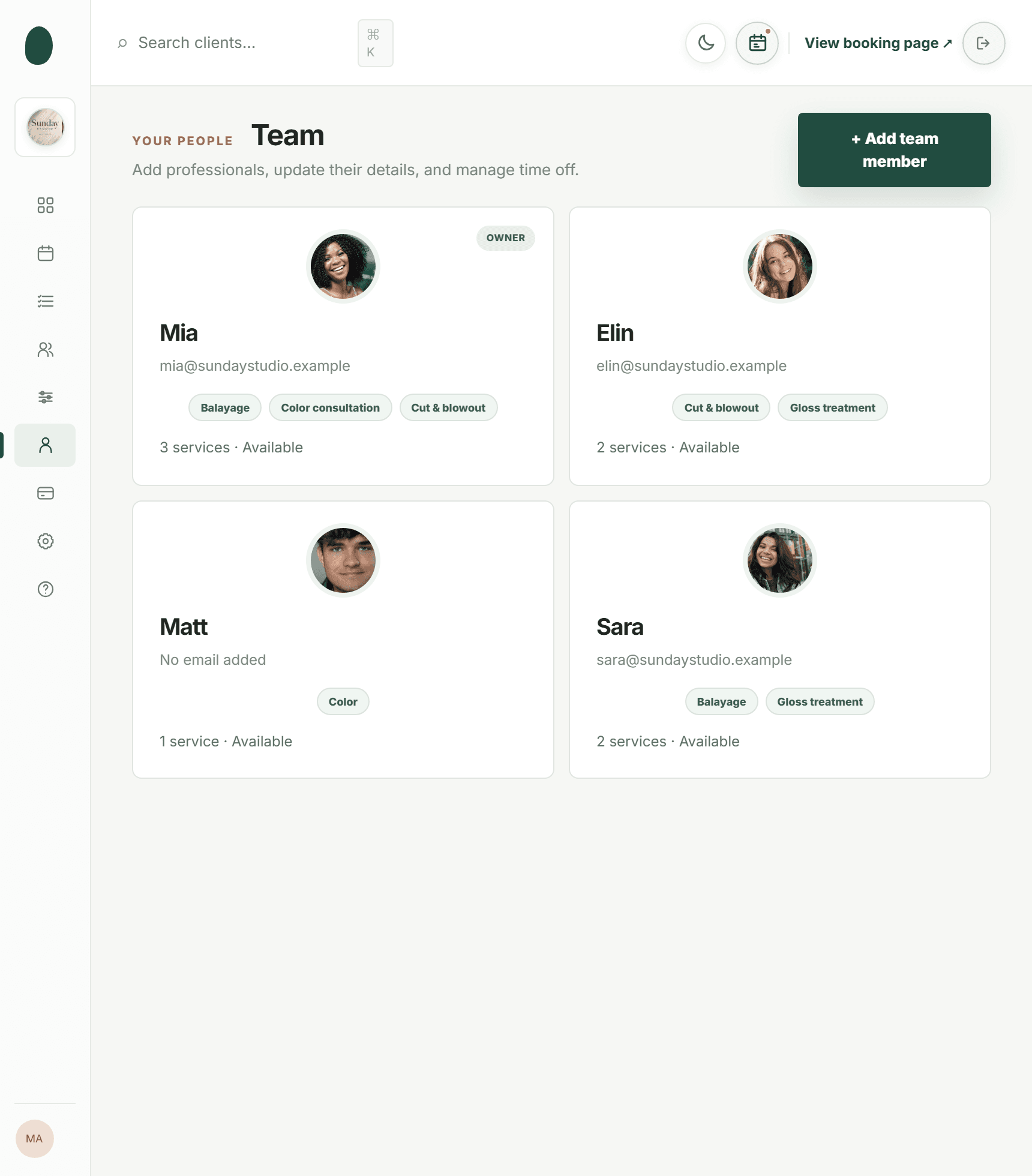
Kevonia is useful when the main problem is turning a profitable menu into a reliable booking operation. It provides a branded online booking page where clients choose a service, professional, date, and time, plus a workspace with a team calendar, client records, service menu, availability rules, and Stripe payments. That combination helps an owner make the service definition match the calendar reality.
For profitability work, the service menu can store duration, cleanup or buffer time, price, optional deposit, and professional assignment. Availability rules can account for opening hours, multiple breaks, time off, closures, booking windows, minimum notice, and slot intervals. Double-booking protection checks those constraints against existing bookings, which helps prevent the hidden labor and client-experience costs created by schedule collisions. For more detail, see Kevonia's salon reservation software.
Kevonia also supports card payments and deposits through Stripe, with payouts to the salon’s bank account. Its automatic day-before reminder allows clients to reschedule or cancel from the email within the salon’s notice window. The owner can review today’s revenue against the same day last week, appointments, client totals, no-shows as a percentage of the last 30 days’ bookings, and a 30-day revenue chart that marks the best day. Those views do not replace accounting or a complete service-profit report, but they can reveal booking volume, no-show patterns, and demand changes that affect capacity decisions.
Kevonia is priced as one US$49.99-per-month plan with unlimited team members, bookings, clients, and services, and no per-booking commission. The trial is free for 7 days, requires no credit card to start, and can be cancelled anytime before the trial ends without a charge. For a small salon comparing software cost with recovered booking capacity, evaluate the subscription against the value of fewer missed appointments, better deposit collection, and less administrative time rather than against the price alone.
Common mistakes that make a “profitable” service lose money
Most service-profit mistakes are operational rather than mathematical. Owners often know the ticket price and product cost but overlook the time, labor model, and customer behavior surrounding the appointment. Review these failure points before investing in equipment, education, or a new menu category.
- Using hands-on time instead of total booked time. Processing, consultation, sanitation, setup, and reset are still capacity costs.
- Ignoring compensation structure. A service can have a high gross margin on paper but leave little for the salon after commission, hourly pay, payroll taxes, or booth-related obligations.
- Underpricing correction work. A correction is not a standard color appointment; it can require more product, more consultation, more risk, and more follow-up.
- Offering every add-on to every client. Irrelevant add-ons slow the schedule and weaken trust. Recommend only what improves the client’s stated result.
- Failing to update durations. If providers regularly finish late, the menu is reporting false capacity and the owner is likely overestimating profit per hour.
- Treating deposits as profit. A deposit is part of the client’s payment, not extra revenue. Refunds, cancellations, and service completion must be recorded correctly.
- Promoting a service before confirming provider capability. A treatment should not be marketed broadly until the salon can deliver consistent results, timing, sanitation, and aftercare.
- Evaluating only the busiest months. Seasonal demand can make a weak service look strong or hide a service that performs well during slower periods.
Also separate business profitability from tax deductions. The IRS says a business expense generally must be ordinary and necessary to be deductible, but a deduction does not turn an unprofitable appointment into a profitable one. Keep clean records for accounting and tax purposes, and use service-level analysis to make operating decisions. Supporting details are available from IRS business expense guidance.
A practical 30-day action plan
You do not need to rebuild the entire menu to find better economics. Start with the services that occupy the most hours, generate the most complaints about timing, or appear frequently in your marketing. Then test one change at a time so you can see what actually improves the result.
- Days 1–7: Export or review recent appointments. Group them by service, provider, price, duration, discounts, deposits, cancellations, and completion status.
- Days 8–14: Measure product usage and labor assumptions for the five services with the most bookings or the highest prices. Use actual times from the calendar, not the advertised duration alone.
- Days 15–21: Choose one intervention: a price adjustment, revised duration, deposit, consultation requirement, clearer add-on, better buffer, or rebooking recommendation.
- Days 22–30: Compare contribution per booked hour, completed bookings, late starts, cancellations, and rebooking behavior with the prior period. Keep the change only if it improves the business without damaging quality or demand.
The strongest service menu is usually a balanced one: a few high-ticket specialties, dependable repeat maintenance, efficient short appointments, and carefully chosen add-ons. Track each category by contribution per booked hour and by its role in the client journey. That is how you identify the most profitable salon services for your own salon instead of relying on a generic internet ranking.
Sources
- U.S. Small Business Administration — Plan Your Business and Break-Even Analysis
- U.S. Bureau of Labor Statistics — Barbers, Hairstylists, and Cosmetologists Occupational Outlook Handbook
- U.S. Bureau of Labor Statistics — May 2025 Occupational Employment and Wage Statistics
- Stripe — Pricing and Fees
- Internal Revenue Service — Publication 334, Tax Guide for Small Business
- Kevonia — Salon and Spa Management Software
- Kevonia — Beauty Salon Booking Software
- Kevonia — Hair Salon Booking Software
- Kevonia — Salon Reservation Software
- Kevonia — Spa Booking Software
- Kevonia Blog — Salon Profit Margin: How to Calculate and Improve Yours in 2026
- Kevonia Blog — How Many Clients Can a Stylist See in a Day?
- Kevonia Blog — How to Price Salon Services: A Practical 2026 Guide
Frequently asked questions
What are the most profitable salon services in 2026?+
Common candidates include specialty and corrective color, extensions and extension maintenance, chemical texture or smoothing services, advanced facials, lashes, brows, waxing, and event styling. The best choice depends on your local price, provider compensation, product cost, total appointment time, demand, and rebooking rate. Rank your own services by contribution profit per booked hour rather than by ticket price.
Are high-ticket salon services always the most profitable?+
No. A high-ticket appointment can use more labor, product, cleanup time, and calendar capacity than its price justifies. Compare the collected price with direct labor and product costs, then divide the remaining contribution by the total blocked time. A lower-priced service may produce more profit per hour if it is efficient, in demand, and frequently rebooked.
How do I calculate salon revenue per hour?+
Start with collected service revenue, excluding sales tax and tips. Divide it by the total booked time, including consultation, setup, processing, cleanup, and required buffers. For a more useful profitability figure, subtract direct labor, product, payment, and appointment-specific costs before dividing. Track both revenue per hour and contribution profit per hour.
Should I add more services to make my salon more profitable?+
Not automatically. More services can create training costs, inventory complexity, scheduling problems, and inconsistent results. First identify gaps in your current menu, such as a missing maintenance appointment or an underpriced consultation. Add a service only when you can define its duration, cost, provider assignment, price, booking rules, and likely repeat demand.
How can deposits improve service profitability?+
Deposits can reduce the financial damage caused by late cancellations and no-shows, especially for long, customized, or inventory-dependent appointments. They do not replace clear cancellation terms or good client communication. Set the deposit amount and notice window deliberately, explain them before booking, and account for refunds correctly.
Can Kevonia help me manage profitable salon services?+
Yes. Kevonia lets you define service duration, cleanup or buffer time, price, optional deposit, and professional assignment. It also includes a branded booking page, team calendar, availability rules, double-booking protection, client records, Stripe payments, reminders, and overview metrics such as revenue, appointments, no-shows, clients, and a 30-day revenue chart. It does not replace accounting or create a complete cost-of-service report, so you should still track labor and product costs separately.
More from the blog

How to Price Salon Services: A Practical 2026 Guide
Set salon prices with a repeatable method instead of guessing. This guide covers costs, labor, profit margins, market research, service menus, deposits, and price reviews.

What to Do When a Stylist Calls in Sick: A Salon Owner’s Plan
A stylist calling in sick can disrupt a full day of appointments. Use this practical plan to protect clients, reassign services, communicate clearly, and prevent repeat problems.

How to Prepare Your Salon for the Holiday Season in 2026
A practical holiday-preparation checklist for salon and spa owners covering staffing, scheduling, services, deposits, client communication, safety, and January rebooking.