How to Fill Quiet Weeks in a Salon: 10 Practical Moves
Quiet weeks do not require panic discounting. Use this practical plan to reactivate clients, promote specific openings, improve booking access, and protect your margins.

Key takeaways
- Start with your existing client list before spending money on new advertising.
- Promote specific services, professionals, and time slots instead of offering vague discounts.
- Make booking easy from Google, your website, and every client message.
- Use quiet weeks to improve rebooking, pricing, service timing, and your salon’s local visibility.
What to do when your salon has a quiet week
If you searched for how to fill quiet weeks in a salon, you probably do not need another list of vague marketing ideas. You need to know what to do when next week has too many empty appointments, which actions can produce bookings quickly, and how to avoid filling the calendar with low-profit work.
The fastest approach is usually a combination of three things: contact people who already know your salon, make a clear offer around a real opening, and remove friction from booking. Then use the quieter period to fix the reason the gap exists instead of repeating the same emergency promotion every month.
1. Check the calendar before creating an offer
Begin by identifying exactly where the problem is. A salon with empty Tuesday mornings needs a different response from a salon with no bookings for one stylist, one service category, or an entire week. Review the next 14 to 21 days and mark openings by professional, service, day, time, and expected revenue.
- Separate genuinely open appointments from times that are unavailable because of breaks, time off, training, cleaning, or a salon closure.
- Look for patterns: the same weekday, the same professional, short-notice openings, or services that take too long to sell.
- Calculate the minimum price that makes an appointment worthwhile after product usage, payment costs, payroll or commission, and cleanup time.
- Decide whether you need more bookings overall or better bookings in a particular part of the schedule.
- Choose one measurable target, such as filling six appointments on Tuesday and Wednesday or bringing back ten clients who have not visited recently.
Do not fill every gap automatically. Some short openings are too small for a full color service but may suit a blowout, bang trim, express facial, gel removal, beard service, or consultation. If a service needs setup and cleanup time, include that time when judging whether the slot is profitable. A booking that looks full on paper can still create an inefficient day. We cover this in more depth in how many clients a stylist can see.
2. Contact past clients before chasing strangers
Your first outreach list should be made up of clients who have already visited, especially those whose usual return window is approaching. A person who had a haircut, manicure, massage, or facial at your salon already understands the location, service, and experience. That makes a relevant reminder more useful than a broad message to everyone in your market. Supporting details are available from existing customers.
Use visit history and private notes to divide the list into practical groups. For example, contact blonding clients due for a maintenance appointment, clients who asked about a treatment but did not book it, people who normally book midweek, and regulars who have not returned within their normal interval. Keep the message specific: name the service, mention the available time, and explain why you thought of them.
- “I have a color-maintenance opening with Jordan on Wednesday at 11:00 a.m. Would you like me to hold it for you?”
- “You usually come in around this time for a gel refresh. We have two openings Thursday afternoon if you want one.”
- “We had a cancellation for a 60-minute facial tomorrow at 3:30 p.m. I thought of you because you asked about this service at your last visit.”
Avoid sending one generic message that says “We have openings!” It makes the salon sound desperate and forces the client to do the work of figuring out whether the offer applies to them. One-to-one outreach can be done manually for a small list. If you use commercial email, follow the Federal Trade Commission’s requirements for accurate sender information, a non-deceptive subject line, a physical postal address, and a clear way to opt out. Supporting details are available from commercial email requirements.
3. Build a narrow quiet-week offer
A quiet-week promotion should solve a scheduling problem, not permanently reduce the perceived value of your services. Limit the offer by date, time, service, professional, or client segment. “20% off everything” is easy to understand, but it can discount appointments that would have booked anyway and may attract clients who only return for a sale.
- Choose one or two services that fit the empty capacity and have healthy margins.
- Attach the offer to specific slow periods, such as Tuesday through Thursday before 2:00 p.m.
- Set an end date and a maximum number of appointments so the promotion cannot consume your busy schedule.
- Use an upgrade or bonus when possible, such as an included conditioning treatment, instead of cutting the entire service price.
- Write the terms plainly: who qualifies, which professional performs the service, when it is available, and whether it can be combined with another offer.
Examples include a midweek blowout package, a new-client consultation paired with a suitable service, a treatment add-on during a slow afternoon, or a limited express service for clients who cannot commit to a longer appointment. If you have a salon january quiet period, plan the offer before the calendar gets empty rather than waiting until the first slow week has already started.
Track the result by offer, not just by total bookings. Record how many people saw it, how many booked, the average ticket, whether they rebooked, and whether the promotion displaced a full-price appointment. After two or three uses, you should know whether the offer creates profitable demand or merely moves existing demand to a cheaper time. We cover this in more depth in how to price salon services.
4. Make every opening visible and bookable
A client cannot book an opening they do not know exists. Update the places people use when they are ready to act: your booking page, Google Business Profile, website, social profiles, and front-desk communication. Use direct language such as “Two Thursday openings for haircut and style with Maya” rather than “Book now for your next appointment.”
Google allows eligible local businesses to add booking links to their Business Profile, and those links can help customers take action from Search or Maps. The destination should be a dedicated page where the customer can complete the booking, not a generic homepage or a social media profile. Check the link yourself on a phone before promoting it.
Create one Google Business Profile post for the quiet-week availability. Include the service, professional if relevant, dates, times, location, booking link, and any terms. Google’s official guidance supports posts for updates, offers, and events; offer posts can include dates, descriptions, links, coupon codes, and terms. Keep the post current because older posts are eventually archived.
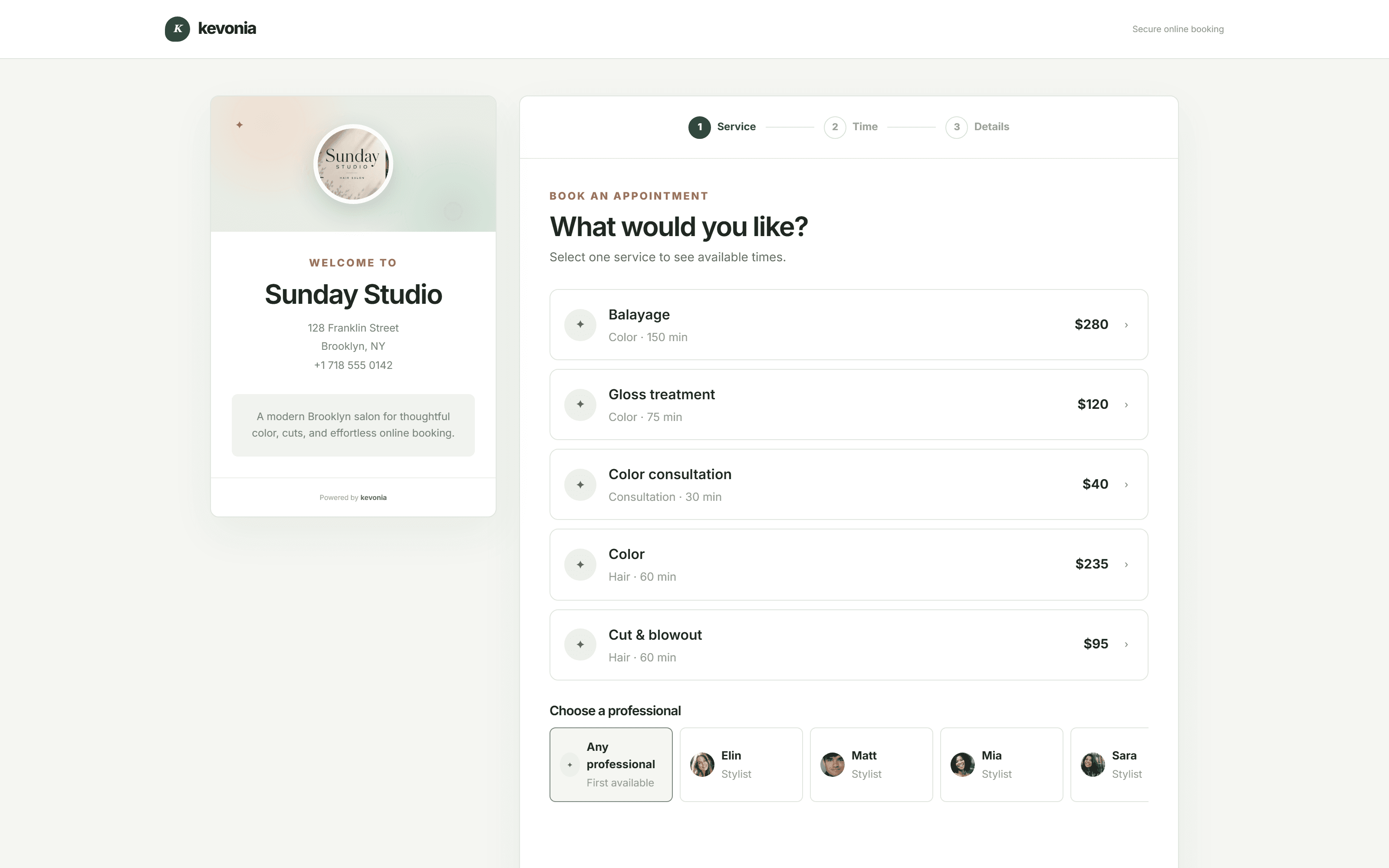
On your own channels, show the actual slot rather than making people search your schedule. A story, email, or website banner can say “Friday at 1:00 p.m. with Alex—deep-conditioning treatment included” and link straight to the relevant booking page. If your salon needs a more direct online path, a branded booking page such as Kevonia’s lets clients choose a service, professional, date, and time without waiting for the front desk.
5. Use the quiet week to improve rebooking
The best quiet-week strategy is not always a promotion. It may be preventing the next quiet week. Ask each client to choose their next appointment before leaving, especially when the service has a predictable maintenance interval. Make the recommendation concrete: “Your next trim will probably make sense in six to eight weeks,” or “Let’s reserve your next lash fill before the times you prefer disappear.”
Give professionals a simple rebooking routine. At checkout, they should recommend the timing, offer two appointment choices, and confirm the service and professional. If the client is not ready, record the useful context in the client record so the next conversation is informed rather than repetitive.
- Ask for the next appointment while the client is happy with the finished result.
- Offer the client’s preferred day or time first, then provide an alternative.
- Explain the maintenance reason for returning instead of using pressure or fear.
- Confirm whether the next visit should use the same service, duration, professional, or add-on.
- Measure rebooking by professional and service so you can coach the process where it is weakest.
A quiet week is also a good time to review why clients leave without rebooking. Common causes include unclear maintenance timing, limited availability, a service that ran late, difficulty booking online, or uncertainty about which service to choose next. Fix the underlying issue before increasing discounts.
6. Add demand without destroying your margins
When your existing clients do not fill the openings, pursue new demand in a controlled way. Ask nearby complementary businesses about a simple referral arrangement, update your local photos and service descriptions, and make sure your booking path works for someone who has never visited. A new client should be able to understand what you offer, how long it takes, what it costs, and how to reserve a time.
You can also use a quiet period to collect genuine reviews from clients who had a good experience. Google permits businesses to share a review link or QR code, but it prohibits offering free or discounted goods or services in exchange for reviews. Ask for honest feedback after the appointment and do not script the client’s words.
- Create a first-visit service with a clear scope and enough time for consultation.
- Partner with a nearby bridal shop, gym, hotel, photographer, boutique, or wellness business whose customers are a genuine fit.
- Publish before-and-after work only with the client’s permission and use accurate service descriptions.
- Promote availability to the neighborhood you can realistically serve rather than advertising across a large area.
- Use a deposit for services where late cancellations would create a significant loss, and explain the policy before the client confirms.
Do not spend on broad advertising until you know the conversion path works. If a new visitor lands on a confusing menu, cannot see availability, or has to call during work hours, more traffic may simply create more unanswered inquiries. Fix the booking experience first, then test a small campaign with one service and one audience. For more detail, see Kevonia's salon reservation software.
7. Use Kevonia to turn empty capacity into clear availability
Kevonia fits salons and spas that want one place to manage availability and online bookings without paying per seat or per booking. It provides a branded online booking page, a workspace with a team calendar, client records, a service menu, availability rules, and Stripe payments. The plan is US$49.99 per month, with unlimited team members, bookings, clients, and services and no per-booking commission.
For a quiet week, the practical difference is control over the details that determine whether a slot is actually bookable. You can set opening hours by weekday, multiple breaks, staff time off, salon closures, booking windows, minimum notice, and time-slot intervals. Double-booking protection checks against hours, breaks, time off, and existing bookings, so a promotion does not accidentally sell time that a professional cannot work.
The service menu can include duration, cleanup or buffer time, price, an optional deposit, and which professionals can perform the service. That lets you promote a short weekday service without pretending every team member has the same availability. The week and day calendars include per-professional filters and color coding, which helps an owner see whether the quiet period affects the whole salon or only one person’s schedule.
Kevonia also keeps client search, visit history, private notes, booking statuses, cancellation history, and online payments connected to the booking. Clients receive an automatic email reminder the day before an appointment and can reschedule or cancel from that email within the salon’s notice window. For a salon trying to fill quiet weeks consistently, that information is more useful than a one-time discount because it helps the owner see who returns, which services create gaps, and where cancellations are happening. For more detail, see Kevonia's hair salon booking software.
There is a 14-day free trial with no credit card required to start; cancel anytime before the trial ends and you are never charged. If you are comparing systems, test one real quiet-week workflow: create the service, set the opening, add the booking rules, send the link, and review what the client experiences before committing to a larger marketing push.
8. Create a repeatable slow-week operating plan
Treat a quiet week as an operating signal. At the end of each month, compare booked hours, revenue, cancellations, no-shows, new clients, returning clients, and rebooking by professional and service. Kevonia’s overview includes today’s revenue against the same day last week, appointment and client counts, no-shows as a percentage of the last 30 days’ bookings, and a 30-day revenue chart that marks the best day. Those measures can help you decide whether the problem is demand, capacity, pricing, timing, or follow-through.
- Four weeks before a historically slow period, review capacity and identify the exact services and times you want to sell.
- Two weeks before, prepare a narrow offer and a list of past clients whose visit timing makes the offer relevant.
- One week before, contact the list, update your Google Business Profile, publish availability, and verify the booking link.
- During the week, fill cancellations quickly, protect profitable appointment lengths, and ask completed clients to rebook.
- After the week, record bookings, revenue, discounts, rebooking, cancellations, and no-shows. Keep what worked and remove what did not.
This is how to get more salon bookings in a slow month without making every week a sale. You are building a system that starts with accurate capacity, reaches the most relevant clients, makes the next action easy, and uses the result to improve the following month.
Common mistakes that keep quiet weeks empty
Some actions feel productive but rarely solve the immediate scheduling problem. Avoid these mistakes when the calendar looks light.
- Posting without a booking link. Awareness is not enough if the client still has to call, wait, or search for availability.
- Promoting every service at once. A large menu creates choice overload and makes it difficult to match the offer to your actual gaps.
- Discounting busy times. If Saturday is already full, a discount there reduces revenue instead of filling capacity.
- Ignoring professional fit. A client may want the service but not the professional, schedule, price, or location shown in the promotion.
- Leaving availability inaccurate. If clients see times that are blocked by breaks, time off, or existing bookings, trust drops quickly.
- Overbooking to compensate. Packing the team too tightly can create late appointments, poor service, and more cancellations later.
- Sending too many messages. Relevance and timing matter more than volume, and commercial email must include a workable opt-out process.
- Measuring only the number of appointments. A full calendar can still be unprofitable if the average ticket, service time, or rebooking rate is weak.
The goal is not simply to make the calendar look busy. The goal is to fill the right openings with services that fit your team, protect the client experience, and create a reasonable chance of a return visit.
FAQ: Filling quiet weeks in a salon
These are the questions salon and spa owners usually ask when they need bookings soon but do not want to damage their pricing or reputation.
What is the fastest way to fill empty salon appointments?
Start with a short list of past clients whose usual service timing is approaching, then offer specific openings by service, professional, and time. Contacting a relevant client directly is usually faster than waiting for a general social post to reach the right person. Also publish the same availability with a direct booking link so people can act immediately.
Should I offer discounts during a salon slow season?
Use discounts selectively rather than automatically. Limit them to services, professionals, or time periods with genuine unused capacity, and calculate the minimum profitable price first. An included add-on, upgrade, or tightly defined package can protect your regular pricing better than a blanket percentage-off promotion.
How can I fill a salon january quiet period?
Prepare before January by identifying clients due for maintenance, creating one or two midweek offers, and asking regulars to prebook their next visit. Use the period to improve your service menu, update local search information, collect genuine reviews, and fix any booking friction. The aim is both immediate bookings and a stronger February calendar.
What should I post when my salon has last-minute openings?
State the exact service, date, time, professional, location, and booking method. For example: “Cancellation opening: 60-minute facial with Sam, Thursday at 2:30 p.m. Book online.” If the slot is short notice, say when the booking must be completed. Remove or update the post as soon as the appointment is taken.
Can online booking help during a quiet week?
Yes, if the schedule is accurate and the booking path is direct. Clients may decide to book outside business hours, so a 24/7 branded booking page can capture demand when nobody is available to answer the phone. Configure service durations, buffers, breaks, time off, minimum notice, and deposits carefully so online availability reflects reality.
How do I know whether a quiet-week promotion worked?
Track bookings generated, average ticket, discount cost, service time, cancellations, no-shows, and whether clients rebooked. Compare the result with a normal week for the same professional or service. If the promotion filled appointments but produced little profit or no repeat visits, change the offer or the target rather than simply repeating it.
Sources
- Google Business Profile: Create and manage posts
- Google Business Profile: Manage local business links
- Google Business Profile: About Business Profile and brand profile
- Google Business Profile: Create a review link or QR code
- Small Business Administration: Marketing to existing customers
- Federal Trade Commission: CAN-SPAM Act compliance guide
- Kevonia salon and spa management software
- Kevonia salon booking program
- Kevonia beauty salon booking software
- Kevonia hair salon booking software
- Kevonia salon reservation software
- Kevonia live demo workspace
- Kevonia blog: How many clients can a stylist see in a day?
- Kevonia blog: How to price salon services
- Kevonia blog: How to get clients to rebook
Frequently asked questions
What is the fastest way to fill empty salon appointments?+
Start with a short list of past clients whose usual service timing is approaching, then offer specific openings by service, professional, and time. Contacting a relevant client directly is usually faster than waiting for a general social post to reach the right person. Also publish the same availability with a direct booking link so people can act immediately.
Should I offer discounts during a salon slow season?+
Use discounts selectively rather than automatically. Limit them to services, professionals, or time periods with genuine unused capacity, and calculate the minimum profitable price first. An included add-on, upgrade, or tightly defined package can protect your regular pricing better than a blanket percentage-off promotion.
How can I fill a salon january quiet period?+
Prepare before January by identifying clients due for maintenance, creating one or two midweek offers, and asking regulars to prebook their next visit. Use the period to improve your service menu, update local search information, collect genuine reviews, and fix any booking friction. The aim is both immediate bookings and a stronger February calendar.
What should I post when my salon has last-minute openings?+
State the exact service, date, time, professional, location, and booking method. For example: “Cancellation opening: 60-minute facial with Sam, Thursday at 2:30 p.m. Book online.” If the slot is short notice, say when the booking must be completed. Remove or update the post as soon as the appointment is taken.
Can online booking help during a quiet week?+
Yes, if the schedule is accurate and the booking path is direct. Clients may decide to book outside business hours, so a 24/7 branded booking page can capture demand when nobody is available to answer the phone. Configure service durations, buffers, breaks, time off, minimum notice, and deposits carefully so online availability reflects reality.
How do I know whether a quiet-week promotion worked?+
Track bookings generated, average ticket, discount cost, service time, cancellations, no-shows, and whether clients rebooked. Compare the result with a normal week for the same professional or service. If the promotion filled appointments but produced little profit or no repeat visits, change the offer or the target rather than simply repeating it.
More from the blog

How to Close Your Salon for a Holiday Without Losing Clients
A holiday closure takes more than putting a note on the door. Use this practical checklist to protect appointments, payments, staff, and your first week back.

Should Salons Offer Discounts? A Smarter Way to Decide
Discounts can fill empty appointments, attract first-time clients, or encourage rebooking—but only when tied to a clear business goal. Here is how to decide whether one makes sense for your salon.

Going Independent as a Hairstylist: A Practical 2026 Guide
A step-by-step 2026 guide to going independent as a hairstylist, from choosing your business model and pricing services to moving clients, managing bookings, and staying organized.