Does a Salon Need a Receptionist? A Practical 2026 Guide
A salon does not automatically need a receptionist. Use this practical guide to decide whether front-desk help, shared duties, or online booking is the right fit for your business.

Key takeaways
- A receptionist is optional, but reliable coverage for bookings, arrivals, payments, and client questions is not.
- Small salons can often operate without a dedicated front desk when online booking and clear operating procedures handle routine work.
- Hire front-desk help when missed calls, interruptions, weak rebooking, or an overloaded owner are costing more than the role would.
- Test the need with real booking and revenue data before committing to a full-time employee.
Does a salon need a receptionist?
No. A salon does not automatically need a receptionist, and many solo professionals, booth-rent businesses, small salons, and appointment-only studios operate successfully without one. The better question is whether someone is consistently handling the work a receptionist would normally do: answering inquiries, scheduling appointments, checking clients in, taking payments, managing cancellations, and keeping the day organized.
If those tasks are manageable between appointments, a dedicated front-desk employee may add unnecessary payroll. If they regularly interrupt services, create missed bookings, or leave clients waiting, front-desk coverage may be one of your highest-value hires. The right answer depends on your appointment volume, service model, hours, client expectations, and how much routine work your booking system can handle.
What a salon receptionist actually does
A salon receptionist is not simply the person sitting near the entrance. The role combines customer service, scheduling, administration, and sometimes sales. The U.S. Bureau of Labor Statistics describes receptionists as handling tasks such as answering phones, scheduling and confirming appointments, greeting visitors, maintaining records, and directing customer questions. Personal care services are one of the industries that employ receptionists. (bls.gov)
In a salon, those responsibilities may include the following:
- Answering calls and messages while stylists or providers are working
- Matching clients with the right service and professional
- Booking, moving, confirming, and canceling appointments
- Greeting clients, collecting intake details, and notifying the provider
- Taking deposits, payments, tips, or balances
- Explaining policies for late arrivals, cancellations, and no-shows
- Keeping client records accurate and adding useful notes
- Recommending rebooking, add-on services, or retail products
- Opening and closing the front area
- Handling complaints and solving scheduling conflicts
That list matters because owners sometimes compare the cost of a receptionist with only the employee’s visible desk time. In reality, you are paying for responsiveness, organization, client reassurance, and the ability to keep providers focused on paid services. You should decide whether those outcomes are needed, not whether your salon has an empty chair near the entrance.
When you probably do not need a dedicated receptionist
A dedicated receptionist is often unnecessary when your business has a simple operating model and predictable demand. This is common for a solo stylist, a small team with staggered appointments, a studio that serves one client at a time, or a business where most clients already know what they want and book in advance.
You may be able to run a salon without a receptionist when most of the following are true:
- You have one to three providers rather than a continuously busy team.
- Most appointments are booked online instead of by phone.
- Your services have clear durations, prices, and provider assignments.
- Clients arrive at known appointment times rather than walking in frequently.
- Providers can greet their own clients without delaying the next service.
- You rarely need to coordinate overlapping arrivals, consultations, or checkout lines.
- Your cancellation and deposit policies are easy to explain and enforce.
- You can review messages and administrative work during planned blocks of time.
The key is not to confuse “no receptionist” with “no system.” If you remove the front desk, replace its processes. Give clients one booking path, publish accurate availability, set a response-time promise for messages, and decide who handles same-day changes. A branded online booking page can allow clients to choose a service, professional, date, and time even when no one is available to answer the phone.
For example, a two-chair salon open from 9 a.m. to 6 p.m. may not need someone stationed at the front all day. The owner can review the calendar before opening, respond to questions during a scheduled administrative period, and let each provider manage check-in and checkout. That arrangement works only if the team follows it consistently and clients are not left wondering what to do when they arrive.
When hiring front-desk help starts to make sense
A receptionist becomes more valuable when the work is frequent, time-sensitive, and difficult to complete without interrupting revenue-producing services. The strongest signal is not simply that your salon is busy. It is that the business is losing opportunities or delivering a weaker client experience because no one owns the front-of-house work.
Consider a dedicated or part-time receptionist if you regularly experience several of these conditions:
- Calls go unanswered because every provider is with a client.
- New inquiries wait long enough that they book somewhere else.
- Clients arrive while the team is occupied and do not receive a prompt welcome.
- Providers stop services to handle payments, scheduling, or complaints.
- There is a queue at checkout during peak periods.
- The owner spends evenings correcting calendar errors and answering routine questions.
- Your team cannot reliably rebook clients before they leave.
- Walk-ins, consultations, bridal groups, or multi-service appointments require coordination.
- No-shows and late cancellations create enough lost revenue to justify prevention and follow-up.
- You are adding providers, extending hours, or opening more treatment rooms.
The role may not need to be full-time. A part-time receptionist during your busiest four or five hours can cover arrivals, checkout, calls, and schedule changes while providers handle quieter periods. You can also assign a rotating front-desk shift to team members, but only if the duty does not routinely pull them away from services. A role that is “everyone’s responsibility” often becomes nobody’s responsibility.
Before hiring a hair salon receptionist, define the business problem the person must solve. “Make the salon feel more professional” is difficult to measure. “Answer peak-hour calls, reduce checkout delays, confirm next-day appointments, and recover open slots from cancellations” gives you a role with clear expectations.
How to calculate the real front-desk cost
The salon front desk cost is more than the hourly wage. For context, the BLS lists a median wage of $17.90 per hour for receptionists in May 2024 and notes that the personal care services industry employs receptionists. That figure is a national occupational median, not a required salon wage or a current quote for your local market. Your budget may need to account for local pay rates, payroll processing, employer taxes, workers’ compensation, training, paid time, and any benefits. (bls.gov)
If you hire an employee in the United States, you also take on administrative obligations. The IRS says employers must correctly classify workers and handle responsibilities such as withholding, depositing, reporting, and paying employment taxes. Review the requirements with your payroll provider or tax professional before making a hiring decision. (irs.gov)
Build the decision around break-even revenue rather than wages alone. Estimate the receptionist’s fully loaded monthly cost, then ask how much additional gross profit the role must protect or create. That could come from more answered inquiries, fewer empty appointment slots, faster checkout, higher rebooking, fewer no-shows, or allowing a provider to complete one additional profitable service per day.
Use this simple calculation:
- Monthly front-desk cost = wages plus employer costs, training, and tools.
- Required monthly contribution = monthly front-desk cost divided by your average gross profit per additional or protected appointment.
- Break-even appointments per week = required monthly contribution divided by 4.33.
For instance, if the role costs $3,000 per month all-in and the average contribution from an additional appointment is $75, the position must protect or create about 40 appointments per month to break even. That does not mean every appointment must be newly sold; preventing no-shows and keeping providers working can produce the same result. Use your own service mix and margins instead of relying on a generic industry benchmark.
The middle options between owner and full-time receptionist
Many salons do not need to choose between doing everything themselves and hiring a full-time receptionist. A hybrid model can provide coverage where it matters most while keeping payroll aligned with demand.
- Peak-hour coverage: Schedule a front-desk employee only during the hours with the most arrivals, calls, and checkout activity.
- Shared team duty: Assign a named provider to front-desk coverage in defined blocks, with another person designated as backup.
- Owner-managed administration: Reserve one or two calendar blocks each day for messages, confirmations, and schedule cleanup instead of reacting continuously.
- Online-first booking: Route routine appointments to a booking page and reserve human attention for consultations, corrections, and complex requests.
- Remote answering support: Use a service or virtual assistant for calls and messages, but establish clear rules for access, privacy, scheduling, and escalation.
- Receptionist plus service duties: In a small salon, combine front-desk work with cleaning, laundry, opening tasks, or other duties during quiet periods.
A hybrid setup should still have one accountable owner. Decide who handles a cancellation received five minutes before an appointment, who approves schedule exceptions, who checks deposits, and who contacts a client when a provider is running late. Technology can organize the information, but it cannot make an unclear responsibility disappear.
How booking software changes the receptionist decision
Booking software does not replace every part of a receptionist’s job. It can, however, remove repetitive work that does not require judgment. The practical question is whether your system can keep the calendar accurate, expose the right availability, collect information, and give clients a dependable way to manage routine appointments.
For a small salon, useful capabilities include a week and day team calendar, filters by professional, service durations, cleanup buffers, deposits, staff time off, breaks, closure dates, minimum notice, and protection against double-booking. Those controls reduce the amount of manual calendar maintenance that would otherwise land on the owner or front desk. Kevonia’s salon booking program includes these scheduling fundamentals along with client records and a service menu; its availability rules can account for opening hours, breaks, time off, closures, booking windows, minimum notice, and time-slot intervals.
Automated reminders also matter. A day-before email reminder can reduce routine confirmation work, while giving clients a way to reschedule or cancel within the salon’s notice window. If fake or high-risk bookings are a recurring problem, you may also want deposits, cancellation history, and a clear process for blocking a client when appropriate. Kevonia’s guide on preventing double bookings goes deeper into the operational side of calendar protection.
Payments are another dividing line. If clients can pay by card or leave a deposit online, the front desk has fewer payment tasks at arrival. Stripe explains that refunds are issued against the original payment and may remain pending when the available balance is insufficient, so your salon should still document who can approve refunds and how exceptions are handled. (docs.stripe.com)
The limitation is important: software will not greet a nervous first-time client, manage a complicated bridal-party change, calm an upset guest, or decide whether a service should be adjusted. Use automation for predictable transactions and people for judgment, hospitality, and recovery.
Where Kevonia fits for a salon without a full-time front desk
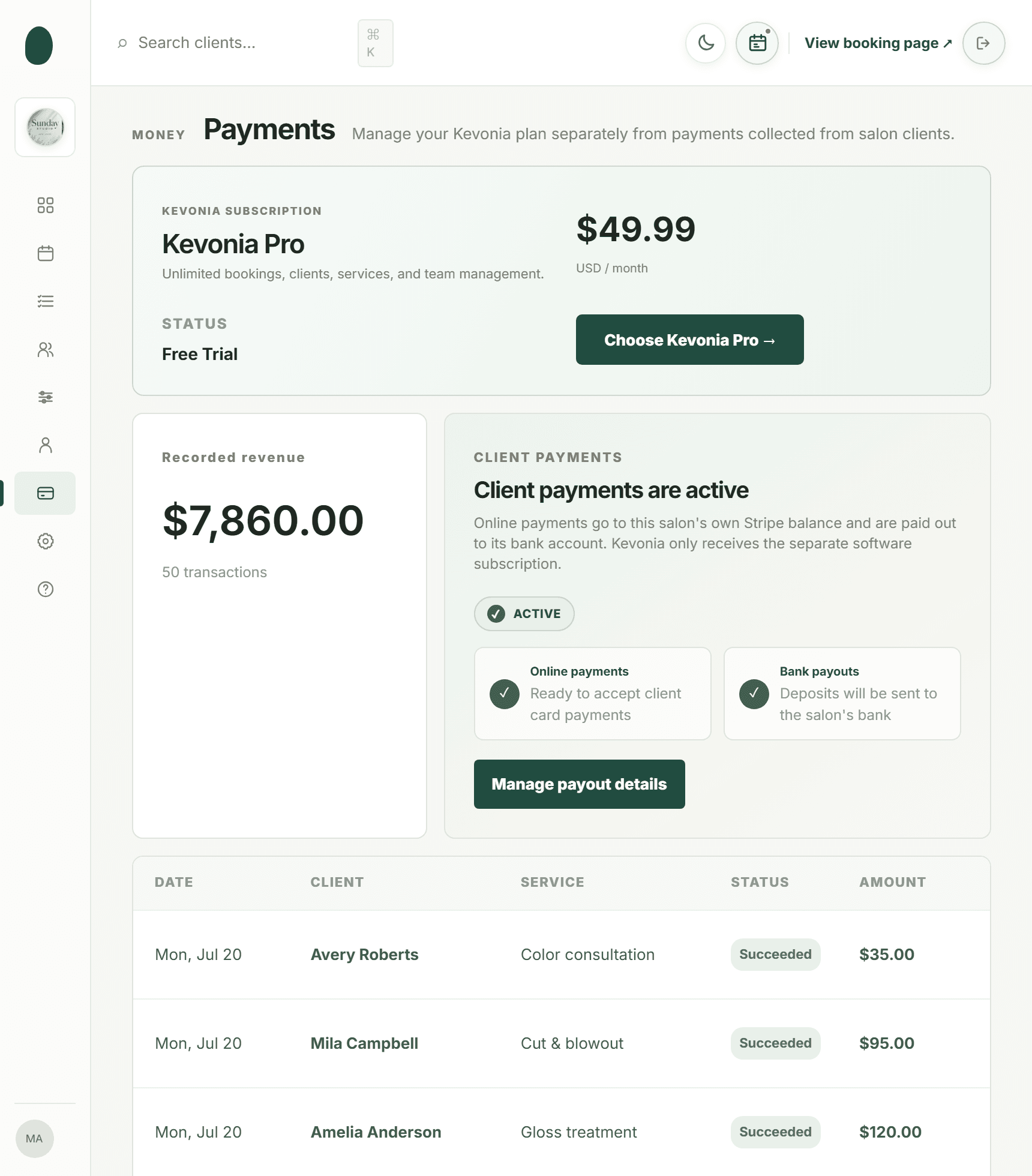
Kevonia fits salons and spas that want the scheduling and administrative structure of a front desk without automatically staffing a desk all day. It provides a branded booking page at kevonia.com/your-salon, where clients choose a service, professional, date, and time. The workspace includes a team calendar, client records, service menu, availability rules, and Stripe payments.
That combination is useful when your main problem is routine appointment handling rather than high-touch hospitality. A client can book outside business hours, the calendar can check availability against breaks, time off, existing appointments, and salon closures, and the owner can review client history and private notes without searching through separate systems. The salon can also set booking statuses such as needs confirmation, awaiting payment, booked, checked in, completed, no-show, or cancelled.
Kevonia is not a complete substitute for every front-of-house operation. It does not currently provide multi-location management from one account, retail or inventory POS, marketing or SMS campaign tools beyond the booking reminder email, or a native mobile app. If you need a staffed welcome experience, retail selling, extensive phone support, or complex multi-location administration, you may still need people or additional systems.
The pricing model can make the comparison straightforward for a small team: Kevonia has one plan at US$49.99 per month, with unlimited team members, bookings, clients, and services, no per-booking commission, and no per-seat charge. It offers a 14-day free trial with no credit card required to start; cancel before the trial ends and you are never charged. Compare that software expense with the revenue you expect a receptionist to protect, not with the wage alone.
A practical test is to run your current operation with a written front-desk checklist and online booking for two weeks. Track unanswered calls, delayed responses, booking errors, no-shows, checkout delays, recovered appointments, and owner hours spent on administration. If the system handles routine work but the team still struggles with arrivals and client communication, you have evidence for part-time or full-time coverage.
A decision checklist for your salon
Before hiring, audit the work for a representative four-week period. Do not base the decision on one exceptionally busy Saturday or one quiet month. Look for recurring patterns by day, hour, service type, and provider.
- Count inbound calls and messages, then record how many were answered within your target response time.
- Measure how many bookings came through the phone, online, walk-in traffic, social media, or referrals.
- Record the number and value of no-shows, late cancellations, schedule changes, and booking corrections.
- Track how often a provider pauses or leaves a service to answer a call, take payment, or solve a calendar issue.
- Measure average checkout time during your busiest periods.
- Record how many clients rebook before leaving and how often someone follows up later.
- Estimate the owner’s weekly hours spent on scheduling, reminders, records, payments, and complaint handling.
- Calculate the revenue or gross profit associated with each protected appointment and each additional appointment.
- Test whether online booking, deposits, reminders, and clearer policies reduce the workload.
- Choose full-time, part-time, shared, or software-led coverage based on the results.
Set a review date after the change. If you hire, define success measures such as response time, booking conversion, checkout time, rebooking rate, no-show rate, and provider utilization. If you do not hire, define service standards such as when messages are answered, how arrivals are handled, and who owns urgent changes. Revisit the decision when you add providers, change hours, introduce walk-ins, or move into a larger space.
Sources
- U.S. Bureau of Labor Statistics — Receptionists Occupational Outlook Handbook
- Internal Revenue Service — Businesses with Employees
- Stripe Documentation — Refund and Cancel Payments
- Kevonia — Online Spa Scheduling Software
- Kevonia — Salon Booking Program
- Kevonia — Salon Reservation Software
- Kevonia — Kevonia Home Page
- Kevonia Blog — How to Prevent Double Bookings in a Salon
- Kevonia Blog — Salon KPIs: 15 Metrics Every Salon Should Track in 2026
Frequently asked questions
Can a small salon operate without a receptionist?+
Yes. A small salon can operate without a dedicated receptionist when most clients book online, providers can manage arrivals and checkout, and someone has defined responsibility for calls, messages, cancellations, and schedule changes. The salon still needs reliable processes; removing the job title does not remove the work.
What is the biggest sign that my salon needs a receptionist?+
The clearest sign is repeated operational loss: missed calls, delayed replies, clients waiting at arrival, providers interrupting services, checkout lines, unfilled cancellation slots, or an owner spending substantial unpaid time on administration. Measure those problems for several weeks and compare the likely recovered revenue with the fully loaded cost of coverage.
Should I hire a full-time or part-time receptionist?+
Start with the hours that create the most pressure. If calls, arrivals, and checkout problems cluster around evenings or weekends, part-time peak-hour coverage may be enough. Full-time coverage makes more sense when the salon has steady traffic throughout the day, frequent walk-ins, multiple overlapping services, or enough administrative work to keep the role productive between arrivals.
Can online booking replace a salon receptionist?+
Online booking can replace many repetitive tasks, including letting clients select services and times, checking availability, collecting deposits, sending reminders, and handling routine rescheduling within your policy. It cannot replace hospitality, complex consultations, complaint resolution, or judgment calls. Use it to reduce front-desk workload, then hire people where human attention creates measurable value.
How should I compare receptionist pay with software cost?+
Compare the total monthly cost of each option with the revenue and time it protects. Employee cost may include wages, employer taxes, payroll administration, training, insurance, and benefits. Software cost is usually more predictable, but it still requires setup and team adoption. The fairest comparison is the number of appointments, hours, and client problems each option prevents or creates.
What should a receptionist do during slow periods?+
Give the role a written secondary workload: confirming details, updating client records, preparing the next day, following up on missed inquiries, organizing the schedule, supporting rebooking, checking deposits, and maintaining the reception area. Avoid hiring someone for a vague “be available” role; define productive tasks and measurable standards for quiet hours.
More from the blog

Does My Salon Need a Website? A Practical 2026 Guide
A salon website is not automatically necessary, but most established salons benefit from having one reliable place for services, policies, location, and booking.

Using Google Calendar for Salon Bookings: Where It Works and Where It Breaks
Google Calendar can handle simple appointment scheduling, but salons often outgrow it when they need services, staff rules, deposits, reminders, and client records in one place.

Boulevard Alternative: Compare Cost, Complexity, and Fit
Boulevard is powerful, but its pricing and broader feature set may be more than a small salon needs. Compare it with Kevonia by cost, workflow, and operational fit.