Treatwell Alternative: Compare the Real Trade-Offs
Treatwell can bring discovery bookings, but it is not the only way to run your calendar. Compare the marketplace model with Kevonia’s flat-cost, direct-booking approach.

Key takeaways
- Treatwell is strongest when you need marketplace discovery and new-client acquisition, not simply appointment scheduling.
- The important cost question is not only the subscription: it is which bookings can trigger commission and how much control you keep over the client relationship.
- Kevonia is a direct-booking alternative with one US$49.99/month plan, 0% per-booking commission, and no per-seat charges.
- Switching only makes sense after you measure how many Treatwell bookings are genuinely incremental and how many could move to your own booking page.
| Tool | Starting price | Commission / booking fees | Standout features | Best fit |
|---|---|---|---|---|
| Treatwell | Not publicly listed; partner page invites salons to start or request a demo | Commission applies to a new client’s first appointment; the exact amount is set in the partner agreement. Repeat bookings and uploaded clients are described as commission-free. | Marketplace discovery, multi-channel booking, reminders, payments, staff tools, POS, stock management, and multi-location support | Salons that need marketplace discovery and a broader operating platform |
| Kevonia | US$49.99/month; 14-day free trial | 0% per-booking commission; no per-seat charge | Branded 24/7 booking page, team calendar, availability rules, client records, service menu, Stripe payments, deposits, refunds, reminders, and booking controls | Single-location salons and spas that want predictable direct-booking software |
What are you actually looking for in a Treatwell alternative?
If you searched for a treatwell alternative, you probably are not looking for another calendar alone. You are weighing two different business models: a marketplace that can put your salon in front of people already searching for appointments, or direct-booking software that helps you run bookings under your own brand. The right choice depends on whether your immediate problem is empty chairs, booking administration, commission, or dependence on a third-party marketplace.
The short answer is straightforward. Keep Treatwell if its discovery traffic produces profitable new clients you would not otherwise reach. Compare an alternative to treatwell when most of your clients already come from referrals, Google, social media, or repeat visits and you want a predictable software bill instead of a marketplace-linked cost. Kevonia fits the second situation: direct online booking and salon operations without a per-booking commission.
Treatwell versus Kevonia at a glance
Treatwell combines salon software with a customer marketplace. Its partner site says salons can receive bookings through the Treatwell app, Google, social media, a website widget, and other channels. It also says Treatwell charges commission on a client’s first appointment while repeat bookings are commission-free; the specific commission amount is set in the partner’s agreement rather than published as one universal rate. Treatwell’s official partner pages also describe calendar management, staff scheduling, reminders, payments, client management, multiple locations, POS, stock management, and reporting. Supporting details are available from Treatwell partner model. Supporting details are available from Treatwell Connect features.
Kevonia uses a different model. It has one plan at US$49.99/month, 0% per-booking commission, and no per-seat charge. The plan includes unlimited team members, bookings, clients, and services. The 14-day trial is free, requires no credit card to start, and does not charge you if you cancel before the trial ends. That makes the cost easier to forecast, but it also means Kevonia is not a marketplace that promises to send shoppers who are browsing for a salon.
For a salon owner, the difference is less about which product has the longer feature list and more about where the booking starts. Treatwell is designed to help a client discover and book a provider through its ecosystem. Kevonia gives you a branded booking page at kevonia.com/your-salon, where clients select a service, professional, date, and time. That distinction should appear in your comparison spreadsheet before you compare reminders or calendar colors.
The cost question is bigger than a monthly subscription
Search results for Treatwell alternatives often reduce the decision to a headline commission percentage. That is too crude. Treatwell’s current partner information confirms that marketplace commission applies to a client’s first appointment, while repeat appointments and clients you upload are described as commission-free. Its partner terms state that the commission amount is set in a special cooperation agreement and may be amended, so you should check your actual agreement rather than rely on a number from a comparison article. Supporting details are available from Treatwell commission terms.
The practical calculation is this: separate bookings by source, then calculate the contribution margin from each source. A new marketplace client may still be profitable after commission if Treatwell genuinely created the demand. A repeat client who would have booked through your own website is a different case. In that situation, the relevant question is not whether the booking is technically available through Treatwell; it is whether you are paying for discovery you did not need.
- Count first-time Treatwell clients separately from existing clients.
- Record the average service revenue and direct treatment cost for each group.
- Measure how many first-time clients return without being acquired again through the marketplace.
- Compare the total marketplace-related cost with a fixed software plan and your existing marketing spend.
- Include operational costs such as retraining staff, rebuilding services, and changing links in social profiles and email signatures.
Kevonia’s pricing is easier to model because the software charge is fixed at US$49.99/month and its booking commission is 0%. Stripe processing still applies when you take card payments or deposits, but the booking software itself does not add a per-booking commission. The important caveat is that a fixed-cost system does not replace demand generation. You must already have a way to send people to your booking page, such as your website, Google profile, social channels, referrals, or repeat-client communication. For more detail, see Kevonia's salon reservation software.
This is where the usual advice can be wrong. Moving away from Treatwell is not automatically cheaper if the marketplace is filling genuinely incremental appointments. Conversely, staying because the software is familiar can be expensive when most of your bookings already come from clients who know your salon. Run the source-by-source calculation for at least four weeks before you decide. We cover this in more depth in real monthly budget.
What Treatwell does well—and where it can become a poor fit
Treatwell is a credible fit for salons that want both operations software and marketplace exposure. Its official partner material positions the platform around new-client discovery, online booking from multiple channels, diary management, reminders, payments, rebooking, reviews, and staff tools. Treatwell also says its software supports salons with more than one location, which matters if your operation has grown beyond a single site.
- You are new in an area and need a channel that can introduce unfamiliar clients.
- Your team would rather trade some booking margin for marketplace visibility.
- You want marketplace reviews and discovery alongside scheduling tools.
- You need a broader operating system that includes POS, stock, or multi-location workflows.
- You have measured that Treatwell-sourced clients return often enough to justify the acquisition cost.
The model becomes less attractive when you already have demand and mainly need a reliable booking workflow. It can also be a poor fit when the salon owner wants every client relationship, booking link, and follow-up process to sit under the salon’s own brand. The marketplace may be useful for acquisition, but it creates a dependency: changing platforms requires changing where clients expect to find you and how staff manage the diary.
Another edge case is the salon with a mixed customer base. You may have a busy core of regulars, a few quiet weekdays, and a need for occasional new-client discovery. In that situation, an all-or-nothing switch may be unnecessary. Keep a marketplace channel only if you can track its incremental value, while directing regulars and referrals to your own booking page. Treatwell itself describes direct widget bookings as a separate channel, so confirm the commercial treatment of each source in your agreement before making assumptions.
Where Kevonia fits for salons and spas
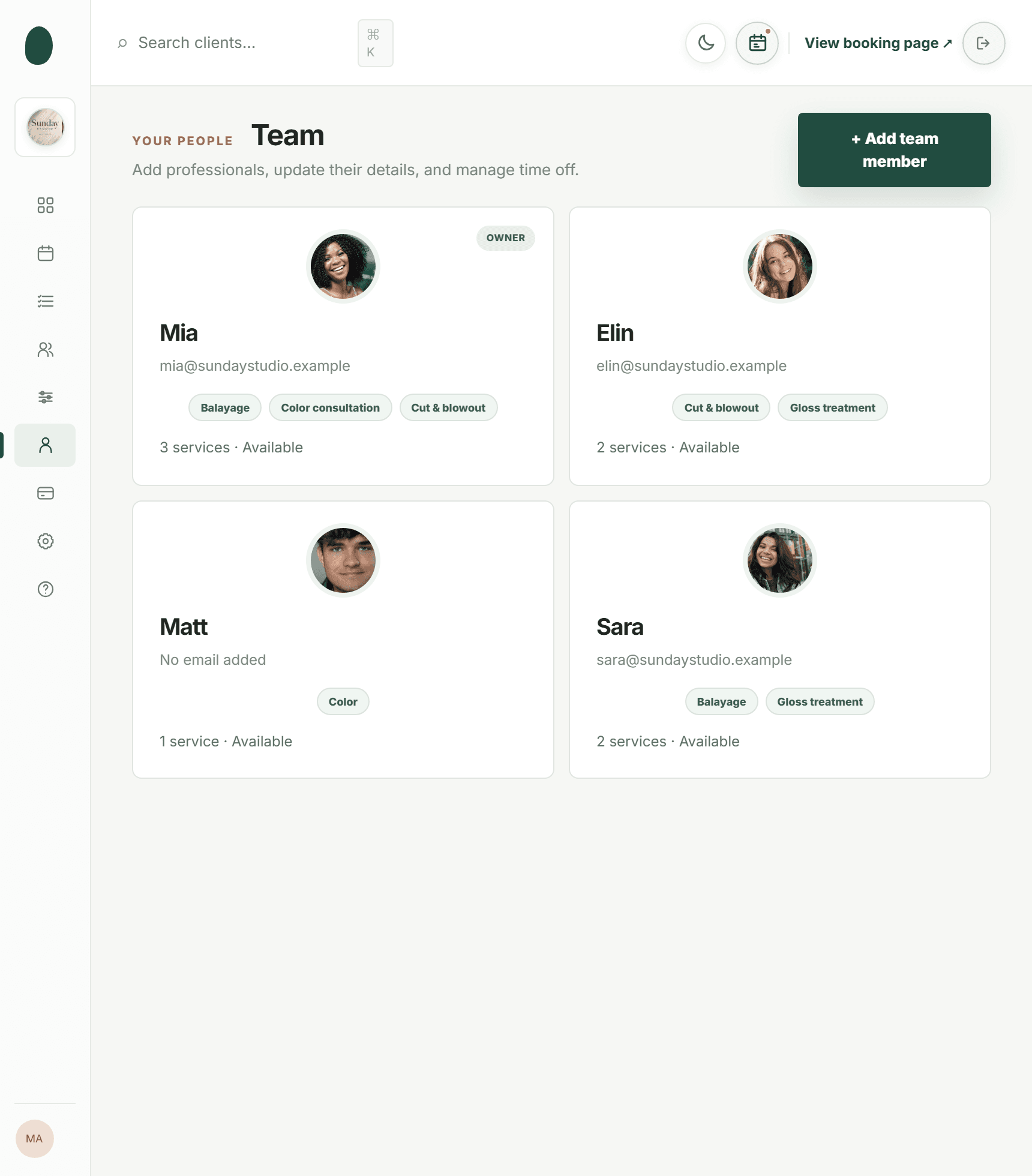
Kevonia is designed for owners who want a direct online booking system with the core controls needed to run a team. The branded booking page is open 24/7, and clients choose the service, professional, date, and time. Behind it, the workspace includes a week and day team calendar, per-professional filters, color coding, client records, a service menu, availability rules, and Stripe payments.
The operational details matter more than a generic “online booking” label. Kevonia checks for double bookings against hours, breaks, time off, and existing appointments. You can set multiple breaks, salon closures, booking windows, minimum notice, time-slot intervals, cleanup or buffer time, deposits, and professional assignments. For a hair salon, spa, barbershop, nail studio, tattoo studio, med spa, or wellness business, those rules determine whether the system reflects the real working day instead of merely displaying open slots.
Client management is also practical rather than marketing-heavy. You can search records by name, email, or phone, add private notes, and review visit history. The system sends an automatic email reminder the day before an appointment, and clients can reschedule or cancel from that email within your notice window. You can see cancellation history, restore a cancelled booking, block a client from online booking with a reason, and review no-show history on the client record.
Payments run through Stripe, with card payments and deposits available and payouts going to the salon’s bank account. From the booking itself, the salon can refund an online payment; the Stripe processing fee on the refund is shown so the actual cost is visible, and the client is emailed automatically. That is useful for owners who want the booking, payment, refund, and client communication connected without adding a separate marketplace layer.
Kevonia is not the right substitute for every Treatwell use case. It does not currently provide multi-location management from one account, retail or inventory POS, marketing or SMS campaign tools beyond the booking reminder email, or a native mobile app. If those are essential, a larger platform may fit better. If your priority is a branded booking page, a team calendar, client records, service and availability control, and predictable pricing, Kevonia is the more focused option.
Owners comparing several salon systems may also want to see how the same direct-control question applies to other marketplaces and booking platforms in the salon software comparisons on this blog. The decision is usually about operating model first and feature count second.
A fair comparison by salon situation
There is no universal winner among Treatwell competitors. The best choice changes with your acquisition situation, team size, and appetite for operating multiple systems. Use the scenarios below instead of selecting software from a feature checklist.
- New salon with weak local awareness: Treatwell may be worth testing because marketplace discovery can shorten the path to first bookings. Track whether those clients return and whether the first appointment is profitable.
- Established neighborhood salon with strong referrals: Kevonia is more likely to fit because the main need is converting existing demand into appointments without adding booking commission.
- Busy single-location team: Kevonia can reduce scheduling friction with per-professional availability, buffers, breaks, time off, and double-booking protection. Treatwell may still win if its wider operating tools are essential.
- Solo professional or small studio: Compare the value of unlimited bookings, clients, services, and team members against the features you will actually use. Do not pay for marketplace reach if nearly every client already comes directly to you.
- Salon with retail, inventory, or multiple locations: Treatwell’s broader software scope may be more relevant than a focused direct-booking product, provided the commercial terms work for your booking mix.
A common mistake is comparing only the first month. Switching costs show up in small places: staff need to learn the new statuses, services need accurate durations and buffers, regulars need the new link, and old booking buttons need to be replaced. Plan the change around a quieter week, export or recreate the information you are legally and operationally allowed to move, and keep a clear record of appointments that were already booked before the change.
How to decide without guessing
Before replacing Treatwell, run a short decision test. You do not need a complicated dashboard; you need enough information to distinguish paid acquisition from routine scheduling. Use the same period for both booking volume and revenue so a busy holiday week does not distort the result.
- Export or record the last 30 days of bookings by source: Treatwell marketplace, your website, phone, walk-in, Google, social, referral, and repeat booking.
- Separate first-time clients from returning clients. Do not treat every Treatwell booking as a new lead.
- Calculate gross service revenue, commission, payment costs, discounts, refunds, and no-show impact for each source.
- Estimate how many direct clients would still book if you changed the software. Ask regulars where they normally find your booking link.
- Test the replacement system with your real service menu, staff schedules, breaks, deposits, minimum notice, and cancellation rules—not a simplified demo calendar.
- Choose the platform that solves your largest measured problem, then set a review date after the first full month.
The test should include an awkward week, not only a clean setup. Try a staff member taking time off, a service with cleanup time, a client cancelling inside the notice window, a refund, and two professionals whose schedules overlap. A booking system can look excellent until it meets the exceptions that happen every day in a real salon.
For owners who want a direct-booking replacement, Kevonia offers a 14-day free trial with no credit card required to start. You can cancel any time before the trial ends and never be charged. Use that period to recreate your real service menu and availability rules rather than judging the product from a blank account.
The bottom line: choose the booking model first
Treatwell is strongest when marketplace discovery is a meaningful source of profitable new business and you value a broader platform for bookings, payments, staff, and salon operations. Its own partner information makes clear that first appointments from new clients can carry commission, while repeat bookings and uploaded clients are handled differently. Confirm the exact terms attached to your account before relying on any published comparison figure. Supporting details are available from exact partner terms.
Kevonia is the stronger treatwell alternative when your clients already know how to find you and you want the software layer to stay simple and predictable: US$49.99/month, 0% booking commission, unlimited team members, bookings, clients, and services, plus a branded booking page and practical salon controls. It will not replace marketplace demand generation, multi-location administration, retail POS, or campaign marketing. It does give a single-location salon or spa a focused way to manage direct bookings without charging more as appointment volume grows.
Make the decision from your booking sources, not from the word “free,” a feature-count contest, or an unsourced commission number. If Treatwell is acquiring clients you could not reach, measure and protect that value. If it is mainly organizing clients you already own, a fixed-cost direct-booking system may leave more control and more predictable margin with your salon.
Sources
- Treatwell Business partner overview
- Treatwell Connect salon software features
- Treatwell partner terms of business
- Treatwell Connect feature overview and direct widget bookings
- G2 Treatwell alternatives overview
- Calendall Treatwell alternative comparison
- Kevonia hairdressing booking system
- Kevonia salon booking program
- Kevonia salon reservation software
- Kevonia beauty salon booking software
- Kevonia live demo
- Kevonia salon budget article
- Kevonia Booksy comparison article
- Kevonia hair salon booking software
Frequently asked questions
Is Kevonia a true Treatwell alternative?+
Yes, if by alternative you mean software for direct online booking and day-to-day salon scheduling. Kevonia provides a branded booking page, team calendar, client records, service and availability controls, Stripe payments, deposits, reminders, refunds, and booking statuses. It is not a marketplace, so it does not perform the same client-discovery role as Treatwell.
Does Treatwell charge commission on every booking?+
Treatwell’s UK partner page says it charges commission on a client’s first appointment and that repeat bookings are commission-free. Its partner terms say the actual commission is set in the salon’s special cooperation agreement and may be amended. Clients you upload are described by Treatwell as commission-free, so check your current agreement and booking-source rules rather than relying on a generic percentage.
How much does Kevonia cost?+
Kevonia has one plan at US$49.99/month. There are no feature tiers, add-on prices, per-seat charges, or per-booking commissions. The trial is free for 14 days, no credit card is required to start, and cancelling before the trial ends means you are never charged.
Will I lose new clients if I move away from Treatwell?+
You may lose Treatwell marketplace discovery, but the impact depends on how many bookings actually come from that channel. Check the last 30 days of bookings and separate Treatwell marketplace clients from repeat clients, referrals, Google, social, and your own website. If marketplace bookings are genuinely incremental, keep that value in your calculation or consider a staged transition.
Does Kevonia include payments and deposits?+
Yes. Kevonia supports card payments and deposits through Stripe, with payouts to the salon’s bank account. The salon can refund an online payment from the booking, see the Stripe processing fee on the refund, and trigger an automatic email to the client.
What does Kevonia not include that Treatwell may offer?+
Kevonia does not currently offer multi-location management from one account, retail or inventory POS, marketing or SMS campaign tools beyond the booking reminder email, or a native mobile app. Treatwell’s official software pages describe broader tools such as multi-location support, POS, stock management, and marketplace discovery. Choose Kevonia for focused direct booking, not if those broader capabilities are essential.
More from the blog

Acuity Scheduling Alternative: What Salon Owners Should Compare
Looking for an Acuity Scheduling alternative? Compare Acuity with Kevonia on pricing, booking fees, salon workflows, team scheduling, payments, and switching risks.

Setmore Alternative: Compare Costs, Limits, and Salon Fit
Setmore is a capable low-cost scheduler, but salon owners often need more control over team calendars, deposits, client records, and predictable monthly costs. Here is how Kevonia compares.

Mangomint Alternative: When Kevonia Is the Better Fit
Looking for a Mangomint alternative? Compare Mangomint’s per-location, per-user model with Kevonia’s flat plan and decide which platform fits your salon or spa.