Booksy Alternative: Kevonia vs. Booksy for Salons in 2026
Looking for a booksy alternative? Compare Kevonia and Booksy on pricing, booking fees, team management, online scheduling, payments, and everyday salon operations.

Key takeaways
- Booksy is a broad salon platform with a customer marketplace, marketing tools, payments, inventory, and an app-based workflow.
- Kevonia uses one $49.99/month plan with unlimited team members, bookings, clients, and services, plus 0% per-booking commission.
- Booksy starts at $29.99/month for one user, then adds $20/month per additional user; optional Boost can charge a commission for qualifying first-time clients.
- Kevonia is a better fit when you want straightforward salon scheduling, availability controls, client records, deposits, and a branded booking page without feature tiers or per-seat charges.
- The right choice depends on whether your priority is marketplace-driven client acquisition or predictable, focused salon operations.
| Tool | Starting price | Commission or booking fees | Standout features |
|---|---|---|---|
| Kevonia | $49.99/month for one plan | 0% per-booking commission; Stripe payment processing may apply | Branded 24/7 booking page, unlimited team members, detailed availability rules, team calendar, client records, deposits, Stripe payments |
| Booksy | $29.99/month plus tax for one user; $20/month for each additional user | No booking commission when Boost is not used; optional Boost can charge a one-time first-visit commission; payment-processing fees vary by method | Customer marketplace and app, online booking, marketing tools, payments, inventory, memberships, gift cards, reports, mobile business app |
What salon owners usually mean by “Booksy alternative”
If you searched for a booksy alternative, you probably are not looking for another generic calendar. You are comparing the cost of Booksy with the way your salon actually works: how clients book, how staff availability is managed, whether deposits are easy to take, and whether adding another professional increases your monthly bill.
Booksy is a substantial platform, but its broad feature set is not automatically the best fit for every salon or spa. Kevonia takes a more focused approach: one plan, a branded online booking page, a team workspace, detailed availability rules, client records, and Stripe payments. This comparison explains the practical trade-offs so you can choose based on your workflow rather than a long feature checklist.
Kevonia vs. Booksy: quick comparison
The biggest difference is not simply the starting subscription price. Booksy begins at a lower price for a solo provider, while Kevonia is designed to keep the monthly cost predictable as a team grows. Booksy also offers a marketplace and marketing suite; Kevonia concentrates on booking, scheduling, client administration, availability, reminders, and payments.
Booksy’s published US pricing lists a $29.99 monthly subscription plus tax for one user and $20 per month for each additional user. Its pricing page says the subscription includes unlimited bookings and no booking commission when Boost is not used. Boost is optional, but it can charge a one-time commission for a new client’s first visit. Booksy also lists separate payment-processing rates depending on the payment method. (biz.booksy.com)
Pricing, team costs, and booking fees
For a solo stylist, barber, esthetician, or massage therapist, Booksy has the lower advertised starting price. The calculation changes as soon as you add staff. At Booksy’s listed $20 monthly charge for each additional user, a three-person team would pay $69.99 per month before tax. A five-person team would pay $109.99 per month before tax. Those figures use Booksy’s published base price and additional-user charge; payment processing and optional marketing-related charges are separate considerations. (biz.booksy.com)
Kevonia has one plan at $49.99 per month. The plan includes unlimited team members, bookings, clients, and services, with no per-seat charge and no per-booking commission. For a solo business, that is a higher monthly starting price than Booksy. For a growing salon, however, the flat structure makes the software cost easier to forecast because adding a professional does not add another subscription line.
The booking-fee question deserves careful attention. Booksy says it does not charge a commission for clients who book through your own marketing or through Booksy when Boost is off. If Boost is turned on and Booksy brings in a new client, the company describes a one-time first-visit commission of 30%, subject to minimum and maximum rules in its help documentation. This can be useful if marketplace discovery is valuable to you, but it means the acquisition cost should be included in your comparison. (biz.booksy.com)
- Choose Booksy when the lower solo price or marketplace exposure is more important than a flat team cost.
- Choose Kevonia when you expect to add professionals and want unlimited team members without a per-seat charge.
- Compare payment-processing costs separately from software subscription costs; neither platform’s subscription price tells you the full cost of taking card payments.
- Ask whether a first-time-client commission is an intentional marketing expense or a cost you would rather avoid.
How the booking experience differs
Booksy is built around online discovery as well as scheduling. Clients can find providers through the Booksy customer app and Booksy marketplace, then view services, availability, and provider information. Its online-booking materials also describe booking integrations and a profile where clients can see service details and prices. That model can help an independent provider who wants another channel for visibility, especially when attracting new local clients is a major goal. (biz.booksy.com)
Kevonia gives your business a branded booking page at kevonia.com/your-salon. Clients move through a clear sequence—service, professional, date, and time—without requiring your staff to coordinate appointments through calls or direct messages. The page is open 24/7, and your booking rules determine which times clients can actually select.
That distinction matters for established salons. If most of your clients already know your business and arrive from your website, Google profile, social media, referrals, or a link in your bio, a direct branded booking experience may be more important than appearing in a marketplace. If you are a new independent provider with limited visibility, Booksy’s marketplace may be a meaningful advantage—but it may also make your client-acquisition strategy more dependent on Booksy.
- Booksy is stronger for owners who want scheduling combined with a client marketplace and built-in marketing options.
- Kevonia is stronger for owners who want a direct booking destination connected to their own brand.
- Both approaches can work, but they solve different growth problems: discovery versus operational control.
- Before switching, identify where your next 20 appointments are expected to come from.
Calendar, availability, and double-booking control
A scheduling system is only useful when it reflects the real working day. Booksy describes a customizable calendar with color coding, booking rules, time off, staff shifts, and an automated waitlist. It also supports staff profiles, assigned services, and permission levels. Those tools make Booksy a broad option for businesses that want scheduling connected to staffing, client outreach, checkout, and reporting. (biz.booksy.com)
Kevonia’s workspace includes a week and day team calendar with per-professional filters and color coding. Its double-booking protection checks hours, breaks, time off, and existing bookings. That is important for a salon where a stylist may be available on Monday but not Tuesday, where a lunch break must remain blocked, or where a service requires cleanup time before the next appointment.
Kevonia also lets you define opening hours by weekday, multiple breaks, staff time off, salon closures, the booking window, minimum notice, and the time-slot interval. For example, you can prevent a same-day booking with too little notice, stop clients from selecting times during a recurring break, and keep a closed holiday unavailable without manually deleting individual slots.
The practical test is not whether a platform has a calendar. It is whether the calendar prevents the mistakes that cost you time and trust. During a trial or demo, create a service with a buffer, assign it to only one professional, block a staff break, and attempt to book around an existing appointment. A system that handles those cases cleanly will save more administrative work than one that merely looks polished.
Client records, reminders, deposits, and payments
Booksy combines client management with scheduling, payments, marketing, and checkout. Its feature pages list deposits, cancellation fees, automated reminders, message blasts, gift cards, memberships, packages, reports, and inventory management. That breadth may suit a larger operation that wants more of its daily business activity in one system. (biz.booksy.com)
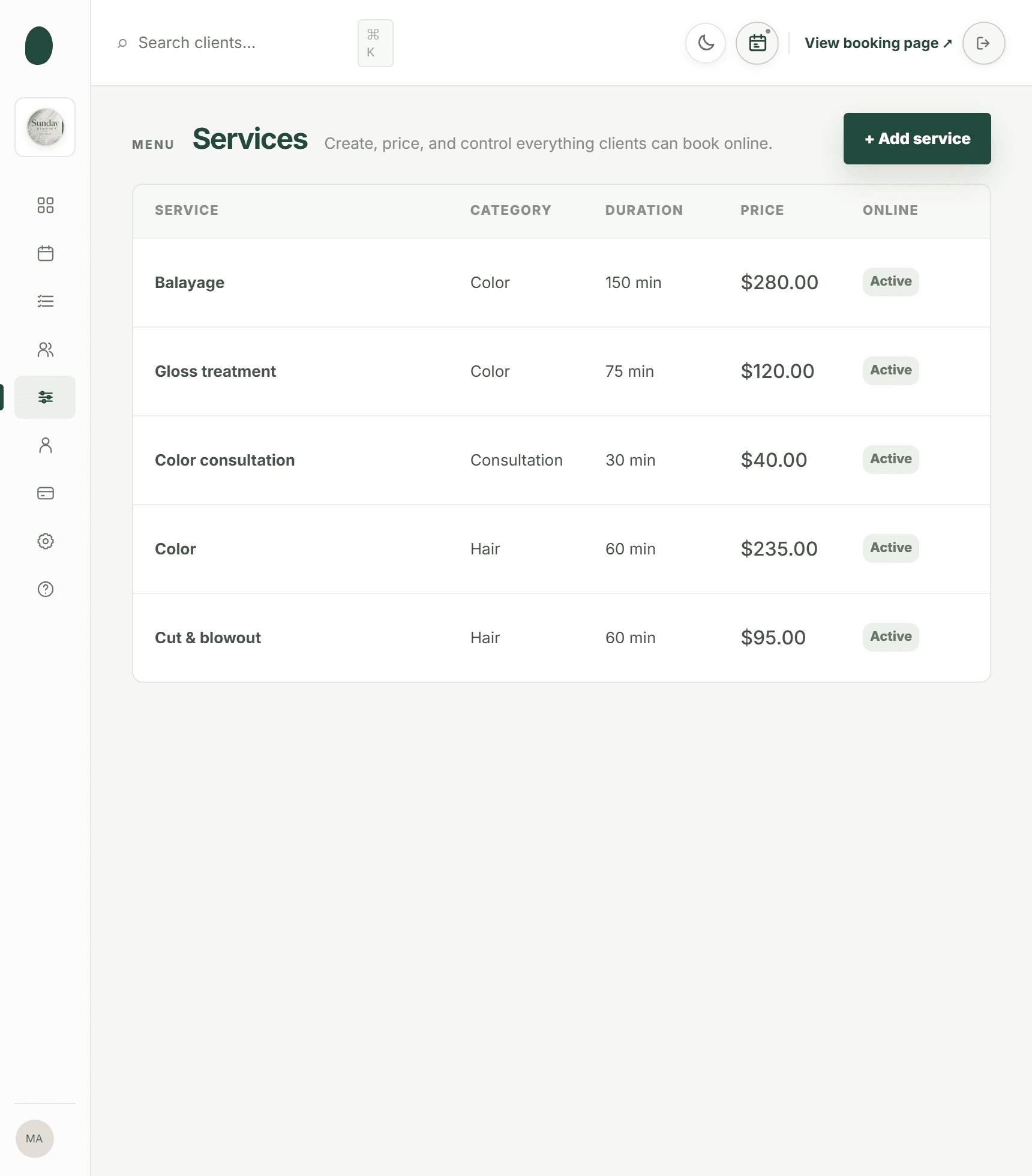
Kevonia focuses on the records and booking controls that many salons use every day. You can search client records by name, email, or phone; add private notes; and review visit history. Your service menu can include duration, cleanup or buffer time, price, an optional deposit, and professional assignment. This gives an owner a practical way to keep service setup, client context, and appointment rules together.
Kevonia sends an automatic email reminder the day before an appointment. Clients can reschedule or cancel from that email within the salon’s notice window. Card payments and deposits are handled through Stripe, with payouts going to the salon’s bank account. Kevonia also keeps cancellation history with restore, which is useful when an appointment is canceled by mistake or needs to be reinstated.
The difference is scope. Booksy is the more expansive operational platform if you need built-in marketing campaigns, marketplace discovery, inventory, memberships, gift cards, or a mobile business app. Kevonia is the more focused option if your main requirements are online booking, team scheduling, client records, deposits, payment collection, reminders, and precise availability rules. Neither choice is universally better; the wrong choice is paying for a workflow your team will not use.
Where Kevonia fits—and where it does not
Kevonia fits hair salons, barbershops, tattoo studios, nail salons, day spas, med spas, esthetician and lash studios, beauty clinics, wellness and yoga studios, and massage therapists that want a straightforward booking and scheduling workspace. Its single $49.99/month plan includes unlimited team members, bookings, clients, and services. There are no feature tiers, add-on pricing, or per-booking commissions.
The strongest reason to choose Kevonia over Booksy is cost predictability for a team. A salon can add professionals without paying per seat, while still giving clients a branded page and the owner a shared calendar, staff-specific availability, client history, service rules, reminders, deposits, and Stripe payments. The 14-day trial is free, requires no credit card to start, and you are never charged if you cancel anytime before the trial ends.
Kevonia is not the right fit if your decision depends on managing multiple locations from one account, retail or inventory POS, marketing or SMS campaign tools beyond the booking reminder email, or a native mobile app. Those are not current Kevonia features. In those cases, Booksy’s wider feature set may be more appropriate, provided its pricing and workflow match your business.
- Best fit for Kevonia: a single-location salon or spa that wants a branded booking page and predictable team pricing.
- Best fit for Booksy: a provider who values marketplace exposure, built-in marketing, mobile access, inventory, or broader business tools.
- Potential mismatch for Kevonia: a business that requires native mobile software, retail operations, or multi-location controls.
- Potential mismatch for Booksy: a team that dislikes per-user pricing or wants to avoid optional first-visit marketplace commissions.
Booksy competitors: how to make the decision without guessing
Comparing software by the number of listed features often produces the wrong answer. A better comparison starts with your appointment flow. Write down how a new client finds you, how they select a service and professional, what prevents an invalid time, how deposits are collected, what happens after a cancellation, and how the owner checks the day’s schedule.
Then calculate the cost for your actual team, not just the advertised solo price. Include every professional who needs access, likely payment processing, any marketing or marketplace fees, and the value of time spent correcting booking errors. A $29.99 starting price can be attractive for one person, but it should not be treated as the expected cost for a five-person salon. A flat $49.99 plan can look more expensive at first, but may become more economical as the team grows.
- Count the people who need calendar access now and within the next year.
- Separate software subscription fees from card-processing fees and client-acquisition commissions.
- Test a complex service with a buffer, a professional assignment, a deposit, and a minimum-notice rule.
- Check whether clients can cancel or reschedule without staff intervention.
- Review the client record workflow using a real-world example, such as a returning color client with private notes.
- Confirm that the booking page matches the way you want clients to experience your brand.
- Decide whether marketplace discovery is essential or simply a nice extra.
If you are also reviewing another platform, the same method applies. For example, the Kevonia comparison of Phorest covers a different feature and pricing trade-off, while the Vagaro comparison focuses on another common salon-software decision. Use those comparisons to understand the questions to ask, then judge every platform against your own appointment workflow.
Which booksy alternative should you choose?
Choose Booksy if you want an established booking marketplace, a customer-facing app, integrated marketing options, inventory tools, memberships, gift cards, reports, and a broader mobile-oriented business platform. Its lower solo starting price can also make sense for an independent provider who does not need multiple user accounts. Remember to evaluate the additional-user charge, payment-processing costs, and whether Boost commissions fit your acquisition budget.
Choose Kevonia if you want a branded direct-booking page, a team calendar, detailed availability rules, double-booking protection, searchable client records, service-specific setup, deposits, Stripe payments, email reminders, and cancellation restoration in one predictable plan. It is particularly compelling for a growing single-location salon or spa that does not want to pay per seat.
In short, Booksy is the broader growth-and-marketplace platform, while Kevonia is the focused salon scheduling system with flat team pricing. The best alternative is the one that matches how your clients book today and how your team will operate next year—not the one with the longest feature list.
Sources
Frequently asked questions
Is Kevonia cheaper than Booksy?+
For a solo provider, Booksy has the lower advertised subscription price at $29.99 per month plus tax, while Kevonia costs $49.99 per month. Kevonia can be more predictable for teams because its plan includes unlimited team members and does not charge per seat. Booksy adds $20 per month for each additional user, so compare the total cost for your actual team rather than only the solo starting price.
Does Booksy charge a fee for every booking?+
Booksy says it does not charge a booking commission when clients book through your own marketing or through Booksy while Boost is turned off. If Boost is enabled and Booksy brings in a new client, Booksy describes a one-time commission on that client’s first visit. Payment-processing fees are separate and depend on the payment method.
Does Kevonia charge per booking or per team member?+
No. Kevonia has one $49.99/month plan with unlimited team members, bookings, clients, and services. It does not charge a per-booking commission or a per-seat fee. Card payments and deposits are handled through Stripe, so payment processing should be considered separately from Kevonia’s subscription.
Which platform is better for a salon that wants new clients?+
Booksy is the stronger option if you specifically want marketplace discovery through Booksy’s customer app and marketplace. Kevonia is better suited to a salon that already attracts clients through its own brand, website, referrals, social channels, or other direct sources and wants those clients to book through a branded page. Decide whether your priority is marketplace acquisition or direct booking control.
Can Kevonia handle staff schedules and prevent double bookings?+
Yes. Kevonia includes a week and day team calendar with professional filters and color coding. Its double-booking protection checks working hours, breaks, time off, and existing bookings. You can also configure weekday opening hours, multiple breaks, salon closures, booking windows, minimum notice, time-slot intervals, service duration, and cleanup or buffer time.
What should I test before switching from Booksy?+
Test the complete appointment journey instead of only checking the calendar. Create your real services, assign each one to the correct professionals, add buffers and deposits, block staff time off, set minimum notice, make a test booking, and try a cancellation or reschedule. Also calculate the monthly cost for your full team and decide whether you need Booksy-specific tools such as marketplace discovery, inventory, marketing campaigns, or a native mobile app.
More from the blog

PocketSuite Alternative: The Better Fit for Salon Teams
Looking for a PocketSuite alternative? Compare PocketSuite and Kevonia on pricing, payment fees, salon workflows, team scheduling, and booking limits.

Schedulicity Alternative: A Better Fit for Growing Salons
Looking for a Schedulicity alternative? Compare the two systems by pricing clarity, booking control, team calendars, payments, client records, and switching risk.

Squire Alternative: When a Leaner Booking System Fits Better
SQUIRE is built for full barbershop operations. Kevonia is a simpler flat-cost alternative when your priority is branded booking, scheduling, payments, and client records without per-seat or per-booking charges.