Salon Marketplace vs Your Own Booking System: The Real Trade-Off
A salon marketplace can bring discovery, but your own booking system gives you more control. Compare fees, client ownership, branding, and the practical choice for your salon or spa.

Key takeaways
- Use a marketplace when you need qualified local discovery and can measure whether the bookings justify the fees.
- Use your own booking system when you already generate demand through referrals, Google, social media, or repeat clients.
- The important comparison is not only monthly software cost; it is also who controls the booking relationship and how much every new client costs.
- A hybrid approach often works best: use a marketplace selectively for discovery while directing regular clients to your own branded booking page.
- Before switching, track booking source, first-visit revenue, repeat visits, client contact details, and the cost of moving your existing data.
The decision is really about where your bookings come from
If you searched for salon marketplace vs own booking system, you are probably not asking which calendar looks nicer. You want to know whether a marketplace will bring enough new clients to justify its commissions, or whether your salon would be better off sending people to a booking page under your own name. The answer depends on how much demand you already create and how much control you want over the client relationship.
A marketplace is a shared discovery channel. Clients search a directory or app, compare nearby professionals, and book inside the platform. An own booking system is operational software behind your brand: you share your own booking link through Google, Instagram, your website, referrals, email, signage, and conversations at checkout. Neither model is automatically better. The mistake is paying for marketplace exposure after your clients are already finding you elsewhere.
What you are actually buying with a marketplace
The strongest reason to join a marketplace is not scheduling. Most modern booking platforms can manage appointments. The marketplace value is access to people who are already searching for a service and may not know your salon exists. That can matter for a new stylist, a recently opened studio, a business in a competitive neighborhood, or a salon with empty weekday capacity.
The trade-off is that the platform sits between you and the client. Your listing appears beside competing salons, the client may experience the booking as an app transaction rather than a relationship with your brand, and the platform controls much of the discovery experience. The client may return through the same app even after becoming a regular. That is convenient, but it makes your future bookings dependent on a channel you do not control.
- Best fit: a new business with limited visibility and unused appointment capacity.
- Main benefit: access to demand you did not have to generate yourself.
- Main cost: a marketplace commission, subscription, payment fee, client fee, or combination of charges, depending on the platform and booking source.
- Main risk: your salon becomes one listing in a platform’s network instead of the destination clients remember and seek out directly.
- Important question: can you identify which bookings came from the marketplace, and can you see whether those clients return?
The practical test is incremental demand. If a client would have found you through your Google Business Profile, Instagram bio, referral card, or existing website, a marketplace commission may be paying for a booking you already earned. If the platform introduced a genuinely new client who would otherwise have booked a competitor, the same fee may be a reasonable acquisition cost.
How the named marketplaces differ from a direct system
Fresha combines salon management software with a consumer marketplace. Its current pricing page lists a $19.95 monthly Independent plan, a Team price of $14.95 per bookable team member per month, and a one-time 20% commission with a $6 minimum for brand-new clients who discover the business through the Fresha Marketplace. Fresha says returning clients and bookings through a salon’s own direct links do not incur that marketplace acquisition fee. That makes Fresha more attractive when discovery is valuable and less attractive when most of your traffic is already direct.
Booksy sells a monthly subscription that includes its core features, unlimited bookings, marketing messages, and a marketplace listing. Its optional Boost program is the important distinction: Booksy’s help center says Boost can charge a one-time commission for a new client Booksy sends, with a minimum Boost fee of $10 in cases where 30% of the service price would be lower. If you use Booksy mainly as a booking calendar and send clients through your Booksy Profile Link, the marketplace economics are different from actively paying for new-client acquisition.
Treatwell is also built around marketplace discovery plus salon management tools, but its commercial terms can vary by country, contract, and the way a client reaches the salon. Treatwell’s partner material presents its Connect system as a way to manage bookings, attract customers, and support loyalty. For a US salon comparing providers, do not rely on an old blog post or a headline percentage: ask for the current written terms for your location, including what happens when a client books again, cancels, or uses a direct link.
StyleSeat uses a subscription-plus-growth-fee model. Its current help page lists a $35 monthly Premium Plan, card processing of 2.5% plus $0.30 when a card is present or 2.6% plus $0.30 for a card on file, and a New Client Connection fee of 30% of the first appointment’s service cost, capped at $50, when StyleSeat brings the client. It also lists an optional Smart Pricing fee of 5.5% capped at $16.50 when that feature raises the appointment price. Those charges are not the same as saying StyleSeat takes 30% of every appointment; the source of the booking matters.
- Fresha: useful when marketplace discovery is part of your acquisition strategy; check the new-client minimum and the per-team-member subscription.
- Booksy: useful when you want a consumer app and optional paid discovery; separate ordinary profile bookings from Boost bookings in your reporting.
- Treatwell: useful to evaluate locally, but request current market-specific terms rather than assuming another country’s commission applies.
- StyleSeat: useful for marketplace visibility and growth tools; separate the monthly plan, payment processing, and optional acquisition features in your cost model.
- A direct system: useful when your own marketing and repeat business already generate most bookings and you want a predictable software bill.
The cost comparison most owners skip
Do not compare only the listed monthly subscription. Compare the cost of acquiring a first visit, the cost of taking payment, the cost of managing the booking, and the value of the second, third, and fourth visit. A marketplace fee may be sensible for a client who generates several profitable appointments. It may be wasteful for a low-margin service, a heavily discounted first visit, or a client who never returns.
Use this calculation for the last 30 to 90 days: marketplace acquisition cost divided by marketplace-sourced first-time clients. Then compare that result with your normal cost to generate a new client through advertising, promotions, referrals, or content. You should also calculate contribution margin, not just revenue. A $100 service is not a $100 gain after product cost, payroll, rent, payment processing, discounts, and the marketplace fee.
- Export or record every booking source: marketplace, Google, Instagram, referral, website, phone, or walk-in.
- Separate first-time clients from existing clients who simply booked through a different link.
- Record the first appointment’s collected revenue, discounts, payment fees, marketplace fees, and service cost.
- Check whether the client returned within 30, 60, and 90 days.
- Calculate revenue and gross contribution across the client’s first three visits, not only the first booking.
- Stop or reduce a paid marketplace channel if it produces low-retention clients or fills times you could have sold directly.
This is also where the usual advice can be wrong. A marketplace is not automatically expensive just because it charges a commission, and an own booking system is not automatically profitable just because it has 0% booking commission. If your direct booking page receives almost no traffic, a zero-commission system can still produce zero new clients. The real comparison is paid discovery versus owned demand, not commission versus no commission in isolation.
Who owns your salon client list? Ask a narrower question
The phrase who owns your salon client list is useful, but it needs precision. There are several different things owners call a client list: names and contact details, appointment history, notes and preferences, reviews, booking consent, payment records, and the ability to message clients. A marketplace may show you some of these while retaining control over how the customer discovers, books, and communicates with businesses on its platform.
Before signing up, ask five direct questions. Can you export client records in a usable format? Can you keep private notes if you leave? Can you contact clients for ordinary business communication, subject to consent and applicable law? Are marketplace reviews portable, or do they remain attached to the platform listing? If a regular books through the marketplace again, is that treated as a direct repeat booking or as platform-sourced demand? Get the answers in writing.
- Client identity: does the record clearly belong to your salon, or is it primarily a platform account?
- Contact access: can you see the email address and phone number needed for legitimate service communication?
- History: can you retain visit history, notes, cancellation history, and preferences if you change software?
- Brand memory: does the client see your name first, or the marketplace name first?
- Rebooking path: after the appointment, are clients encouraged to return to you or continue shopping in the marketplace?
For a salon built on repeat color, extensions, memberships, or treatment plans, this matters more than a small difference in monthly pricing. A repeat client is not only another appointment; the relationship helps you plan capacity, recommend the next service, recover a cancellation, and build referrals. A marketplace can still be part of the strategy, but you should know whether it is helping you build an asset or merely renting you access to an audience.
Where Kevonia fits: owned booking without marketplace commission
Kevonia fits the own-booking-system side of this decision. It provides a branded online booking page at kevonia.com/your-salon, where clients choose a service, professional, date, and time. The page is available 24/7 and is designed to be shared as your salon’s booking destination rather than as a listing beside competing businesses. Kevonia does not operate a consumer marketplace that charges a per-booking acquisition commission.
The software is priced at US$49.99 per month on one plan, with 0% booking commission. The plan includes unlimited team members, bookings, clients, and services. Kevonia also offers a free 14-day trial with no credit card required to start; if you cancel before the trial ends, you are never charged. That structure is easier to forecast than a low subscription that rises with team size or adds a percentage to selected bookings.
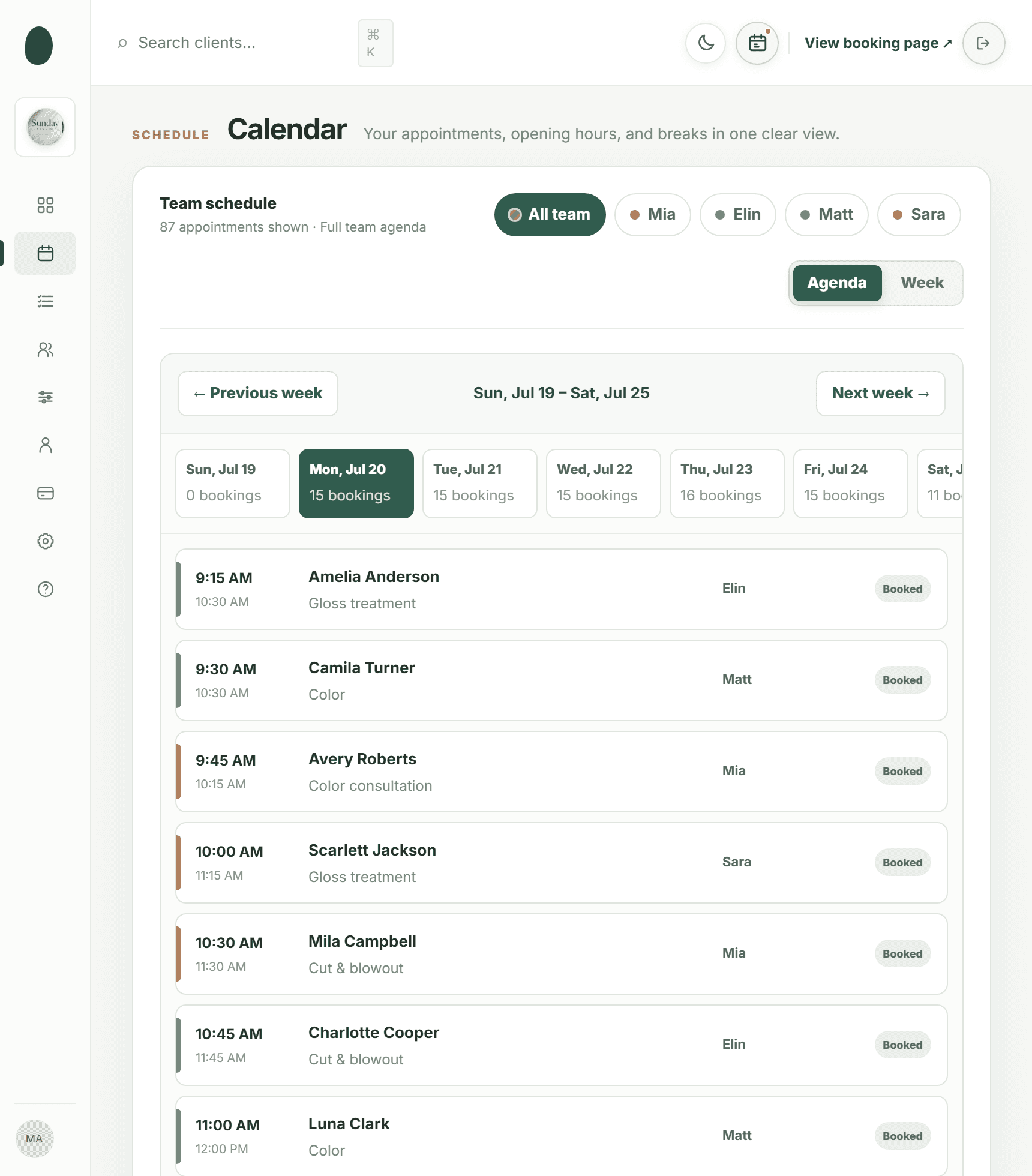
Operationally, Kevonia includes a week and day team calendar with per-professional filters and color coding, availability rules, double-booking protection, client records, service setup, Stripe card payments and deposits, and an automatic day-before email reminder. Clients can reschedule or cancel from the reminder within the salon’s notice window. Owners can also review cancellation history, block a client from booking online, and refund an online payment from the booking itself.
Kevonia is not the right answer if your main problem is lack of discovery and you need a marketplace to put your business in front of strangers. It is a better fit when you already have a route to reach clients and want the booking process, client information, schedule rules, and payment flow to operate under your brand. It also does not currently offer multi-location management from one account, retail or inventory POS, marketing or SMS campaign tools beyond the booking reminder email, or a native mobile app.
When a hybrid strategy makes more sense
You do not have to choose one channel forever. Many salons can use a marketplace for a limited discovery purpose while building a direct booking habit for existing clients. The key is to make the channels intentional instead of allowing every client to choose the most expensive path by default.
- Keep the marketplace listing active if it consistently delivers profitable first-time clients during specific low-demand periods.
- Put your own booking link on your website, Google Business Profile, social bios, email signature, front desk card, receipt, and printed aftercare instructions.
- Ask existing clients to use the direct link for future appointments, without making the process confusing or punitive.
- Track marketplace and direct bookings separately so you know whether the marketplace is still producing incremental demand.
- Review the numbers monthly and reduce marketplace dependence as direct search, referrals, and repeat bookings grow.
The handoff needs to be operationally clean. Use the same service names, durations, prices, deposits, cancellation window, and professional availability everywhere. If a client sees a 60-minute service on one channel and a 75-minute service on another, the problem is not ownership; it is a broken booking experience. Your booking page should also make the next action obvious, especially on mobile.
A hybrid setup is especially useful during a transition. Keep the marketplace available while you move regular clients to your branded page, then reassess after you have enough direct-booking data. Do not cancel a channel before you know where its clients came from, what information you can retain, and whether the platform controls any reviews or future communication you rely on.
A decision framework for your salon or spa
Choose a marketplace-first approach when you are new, have meaningful unused capacity, lack a reliable source of local traffic, and can measure the value of the clients it brings. It is also reasonable when your services are easy to compare and clients commonly shop by availability, price, location, and reviews. In that situation, marketplace placement can function like a marketing channel rather than merely a booking tool.
Choose an own booking system first when most clients already come from repeat visits, referrals, Google searches for your salon, social content, or an established local reputation. It is also the stronger foundation when your business depends on client history, consultation notes, repeat treatment plans, deposits, custom availability rules, or a consistent branded experience.
- Pick a marketplace if: you need discovery now, have open capacity, accept variable acquisition costs, and will review retention by source.
- Pick your own system if: you already create demand, want predictable pricing, value direct client relationships, and need your brand to lead the booking journey.
- Use both if: the marketplace brings measurable incremental clients but your regulars can be moved to a direct link.
- Delay the decision if: you have not identified booking sources, cannot export your data, or have not read the current fee and cancellation terms.
For most established salons, the strongest long-term answer is not marketplace versus own booking system as a permanent either-or choice. It is marketplace for carefully measured discovery, plus an owned booking channel for the clients you have already earned. The more direct demand you create, the less sense it makes to pay a marketplace to stand between you and your regulars.
FAQ: salon marketplaces and own booking systems
These are the questions owners usually need answered before changing booking software or adding a marketplace channel.
Sources
- Fresha pricing
- Fresha marketplace
- Booksy pricing
- Booksy Boost pricing
- Treatwell partner material
- StyleSeat pricing help
- Google Business Profile
- Kevonia salon booking program
- Kevonia salon reservation software
- Kevonia beauty salon booking software
- Kevonia spa booking software
- Kevonia hair salon booking software
- Online Booking System for Salons: 2026 Setup Guide
Frequently asked questions
Should salons use a booking marketplace?+
Use one when it delivers measurable new demand that you could not easily generate yourself. Track first-time clients, acquisition fees, gross contribution, and repeat visits. If most bookings come from existing clients or your own marketing, a branded direct booking system is usually the better primary channel.
Is a salon marketplace cheaper than a subscription booking system?+
It can look cheaper if the monthly fee is low or the marketplace listing is included, but the total cost depends on booking source. Add subscription fees, per-team-member charges, new-client commissions, payment processing, client booking fees, discounts, and any optional growth tools. Compare the total cost over a typical month, not the advertised starting price.
Can I use a marketplace and my own booking page at the same time?+
Usually, the practical approach is to use the marketplace for discovery and your own branded page for direct traffic and regular clients. Keep services, pricing, availability, deposits, and cancellation rules consistent. Track each source separately so the marketplace does not appear successful simply because existing clients keep booking there.
Who owns the client information when someone books through a marketplace?+
That depends on the platform’s terms and the information it makes available to the business. Ask whether you can export names, contact details, appointment history, notes, and consent records, and whether marketplace reviews remain with you if you leave. Do not assume that seeing a client in your calendar means you control the entire relationship.
What is the biggest mistake when comparing Fresha, Booksy, Treatwell, and StyleSeat?+
Comparing only the monthly subscription. These platforms can have different rules for marketplace-sourced clients, direct-link bookings, returning clients, payment processing, optional acquisition programs, and client fees. Read the current terms for your country and calculate the cost of the actual booking paths your salon uses.
Is Kevonia a marketplace?+
No. Kevonia provides a branded online booking page and salon management workspace rather than a shared consumer marketplace. Its plan is US$49.99 per month with 0% booking commission, unlimited team members, bookings, clients, and services, plus a free 14-day trial with no credit card required to start. It is designed for salons and spas that want to bring clients to their own booking destination.
More from the blog

Treatwell Alternative: Compare the Real Trade-Offs
Treatwell can bring discovery bookings, but it is not the only way to run your calendar. Compare the marketplace model with Kevonia’s flat-cost, direct-booking approach.

Online Booking System for Salons: 2026 Setup Guide
A practical, no-fluff guide to choosing and setting up an online booking system for salons — what it should do, how to configure it, and mistakes to avoid.

Squire Alternative: When a Leaner Booking System Fits Better
SQUIRE is built for full barbershop operations. Kevonia is a simpler flat-cost alternative when your priority is branded booking, scheduling, payments, and client records without per-seat or per-booking charges.