Salon Cash Flow: Keep Payroll Covered and Plan Slow Months
A practical system for tracking money in and out of your salon, protecting payroll, preparing for slow months, and finding the operational leaks that create cash shortages.

Key takeaways
- Cash flow is about timing, not just whether your salon is profitable on paper.
- Build a rolling 13-week forecast around your actual payroll, rent, taxes, debt, and supplier dates.
- Use deposits, rebooking, capacity planning, and tighter expense controls without creating future refund or service obligations.
- Review cash weekly and financial records monthly so small leaks do not become a payroll emergency.
What salon owners really need to know about cash flow
If you searched for salon cash flow, you probably do not need another definition of revenue. You need to know whether there will be enough money in the bank when payroll, rent, taxes, supplies, loan payments, and owner draws are due. A salon can have a profitable month and still feel short of cash if payments arrive later than expenses or if a busy month creates unusually large product, commission, or tax obligations.
The useful question is not “Did we make money?” It is “How much cash will be available each week after committed payments?” This article gives you a working system: separate profit from cash, build a short-term forecast, protect your slow months, and use booking and payment controls to reduce avoidable gaps.
Cash flow is different from profit
Profit is an accounting result: income minus expenses over a period. Cash flow tracks when money actually enters and leaves your bank account. The difference matters in a salon because service revenue, card payouts, payroll, rent, inventory, taxes, deposits, refunds, and owner withdrawals rarely happen on the same day.
For example, suppose your salon completes $24,000 of services in a month and appears profitable. If payroll is due weekly, rent is due on the first, a quarterly tax payment is due near the end of the month, and a supplier invoice from the previous month is also payable, your bank balance can fall sharply even though the income statement looks fine. The opposite can also happen: a large upfront deposit improves this week’s bank balance but represents a service you still owe the client.
Do not treat a bank balance as free cash. First subtract money already committed to payroll, payroll taxes, sales taxes where applicable, rent, subscriptions, debt payments, refunds, supplier invoices, and planned owner distributions. The remaining amount is your usable cushion. The IRS recommends keeping records that clearly show business income and expenses, with supporting documents such as invoices, receipts, deposit information, and paid bills. Use that discipline to reconcile your cash forecast, not just to prepare for tax filing.
A profitable salon can still miss payroll when cash arrives after the bills are due.
Build a rolling 13-week cash forecast
A 13-week forecast is short enough to be realistic and long enough to expose a slow booking period, a tax deadline, a lease payment, or a planned equipment purchase before it becomes urgent. Update it once a week using actual bank balances and booked work rather than relying on an annual revenue target.
Create one row for each week and begin with the cash available at the start of that week. Add only money you reasonably expect to collect, then subtract committed outflows. Keep the forecast separate from your profit-and-loss report: the forecast is a timing tool.
- Enter the opening balance from the business checking account and verify it against the bank statement.
- Add expected service collections, deposits, gift card redemptions, retail receipts if you sell retail, and other inflows by the week you expect the money to arrive.
- Subtract weekly payroll, commissions, contractor payments, rent, utilities, insurance, loan payments, software, supplies, taxes, refunds, and owner draws on their actual due dates.
- Mark uncertain items separately, such as a client deposit that may be refunded, an invoice with an unclear due date, or a fully booked week with a history of cancellations.
- Calculate the ending balance and flag any week below your minimum cash floor.
- Replace estimates with actuals every week, then move the forecast forward one week.
Set the minimum cash floor before you need it. It might be the amount required to cover the next payroll and rent, or a larger reserve if your business has seasonal swings, high payroll, or irregular tax payments. Do not choose the floor because a generic article says salons need a particular percentage of revenue. Calculate it from your own obligations and payment timing.
The SBA’s planning guidance treats monthly projections as useful for an established business and recommends using historical financial statements when planning or seeking funding. Even if you never apply for a loan, the same principle helps: use your own past cash movements to create a forecast instead of guessing from a strong month.
Find the leaks behind salon cash flow problems
Most cash shortages are not caused by one dramatic event. They usually come from several small leaks that remain invisible when the calendar looks busy. Review the following areas before cutting staff or taking on expensive financing.
- Unfilled gaps: A 30-minute opening between appointments may be too short for a full service but long enough for a quick add-on, consultation, or properly timed booking if your schedule allows it.
- Late cancellations and no-shows: The lost service is only part of the cost. The team member’s time, payroll, and potential replacement booking matter too.
- Underpriced services: A service that takes longer than its listed duration, needs extensive cleanup, or uses more product than expected may produce sales without producing enough cash contribution.
- Unplanned owner withdrawals: Treating the checking account as personal spending makes the forecast unreliable and can push a slow month into a crisis.
- Overbuying supplies: Buying inventory because it is discounted is still a cash outflow today. Order against usage and lead time, not optimism.
- Delayed reconciliation: If card payouts, cash, deposits, refunds, and invoices are not matched weekly, you may make decisions using revenue that is not actually available.
- Tax money mixed with operating cash: Setting aside tax obligations only when payment is due creates a predictable shock that looks like a sudden emergency.
One failure case deserves special attention: deposits can make a salon look healthier while increasing future obligations. If you collect deposits for a large number of appointments, record the cash as restricted in your planning. It is not the same as unrestricted revenue until the service is delivered and the cancellation or refund window has passed. If the client cancels under your policy, that money may need to leave the business.
Track four weekly numbers alongside your bank balance: completed service revenue, cash collected, booked future revenue, and refunds or credits issued. A growing gap between booked future revenue and collected cash may be normal, but it tells you not to spend as if the appointments have already happened.
Plan for a slow month before the calendar slows
A salon slow month money plan should begin during a strong month, not after the first quiet week. Look at the last 12 to 24 months and identify the weeks when bookings, average ticket, or client visits consistently fell. Then compare those periods with fixed expenses that continued unchanged.
Do not assume every salon has the same January or summer pattern. A bridal-focused studio, a college-town barbershop, a med spa, and a neighborhood nail salon may have completely different demand cycles. Your booking history is more useful than a generic seasonal calendar.
- Estimate the lowest realistic weekly collections for the slow period using completed appointments, not the number of appointments on the calendar.
- List fixed costs that cannot be reduced quickly, including rent, insurance, debt, core software, and minimum payroll commitments.
- Decide how much cash must be saved before the slow period and transfer it to a separate business savings account on a schedule.
- Pre-book maintenance visits before clients leave after a busy season, while keeping the service recommendation honest and appropriate.
- Reduce discretionary spending first: nonessential equipment, untested promotions, excess supplies, and owner purchases that can wait.
- Set a trigger for action, such as two weeks below forecast, rather than waiting until the account is nearly empty.
- Review the forecast weekly and make measured changes instead of discounting every service immediately.
The usual advice to “run a promotion” is often wrong when the real problem is capacity or margin. A discount can fill chairs while leaving too little cash after product cost, payment processing, commissions, and payroll. Before discounting, test whether the offer fills genuinely unused capacity, brings in a service the team can deliver efficiently, and creates a reasonable path to a full-price return visit.
If your staffing model is changing, separate the cash effect from the long-term business decision. A booth-rent model may shift collection timing and responsibility, while commission or employee payroll can create more predictable service control but larger fixed obligations. Kevonia’s article on booth rent and commission goes deeper into how the two models affect an owner’s planning.
Manage payroll, taxes, and owner pay deliberately
Payroll is usually the largest recurring cash commitment in a service business, but “cut payroll” is not a complete plan. Reducing coverage too aggressively can create longer waits, lost bookings, staff burnout, and lower future collections. Instead, compare scheduled labor with demand by day and service type.
- Identify the minimum coverage needed to open, handle booked appointments, answer clients, and complete closing tasks.
- Separate guaranteed wages or salaries from variable commissions, bonuses, contractor payments, and owner compensation.
- Review whether staff hours match actual demand by weekday and time block, not just total monthly appointments.
- Calculate the cash impact of bringing on another professional before committing: expected collections, compensation, supplies, payment costs, and the time needed to build their book.
- Keep payroll tax money separate from operating cash and confirm deadlines with your payroll provider or accountant.
- Set a written owner-pay schedule so personal withdrawals do not quietly replace a budget.
Owner pay should be planned like any other outflow. If you take whatever remains at the end of a busy week, you may remove the money needed for a quarterly tax payment or a known slow period. A consistent draw gives your forecast a stable assumption and makes it easier to see whether the salon can support the owner’s target income.
For tax treatment, payroll classification, sales tax, and owner compensation rules, use a qualified tax professional who understands your state and business structure. Cash-flow planning can show when money is tight; it does not replace tax or employment advice.
Use booking and payment controls to make cash more predictable
Booking operations affect cash before the appointment happens. Clear service durations, cleanup buffers, availability rules, cancellation windows, and deposits help turn a theoretical schedule into a more reliable collection forecast. They do not eliminate cancellations, but they reduce the number of surprises your spreadsheet has to absorb.
A deposit can protect a high-value or time-intensive appointment, especially when a late cancellation would leave no realistic chance to rebook. Set the amount and refund rules deliberately. A deposit that is too high can create booking resistance; one that is too low may not change client behavior. Always explain the policy before the client pays and apply it consistently.
Treat card payments, payouts, refunds, and disputes as separate cash events. Stripe explains that a successful payment indicates funds will be received, while refunds use available Stripe balance and can become pending when that balance is insufficient. That means a refund can affect available cash even after the original appointment has already been counted in your sales report.
Reconcile the following every week: completed appointments against collected payments, deposits against future appointments, refunds against the original booking, and payouts against the bank statement. If a client disputes a card payment, the amount and related dispute fee can be debited from the Stripe account while the case is reviewed, so keep appointment records, policies, and communication organized.
Where Kevonia fits in a salon cash-flow system
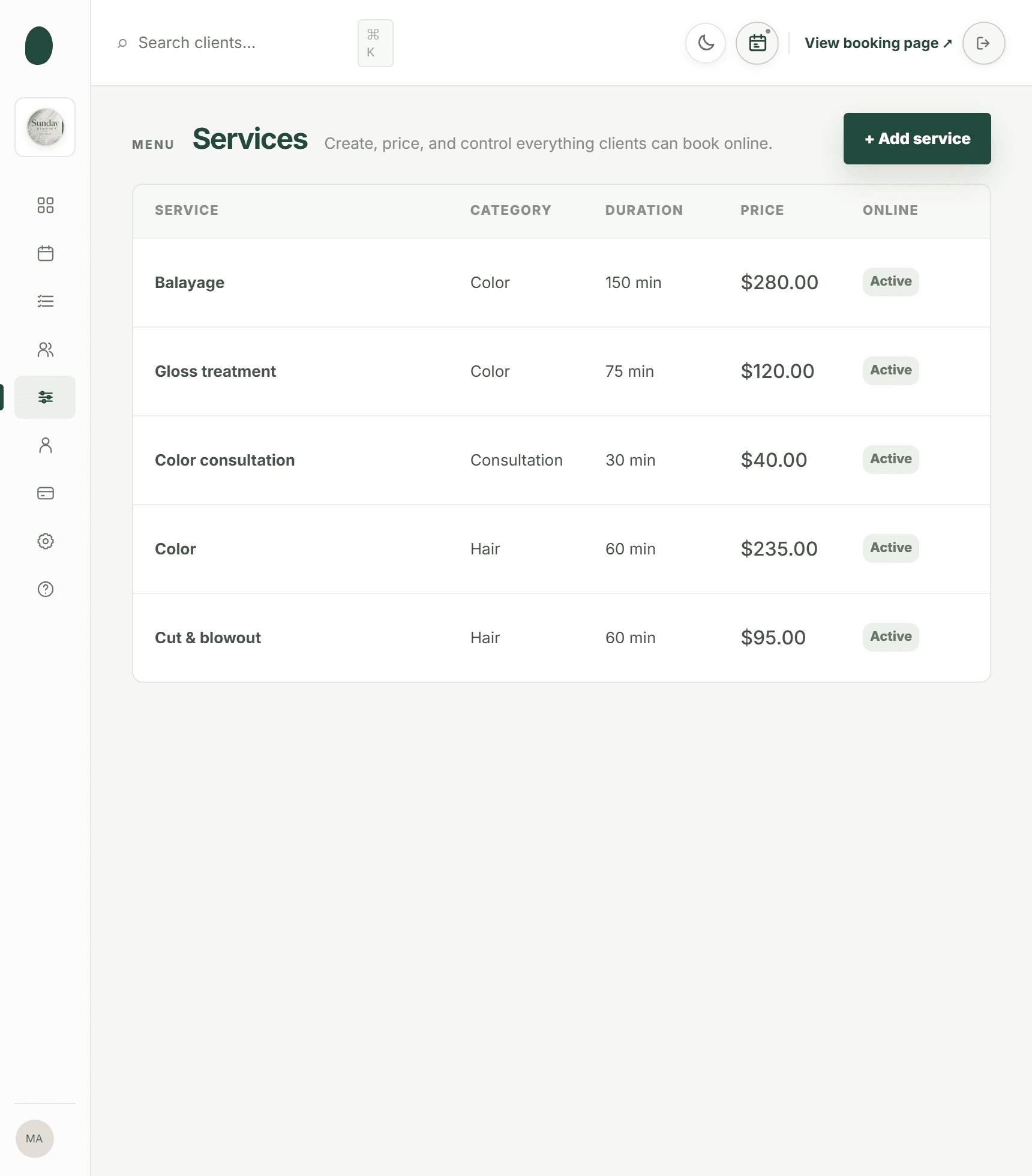
Kevonia fits best when your cash problem is connected to booking visibility, payment collection, and appointment follow-through rather than full accounting. It provides a branded online booking page at kevonia.com/your-salon and a workspace with a team calendar, client records, a service menu, availability rules, and Stripe payments. That gives an owner one place to keep the operational inputs that feed a cash forecast.
For cash-flow purposes, the practical difference is that your service duration, cleanup time, price, optional deposit, professional assignment, opening hours, breaks, time off, salon closures, minimum notice, and booking window can be defined before clients book. Kevonia also checks new bookings against existing appointments, hours, breaks, and time off to reduce double-booking errors that can lead to refunds or lost capacity.
The overview screen shows today’s revenue against the same day last week, appointments and how many were booked in 30 days, total and new clients, no-shows as a percentage of the last 30 days’ bookings, and a 30-day revenue chart that marks the best day. Use those figures as operating signals, not as a replacement for your accounting records. The IRS still expects a system that supports income and expense records with appropriate documentation.
Kevonia’s single plan is US$49.99 per month with unlimited team members, bookings, clients, and services, no per-booking commission, and no add-on pricing. It offers a free 14-day trial with no credit card required to start; if you cancel before the trial ends, you are never charged. Those terms make the software cost easy to place in a forecast, but the decision should still depend on whether the booking and payment controls solve a real operational gap for your salon.
Kevonia is not a substitute for bookkeeping, payroll, inventory POS, marketing campaigns, or multi-location financial consolidation. If you need those functions, keep the appropriate accounting, payroll, or retail systems in place and use the booking records as one source of operational data.
Make managing salon finances monthly a short, repeatable routine
Weekly cash checks catch timing problems. A monthly review helps you understand whether the business model is improving. Schedule both instead of waiting until tax time or a bank balance feels uncomfortable.
- Weekly: reconcile bank deposits, card payouts, cash, refunds, deposits, completed appointments, and upcoming payroll.
- Weekly: update the 13-week forecast and note any week below the cash floor.
- Monthly: compare completed service revenue with cash collected and investigate the difference.
- Monthly: review revenue by service, average ticket, rebooking behavior, cancellations, no-shows, labor cost, product spending, and owner withdrawals.
- Monthly: compare the current month with the same month last year and with your forecast, then explain material differences in plain language.
- Quarterly: review tax reserves, pricing, staffing capacity, lease or debt obligations, and whether your minimum cash floor still fits the business.
Look for patterns, not isolated bad days. One empty Tuesday may be normal. Four consecutive weeks with fewer future bookings, rising refunds, and a declining average ticket require action. The right response might be better schedule design, service pricing, rebooking, client retention, expense timing, or staffing—not automatically a discount or loan.
Keep the records simple enough that you will actually maintain them. A spreadsheet can work if it is updated consistently; software can help when bookings, payments, client history, and availability are scattered across several tools. The goal is a current answer to three questions: what cash do I have, what cash is committed, and what cash is likely to arrive?
Sources
- IRS: What kind of records should I keep?
- U.S. Small Business Administration: Plan your business
- Stripe: Payment Methods API
- Stripe: Refund and cancel payments
- Stripe: How disputes work
- Kevonia home page
- Kevonia spa booking software
- Kevonia salon booking program
- Kevonia salon reservation software
- Kevonia beauty salon booking software
- Kevonia booth rent vs commission article
Frequently asked questions
What is a healthy salon cash flow?+
There is no universal healthy balance or revenue percentage. A healthier salon can pay upcoming payroll, rent, taxes, suppliers, refunds, and debt from available cash while maintaining a reserve for its known slow periods. Set your own cash floor from actual obligations and test it in a rolling 13-week forecast.
How much cash should a salon keep in reserve?+
Start with the weeks when your fixed costs continue but collections are lowest. Add the cash required for payroll, rent, taxes, debt, and essential supplies during that period, then include a buffer for cancellations, refunds, repairs, or a failed payment. Do not copy a generic reserve target without checking your own timing and staffing model.
Can deposits fix salon cash flow?+
Deposits can reduce the cash impact of no-shows and late cancellations, but they do not create unrestricted profit. A deposit may need to be refunded, or it may represent a service you still owe. Forecast deposits separately from completed-service collections and publish a clear cancellation and refund policy.
Should I discount services during a slow month?+
Only when the offer uses capacity that would otherwise remain empty and still covers the service’s labor, product, processing, and overhead contribution. If the issue is underpricing, weak rebooking, poor availability, or excessive fixed costs, a discount can increase appointments without improving cash. Test a targeted offer instead of reducing every price.
How often should a salon owner review cash flow?+
Review the bank balance, upcoming obligations, payouts, refunds, and the next few weeks of expected collections every week. Review the full income and expense picture monthly, including service performance, labor, supplies, owner pay, and taxes. A quarterly review is useful for pricing, staffing, debt, and reserve assumptions.
Can salon booking software replace accounting software?+
No. Booking software can improve the operational data behind your forecast, including appointments, deposits, payments, cancellations, no-shows, and future demand. It does not replace bookkeeping, payroll, tax records, expense tracking, or professional accounting advice. Use the systems together and reconcile them regularly.
More from the blog

When to Hire Your First Stylist: A Salon Owner’s Guide
Hiring your first stylist is a capacity and cash-flow decision, not just a sign of growth. Use this practical checklist to know when demand, finances, and systems are ready.

Booth Rent vs Commission: Which Salon Model Is Better in 2026?
Booth rent and commission create very different salon businesses. Compare cash flow, control, taxes, staffing, and client ownership before choosing a model.

Vagaro Alternative: Kevonia vs. Vagaro in 2026
Vagaro offers a broad salon platform, while Kevonia keeps booking and daily scheduling simpler with one $49.99 plan and no per-booking commission. Compare both before you switch.